
Did you know possessing a potato can land you 10 years in federal prison and $250,000 in fines?
That is the reality of the National Firearms Act. An outdated, illogical, nearly century-old law that is long overdue for abolition. pic.twitter.com/rvxvQWuckO
— National Association for Gun Rights (@gunrights) January 16, 2026
National Association for Gun Rights staff member Zackary Clark successfully registered a potato with the Bureau of Alcohol, Tobacco, Firearms, and Explosives during 2026 under the new rules, as a silencer. The new rules, starting on January 1, do not require the payment of a tax to make and register a silencer. Silencers are classified as “firearms” in the National Firearms Act (NFA). The video recorded by Zackary shows what happened to the potato when it was used as a silencer. A fair amount of energy goes into blowing a potato into small pieces. Almost certainly, the noise from the shot, fired through the potato, was reduced by some amount. This makes the potato a silencer under the law’s definition. Zackary Clark has the receipts. From gunrights.org:
National Association for Gun Rights’ own Digital Content Creator, Zackary Clark, became the first person to legally register a potato as a firearm suppressor with the Bureau of Alcohol, Tobacco, Firearms, and Explosives (ATF).
The ATF Form 1, shown below in part, clearly identifies the potato as the registered silencer. Silencer designs are not required to be effective. A one-shot silencer is not unreasonable when there is no tax. A zero tax is no tax.
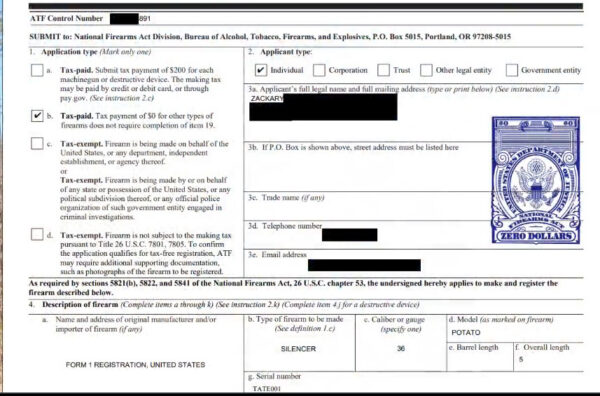
The nomenclature required to be on the silencer appears to have been engraved on the rear attachment, or cap, which is a reasonable place to put it. Areas on the back of the end cap have been blacked out to preserve privacy. Zachary is effectively using absurdity, hilarious absurdity, to show the idiocy of the NFA’s ridiculous bureaucratic requirements to allow people to access a useful safety device.
Zachary’s political range-theater does a good job. It was masterfully done. It illustrates more than the absurdity of a one-shot potato silencer. It shows the ease with which ordinary people can fill out a Form 1 and make their own silencers for very little money. By the end of January 2026, over 300,000 applications have been filed with the ATF to purchase, transfer, or make items requiring a zero-tax tax-stamp (what an absurdity!) for short barreled rifles (sbr), short barreled shotguns (sbs), silencers, and any other weapons (aow). Most of those are probably for the transfer of commercially made silencers on a form 4. A good chunk are for the manufacture of short barreled rifles or short barreled shotguns on a Form 1. A significant number will be for the manufacture of silencers on a Form 1.
Fairly effective silencers for subsonic and even cartridges up to the 5.56×45 or .223 Remington are not difficult to make from common materials if the barrel of the firearm is threaded. The correct alignment of the threaded barrel is the most difficult part of the operation.
A silencer can become fairly effective through volume control. Large volume suppressors reduce the pressure of the expanding gases, so lower-strength materials become effective. Internal baffles and sound-absorbing materials make a silencer more effective at all sizes.
At the SHOT show, this correspondent expressed interest in making a simple suppressor after legally obtaining a Form 1. When a person at the ATF booth was engaged in casual conversation about it, they were neither dismayed, surprised, nor concerned. Effective suppressors can be easily printed on 3D printers from common materials. The designs are available online. It is likely that a plastic, 3D printed suppressor for .22 cartridges will last several hundred rounds without significant degradation.
A 3D printer is not necessary. With an inexpensive thread adapter from 1/2×28 or 5/8×24 to 3/4 NPT, a large volume, effective suppressor can be assembled from common PVC pipe and parts. Make sure your thread adapter matches the thread on the firearm you wish to suppress. The serial number should be placed on the metal part, the thread adapter. PVC caps threaded in 3/4 NPT are readily available.
Homemade silencers that are made from readily available materials may not be as pretty, light, small, or well-designed as commercial silencers made from titanium, Inconel, or even steel and aluminum. They can be effective, especially with subsonic cartridges. They can substantially reduce the blast from more intense cartridges if the volume is large enough.
This correspondent has been told the 5.56×45 cartridge can be effectively suppressed with a PVC suppressor of 4 inches in diameter, about 16 inches long. It won’t be whisper quiet, but hearing damage potential is greatly reduced, as is flash and recoil. Subsonic .22 rimfire suppressors can be effectively suppressed with a volumetric suppressor an inch in diameter and 5 inches long, for a long barreled rifle. An endcap at the front of the silencer, with a cone pointed toward the back, is very helpful. The more volume the less of sophisticated design is required. .22 pistols require large/more sophisticated suppressors because of higher pressures and more gas at the muzzle of the pistol. Many designs can be found with a little searching on the Internet. Centerfire pistols which move the barrel to unlock the action require a more sophisticated suppressor to operate the action reliably.
The removal of silencers from the NFA is on the horizon. The more politicians and public become informed of the absurdities of the NFA, the more likely silencer and short barreled rifles are to be removed, along with any other weapons (aow) from the NFA.
Short barreled shotguns may take a bit more because they have been hyped so much. It seems likely the 1986 ban on the manufacture of machine guns available to the public will be struck down, but the timing is unclear. Machine guns and destructive devices will be the last to be taken off the NFA. Do not spoil the removal of silencers, sbrs, sbs, and aow by insisting on the inclusion of machine guns and destructive devices. Incrementalism works.
The more people who pay zero tax and who buy or make silencers, the more likely they will be removed from the NFA, either by legislation or by court action.
This correspondent expects to help swell the numbers. Silencers are very useful safety devices.
About Dean Weingarten:
Dean Weingarten has been a peace officer, a military officer, was on the University of Wisconsin Pistol Team for four years, and was first certified to teach firearms safety in 1973. He taught the Arizona concealed carry course for fifteen years until the goal of Constitutional Carry was attained. He has degrees in meteorology and mining engineering, and retired from the Department of Defense after a 30 year career in Army Research, Development, Testing, and Evaluation.

from https://ift.tt/wjERt1h
via IFTTT

No comments:
Post a Comment