
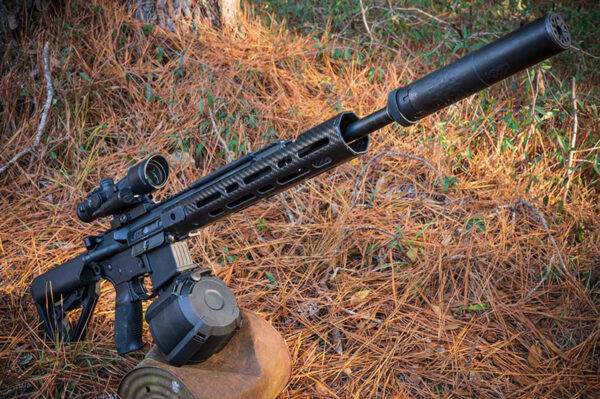
Jay Jones’s office wants a Virginia court to declare common semiautomatic rifles and standard-capacity magazines outside the right to keep and bear arms.
Virginia’s gun-control machine is trying to save its new rifle and magazine restrictions with an audacious argument: The AR-15 is not a constitutionally protected “Arm” at all.
On July 15, Virginia Attorney General Jay Jones’s office filed a motion to dismiss and demurrer in Crump v. Katz, the lawsuit challenging House Bill 217 and Senate Bill 749 under Article I, Section 13 of the Virginia Constitution. The plaintiffs include AmmoLand contributor John Crump, Gun Owners of America, Gun Owners Foundation, Virginia Citizens Defense League, and Virginia Citizens Defense Foundation.
The Commonwealth first argues that Virginia’s Constitution protects only a collective, militia-tethered right rather than an individual right. It then asks the court to go even further:
“Even if the Court adopts Plaintiffs’ mistaken theory that there is an individual right in § 13, Plaintiffs cannot demonstrate that assault firearms and large capacity magazines are “arms” protected by §13 or the Second Amendment.”
Jones’s office is not simply claiming that the state may regulate how a rifle is carried or sold. It is asking a court to place an entire class of common semiautomatic firearms, and magazines holding more than 15 rounds, outside constitutional protection.
Crump blasted the Commonwealth’s position, “The latest move of trying to claim that AR-15s are not protected arms smells of desperation. Jay Jones and his cohorts know they are fighting a losing battle and will try anything to stave off their inevitable defeat.”
Virginia Has a “Common Use” Problem
The motion claims that so-called assault firearms and large-capacity magazines “are not in common use today for lawful self-defense.” It adds that because they are “weapons that are most useful in military service,” they lie “outside the ambit of the Second Amendment.”
There are several problems packed into those two sentences.
First, District of Columbia v. Heller spoke of weapons typically possessed by law-abiding citizens for lawful purposes. It did not limit constitutional protection to firearms that can be proven to have been fired in a documented defensive encounter. Training, target shooting, competition, hunting, home defense, and simply being prepared are all lawful purposes.
The Supreme Court’s June 2026 decision in Wolford v. Lopez also described “Arms” as weapons customarily used for offensive or defensive purposes. Under the federal test, an ordinary semiautomatic rifle would appear to clear the textual threshold. The burden would then shift to the government to establish a historical tradition supporting its ban.
Second, calling the AR-15 “unusual” collides with reality. In Smith & Wesson Brands v. Mexico, a unanimous Supreme Court described the AR-15 as “the most popular rifle in the country” and noted that such rifles are widely legal and purchased by ordinary consumers.
That is a devastating factual problem for anyone trying to call the platform unusual. NSSF currently estimates that more than 32 million modern sporting rifles are in circulation.
Virginia nevertheless insists that the banned rifles and magazines are “dangerous and unusual” and therefore “beyond the reach of any arms guarantee.” But Heller’s formulation is dangerous and unusual. The Commonwealth cannot erase the second half merely because every firearm is capable of causing harm.
Is Military Usefulness Supposed to Protect an Arm or Disqualify It?
Virginia leans heavily on the Fourth Circuit’s Kolbe and Bianchi decisions, which treated AR-15-style rifles as sufficiently similar to military weapons to fall outside the Second Amendment. That gives the Commonwealth lower-court precedent to cite, but it does not settle the national argument.
An AR-15 is a semiautomatic rifle that fires one round with each trigger pull. It is not the select-fire M16 discussed in Heller. More importantly, Virginia’s position creates a glaring contradiction: The state says Section 13 protects a militia-tethered right, then says rifles useful for militia or military purposes are the least protected arms. Which is it?
That dispute is now headed directly to the Supreme Court. On June 30, the Court granted review in Viramontes v. Cook County to decide whether the Second and Fourteenth Amendments guarantee the right to possess AR-15-platform and similar semiautomatic rifles. Virginia filed its motion just 15 days later.
Virginia Tries to Bring Back Interest Balancing
The most revealing language appears in paragraph 37. Virginia claims SB749 responds to “the dramatic technological change of rapid-fire semi-automatic assault firearms and large-capacity magazines” and “the unprecedented societal concern of mass shootings.”
The motion then states: “The Commonwealth’s public-safety interest is substantial, and SB749 is reasonably adapted to that interest. Any burden on Plaintiffs’ rights is modest and does not outweigh the Commonwealth’s interest.”
That is interest balancing, the very approach the Supreme Court rejected in New York State Rifle & Pistol Association v. Bruen. In fact, the phrase “reasonably adapted to a substantial governmental interest” comes straight from the Fourth Circuit’s description of intermediate scrutiny in Kolbe v. Hogan.
Bruen held that this two-step methodology had “one step too many.” The government must prove that its restriction is consistent with America’s historical tradition of firearms regulation. It does not get to win by declaring its objective substantial and the citizens’ burden modest.
Virginia asserts that it has a “long tradition of regulating dangerous weapons,” but the motion does not identify a single historical law that imposed a comparable ban on commonly possessed rifles or standard-capacity magazines. The Commonwealth reserved the right to submit more briefing, but an unsupported reference to generic “dangerous weapons” is not a historical tradition.
The filing is only a motion, not a court ruling, and the judge could address standing or other procedural questions without reaching every merits issue. Nevertheless, Jones’s office has now put its position in black and white: The state believes it can declare America’s most popular rifle a non-Arm, label common magazines unusual, and then balance away whatever constitutional protection remains.
That argument may play well with gun-control activists. However, it will not survive serious constitutional scrutiny.
About Duncan Johnson:
Duncan Johnson is a lifelong firearms enthusiast and unwavering defender of the Second Amendment—where “shall not be infringed” means exactly what it says. A graduate of George Mason University, he enjoys competing in local USPSA and multi-gun competitions whenever he’s not covering the latest in gun rights and firearm policy. Duncan is a regular contributor to AmmoLand News and serves as part of the editorial team responsible for AmmoLand’s daily gun-rights reporting and industry coverage.
from https://ift.tt/qdBJIfQ
via IFTTT

No comments:
Post a Comment