Tennessee Gov. Bill Lee signed SB1847 into law, expanding limited legal protections for residents facing serious crimes involving property defense. iStock-2150217425
Governor Bill Lee has signed Tennessee Bill SB1847 into law on May 22, 2026. The bill reforms the law on restrictions of the use of deadly force, allowing some uses of deadly force to protect property in certain circumstances.
Tennessee Bill SB1847 started out as a significant expansion of the legal use of deadly force in Tennessee. The bill would have made the use of deadly force in defense of property legal for a broad swath of issues, including trespass. In the Legislative process the bill was amended to specify the use of deadly force would be legally acceptable in fewer situations.
The new language allows residents to use deadly force to prevent “the other’s imminent commission of arson, burglary, robbery, aggravated robbery, or aggravated cruelty to animals; “if the resident reasonably believes the property cannot otherwise be protected and the use of lesser force would expose the resident or a third party to “a risk of death, serious bodily injury, or grave sexual abuse.”
The bill passed both houses on April 23, 2026. The bill took a month to be signed by Governor Bill Lee. Legislatures have a sequence of events which are required before a governor signs a bill into law, vetoes the bill, or in Tennessee as in some other states, allows the bill to become law without the governor’s signature. Those sequences allow the leadership of a legislature to speed up or delay the sending of the bill to the governor. The governor can choose when to sign a bill after it is received, within limits.
Tennessee’s process is fairly straightforward. The bill is made ready for the signatures of the Senate Speaker and the House Speaker, to certify the bill is what the legislature passed. This can happen very quickly, if the leadership insists on it. For SB1847 it took a week until April 30. The Senate Speaker signed on the same day, April 30. The House speaker did not sign for a week, on May 7th. Sending the bill to the Governor for signature is said to be automatic. May 7th was a Thursday. SB1847 was sent to Governor Bill Lee on the 11th, the next Monday. The Governor has ten days, not counting Sundays, in Tennessee to sign, veto, or allow the bill to become law without the governor’s signature. Governor Lee waited the full 10 days, not counting the intervening Sunday, and signed the bill on the May 22.
The bill is now signed and will become effective as of July 1, 2026.
This correspondent expected SB1847 to be signed a week or two sooner than it was. The votes for passage were supermajorities. In the House, 62-24; in the Senate, 23-5. In Tennessee, only simple majorities in both houses are necessary to override a veto. The amended bill is not a radical change. It gives people who are protecting themselves, others, and their property a little more legal protection than they had before.
SB1847 moves Tennessee law a little closer to Texas law about the use of deadly force in protecting property.
Dean Weingarten has been a peace officer, a military officer, was on the University of Wisconsin Pistol Team for four years, and was first certified to teach firearms safety in 1973. He taught the Arizona concealed carry course for fifteen years until the goal of Constitutional Carry was attained. He has degrees in meteorology and mining engineering, and retired from the Department of Defense after a 30 year career in Army Research, Development, Testing, and Evaluation.
ATF’s proposed firearms rule reforms have sent Everytown and other gun-control advocates into attack mode, even as many of the changes address Biden-era regulatory overreach. IMG Jim Grant
The Bureau of Alcohol, Tobacco, Firearms and Explosives (ATF) has proposed nearly three dozen changes to its rules: The shrieks from gun control addicts could drown out a chorus of scorched cats.
Everytown for Gun Control (“every town; every gun”) wasted no time accusing the ATF of selling out to the firearms industry.
“The ATF has only released summaries of the rules so far, but like past deregulation efforts by the Trump administration, many will likely put public safety at risk and hamper law enforcement efforts to solve gun crimes and stop traffickers.
“(T)he rules are clearly designed to benefit the gun industry, whose surrogates were all in attendance at the press conference announcing the rules — including some representing extreme groups dedicated to undoing all gun laws. Leaders from the American Suppressor Association (ASA), National Rifle Association (NRA), National Shooting Sports Foundation (NSSF), National Association for Gun Rights (NAGR), Second Amendment Foundation (SAF), and Gun Owners of America (GOA) surrounded Robert Cekada, the ATF’s new director, as he signed the rules.”
Last time we looked, Gun Owners of America, the NRA, National Association for Gun Rights, and the Second Amendment Foundation weren’t part of the gun industry. There have even been times when the industry and the organizations have been at odds. Lickenbrock apparently is unaware of the reactions to Bill Ruger or to the “Lawsuit Locks” on Smith & Wesson handguns.
Lickenbrock claims the ATF is abdicating its role as the archenemy of the gun industry and gearing up to give gunmakers their best Christmas ever. He was aghast that the ATF reached out to the National Shooting Sports Foundation (NSSF) for input on the proposed regulations.
It will probably come as a shock to the folks at Everytown, but regulatory agencies and the industries they regulate are supposed to communicate. They are even supposed to work together—fancy that!
Everytown’s propaganda pros have mad skills when it comes to shaping public opinion. They’ve mastered the art of the Big Lie; they make monsters virtually out of thin air; and turn tiny numbers into existential threats. Greg Lickenbrock’s article is a prime example of this.
“For example, the ATF estimates that 3.28 million gun buyers would take advantage of one of the agency’s most troubling proposals: allowing FFLs to ship guns directly to a buyer’s door without visiting a brick-and-mortar location, in what is known as a ‘non-over-the-counter’ (NOTC) transaction.”
Ooohh! Scary, huh? Well, if you didn’t know, the ATF is simply expanding an existing regulation, it might be.
Gun-grabbers have a nearly pathological fear of any firearm transfer that hasn’t been blessed by the FBI/NICS. They might become totally unhinged if someone told them 29 states have concealed-carry permits that exempt the holder from background checks.
“The agency has also proposed a new, significantly shorter version of the Form 4473, the decades-old firearm transaction record, that dispenses with several questions used to stop illegal straw purchases and allows a gun dealer to determine if the customer can legally purchase the gun,” Lickenbrock wrote.
The questions supposedly used to stop illegal straw purchases are:
A requirement for the purchaser to use their biological gender in answering Part 1, Section A, Question 6;
An expanded explanation of the status of the federal marijuana prohibition in Question 11.e.
Those are sure to reveal lots and lots of straw purchasers.
Lickenbrock is also concerned about the ATF’s proposed doubling the time a NICS decision remains valid from 30 days to 60 days.“Incredibly, the ATF states that the proposal increases the risk that a prohibited person will obtain a firearm and use it ‘to inflict mass casualties’ when they ‘would have been prevented under the current baseline requirement to renew the background check.’”
Someone should remind Mr. Lickenbrock that a prohibited person with a firearm is still a prohibited person with a firearm. In the event of a glitch in the system, the ATF already has the statutory authority to retrieve the gun.
There’s no way to predict whether or not there will be any mass shootings attributable to the extra 30 days. However, there have been two mass shootings that can be blamed on law enforcement failures to act.
A shooter took possession of a Glock pistol on April 11, 2015, 67 days before he used it to murder nine people at the Emanuel AME Church in Charleston, South Carolina. When the 72-hour NICS deadline for a proceed/deny decision expires, the FFL can opt to transfer the gun. If the NICS examiner later discovers the transfer should have been denied, the FBI sends a retrieval request to the ATF.
Calling this the ‘Charleston Loophole’, gun control addicts demanded almost unlimited time for the NICS to process inquiries. The other mass shooting incident was at the Henry Pratt Company in Aurora, Illinois, in 2019. In that incident, the Illinois State Police dropped the ball. In fact, they dropped enough balls to fill a McDonald’s play pit.
Illinois requires a Firearm Owner’s Identification (FOID) card to purchase and/or possess a firearm. When the ISP revoked a citizen’s FOID card, the agency would send a letter informing the citizen of the action and directing them to turn in any guns they owned.
And that was it. The police never followed up; never verified the guns had been surrendered or disposed of in some other legal manner. The holder of one of those revoked cards used the gun he purchased when his card was still valid to murder five people and take his own life after he lost his job at a valve manufacturing company in Aurora, Illinois.
Lickenbrock’s rant next moves on to the ATF’s rescission of the 2023 “stabilizing brace” rule.
At this point, Lickenbrock’s case abandons any credibility it might have had.
Lickenbrock claimed the rule was, “(F)inalized to stop gun makers from selling easily concealed short-barreled AR-15s, AK-47s, and other assault weapons as ‘pistols’ — instead of short-barreled rifles that must be registered under the National Firearms Act (NFA) — when fitted with arm braces that can be used like shoulder stocks. While brace-equipped AR-15s have been used in at least five mass shootings, the ATF says that rescinding its prior rule would allow “small entities” to “experience an increase in revenue due to weapons with brace configuration no longer undergoing NFA requirements such as enhanced background checks.”
If that isn’t a lie, it’s profound ignorance with malice aforethought.
The ATF isn’t making the change to help the gunmakers. They’re making the changes because the previous version was thrown out by the Fifth Circuit Court of Appeals. Turns out the ATF violated federal law when it created the new rule.
“Additionally, the ATF is proposing to simplify the process for spouses to apply for NFA weapons like silencers, short-barreled rifles and shotguns, and other concealable firearms; cross state lines with them, and notify local law enforcement of one’s intent to make or purchase them. Taken together, these proposals may make NFA weapons more appealing to customers and easier to own, again benefiting the gun industry.”
Last year, Congress reduced the tax on short-barreled rifles, short-barreled shotguns, and suppressors to zero. There’s a question about all the compliance hoops and hurdles. They were designed to confirm the tax was paid. With no tax being due, can they be justified?
I doubt any of this is going to go the way Everytown wants. Good.
Lickenbrock is angered that the ATF is removing bump stocks from its definition of ‘machine gun’. Apparently, he hasn’t heard the Supreme Court tossed the bump stock ban in June 2024. The court found the ATF exceeded its authority.
Actually, he seems to be more upset by the ATF’s failure to mention the 2017 Las Vegas killer. Doesn’t matter that the Las Vegas massacre was one of the most meticulously planned crimes in American history; doesn’t matter that the murderer controlled the scene, including law enforcement agencies’ abilities to effectively respond.
Nope, all that matters is that the perpetrator used evil black rifles with bump stocks.
This implies that, had he used Molotov cocktails and pipe bombs, Greg Lickenbrock and the rest of the gang over at The Smoking Mess might have been okay with it.
The ATF is trying to repair the damage done by four years of the Biden holy war on guns, gunmakers, and the American people. It’s going to take some time and some persistence. However, if we stay the course and resist Everytown’s ‘commonsense tyranny’, the fight will be worth it.
Bill Cawthon first became a gun owner 55 years ago. He has been an active advocate for Americans’ civil liberties for more than a decade. He is the information director for the Second Amendment Society of Texas.
ATF Director Robert Cekada says the Bureau needs to focus on violent criminals, not law-abiding gun owners, while promising more transparency and reform inside the agency.
Shermichael Singleton of We the Free recently interviewed Bureau of Alcohol, Tobacco, Firearms and Explosives (ATF) Director Robert Cekada on his platform, alongside ATF Chief Legal Counsel Robert Leider.
Director Cekada was confirmed in late April. On the same day, he and Leider introduced a package of 34 new rules and regulatory rollbacks intended to make the ATF more accessible and responsive to law-abiding gun owners. This approach represents a clear departure from the previous ATF administration, which took a much more adversarial stance toward gun stores and gun ownership. Cekada has publicly stated that he wants the ATF to focus on criminal activity rather than average, law-abiding gun owners.
The interview began with Cekada’s personal history and background in law enforcement. His parents immigrated from Yugoslavia to escape a brutal communist dictator. His father worked in the trades and held a negative view of law enforcement, not only because of the Yugoslavian secret police that made political dissidents disappear, but also due to corruption in the New York City Police Department (NYPD).
Despite his father’s objections, Cekada joined the NYPD in 1992. He served in anti-gang units, street crime, and organized crime investigations, eventually rising to the rank of detective. He later served with the Plantation Police Department in Florida before joining the Broward County Sheriff’s Office, where he worked in patrol and as a member of the SWAT team. In 2005, Cekada joined the ATF as a Special Agent, where he would serve for over 20 years.
Director Cekada said most Americans do not understand what the ATF does on a daily basis. He noted that when the Bureau fails, it makes headlines, but its successes often go unnoticed. He acknowledged that the ATF has not done a good job of explaining its mission. Cekada believes the lack of transparency and ambiguity surrounding the agency has led to widespread misunderstandings about its role and operations.
Mr. Leider noted that the Bureau has held diverse views on the Second Amendment over the years. He pointed out that under the previous administration, some high-ranking officials held anti-gun views. Cekada confirmed Leider’s statement and highlighted how the ATF has flip-flopped on policy in the past. He criticized the agency for previously making decisions with little or no explanation. Cekada said he intends to fix that by making the Bureau far more transparent.
Director Cekada criticized the last administration for targeting lawful gun owners instead of focusing on criminals. One key way to change this, he said, is to reform or roll back certain rules.
Leider emphasized that the ATF must operate within the laws passed by Congress. He noted that some previous ATF regulations went too far beyond what Congress intended — specifically citing the pistol brace rule. Cekada even mentioned receiving pushback for personally owning braced pistols. He pointed out that braced pistols rarely appear at crime scenes. He described the old pistol brace rule as more of a “feel-good” measure than an effective public safety policy.
Director Cekada said the ATF would be happy to work with Congress to clarify and revise regulations on suppressors, short-barrel rifles (SBRs), and short-barrel shotguns (SBSs).
When Singleton asked why the ATF needs to keep records for 20 years, Cekada replied that data shows records that are 20 years old still provide value, while older ones do not. He said this position is supported by data.
Director Cekada stated that he needs additional budget support for technological improvements. He believes customers should be able to purchase a suppressor and walk out with it the same day. He noted that the ATF is currently limited by outdated technology and budget constraints that prevent the implementation of such a system. This exchange highlighted the agency’s need for better technical personnel.
As an engineer who specializes in some of the systems the ATF uses, I can say that implementing this upgrade would not be a heavy lift.
The final topic was the Tiahrt Amendment. That law restricts how the ATF can share firearm trace data. Recently, the ATF sent unredacted information to Gun Owners of America (GOA). The ATF tried to claw back the data and got a restraining order against the gun rights group, preventing them from sharing it.
That legal battle continues, but both men highlighted that certain anti-gun states are sharing the information that is supposed to be used for law enforcement only.
Mr. Crump is an NRA instructor and a constitutional activist. John has written about firearms, interviewed people from all walks of life, and on the Constitution. John lives in Northern Virginia with his wife and sons, follow him on X at @right2bear, or at www.crumpy.com.
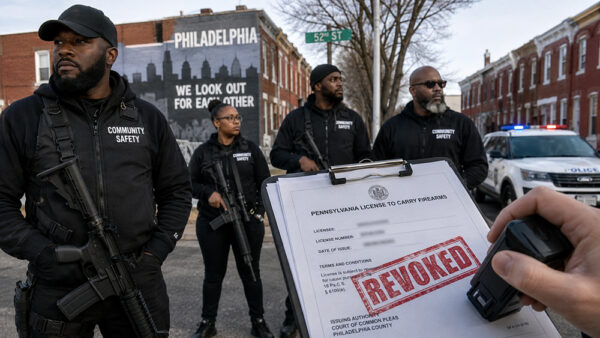
Revocation of carry licenses over vague “character and reputation” claims raises serious due process and Second Amendment concerns for all gun owners. AI-generated illustration by AmmoLand using ChatGPT/OpenAI.
“Visibly Armed, They Patrolled the Streets to Protect the Public from ICE. Now Their Gun Licenses are Being Revoked,” The Trace reported May 20. “Philadelphia says it pulled the licenses of Black Lions because of their “character and reputation.” The group argues it’s retaliation for policing the police.”
“The Trace?”, gun owners active in protecting the right to keep and bear arms might well ask. The group funded by anti-gun billionaire Michael Bloomberg that poses as a legitimate journalism outlet while spreading anti-gun propaganda designed to abet citizen disarmament edicts?
Why would we believe anything they say?
Noting the number of times this correspondent has called them out on just those charges, it’s a legitimate question, so it pays to corroborate the information from other sources. It’s also curious that in this case, the focus of The Trace is not to cheer this on as a “commonsense gun safety law,” and that’s especially contradictory considering the sentiments of its benefactor when it comes to armed minorities.
Noting the Black Lions “(formerly the Philadelphia chapter of the Black Panther Party) identify with revolutionary socialist and Black nationalist traditions, which are heavily rooted in Marxist principles,” it’s also fair to ask why the hell Second Amendment advocates should give a damn if their licenses are revoked. After all, one of the purposes of the Militia as envisioned by the Founders was “to suppress Insurrections,” and it certainly looks like they have the potential and the inclination to threaten Constitutional rule of law, especially if political tensions being egged on by racist Democrat demagogues erupt into widespread collectivist violence.
It’s because the Constitutional rule of law says the right of the people to keep and bear arms shall not be infringed, and that efforts to disarm citizens can only be legitimate if it has been proven – with full due process – that they cannot be trusted with a gun (meaning they shouldn’t be trusted with unfettered access to the rest of us).
The whole concept of prior restraint licensing and the reason for revocation given, “character and reputation,” are tyrannical affronts to everything the Republic is supposed to stand for, and a government powerful enough to enforce such diktats is much more of a fearsome threat than the one it’s “protecting” from. Just don’t forget that what the government can do to the Black Lions, it will do to whomever it can. (It’s ironic that the communist system they would impose on all ultimately relies on a disarmed populace. It never seems to evolve beyond Marx’s dictatorship of the proletariat and into the stateless Nirvana he promised.)
“We condemn any program that involves enforcing unconstitutional ‘laws’, even if such ‘laws’ are enforced only against violent criminals,” the Project Exile Condemnation Coalition declared in 2001. “Unconstitutional ‘laws’ are illegal, harmful to public safety, tyrannical, and are inevitably enforced against ordinary, non-criminal citizens.”
If the Black Lions are threatening and victimizing people and obstructing immigration law enforcement, go after the ones doing it with the laws against it. Otherwise, leave them alone to run food assistance programs, give out clothes to the needy, and, yes, patrol the streets while armed.
David Codrea is the winner of multiple journalist awards for investigating/defending the RKBA and a long-time gun owner rights advocate who defiantly challenges the folly of citizen disarmament. He blogs at “The War on Guns: Notes from the Resistance,” is a regularly featured contributor to Firearms News, and posts on Twitter: @dcodrea and Facebook.
The Minnesota Court of Appeals just handed Tim Walz and the DFL another gun control defeat.
Minnesota Gov. Tim Walz and his legislative allies in the Democratic-Farmer-Labor (DFL) party had a rough eight days in May, with the legislative session ending on the 18th without passing their gun control legislation, and a major court loss on the 26th, striking down the “binary trigger” ban snuck into a spending bill in 2024.
Walz has not had a good year, with much attention paid to welfare fraud in the North Star State on his watch, and his inability to move legislation which would have put new restrictions on gun owners. It is no wonder he is not running for re-election, and is vowing to quite politics.
The Minnesota Gun Owners Caucus is celebrating its victory in the state Court of Appeals, nullifying the binary trigger ban because its inclusion in the 2024 omnibus tax/spending bill violated the state constitution’s single subject rule. The MGOC had earlier won at the trial court level before Ramsey County District Court Judge Leonardo Castro. The Appeals Court ruling cemented the defeat.
In a news release, MGOC Chairman Bryan Strawser observed, “This is a complete victory on the question we asked the court to decide. The Walz administration and anti-gun legislators tried to sneak a firearms ban into an omnibus bill where it didn’t belong. The district court said no. The Court of Appeals said no. Minnesota’s Constitution, not legislative gamesmanship, controls how laws get made in this state, and Minnesota gun owners just proved it twice.”
It came one week and a day after the legislature adjourned, putting a spike through SF 4067, which the MGOC described in a news story as a “sweeping gun ban omnibus bill.”
The legislation died even after—or perhaps because—DFL lawmakers held a sit-in to demand action on the gun control bill. They were furious that Republican House Speaker Lisa Demuth had declined to move it to a vote.
Joining Minnesota gun owners in celebrating the defeat of gun control for another year, the Citizens Committee for the Right to Keep and Bear Arms issued a scathing statement to the media, describing the binary trigger ban as a “shenanigan used by anti-gunners time and again to conceal something they know would never pass muster in the broad daylight.”
“We’re delighted our colleagues at the Minnesota Gun Owners Caucus, a CCRKBA state affiliate, challenged this sneaky tactic,” said CCRKBA Chairman Alan Gottlieb.
But the nationally-recognized gun rights leader had something more ominous to say.
“Tim Walz and his anti-gun-rights DFL cronies in St. Paul were defeated twice this month,” he added, “once when they couldn’t pressure Minnesota House Speaker Lisa Demuth with their ridiculous ‘sit-in’ to bring their gun ban bill up for a vote, and now by the state Court of Appeals. It was briefly fun to watch them pout like disappointed spoiled brats, but the novelty wore off pretty fast. All they’ve proven is their willingness to be sneaky and childish in an effort to get their way, while the adults at the capitol and in the court keep them in check. We hope Minnesota voters remember this in November.”
Right now, there is an even split in the Minnesota House, which could change with this fall’s elections. If Democrats win, expect more gun control to be introduced, but if Republicans take majority control, such legislation would likely be held in check.
Is there national significance in the Minnesota situation? There is clearly a message that GOP unity and strength can prevent restrictive gun control from becoming law, and across the map, Democrats are recognized as the “party of gun prohibition.” They have rammed through gun and magazine bans in Washington, Colorado, Illinois and other states, and Maryland Gov. Wes Moore just signed legislation banning Glock-style pistols, for which he was promptly sued in federal court by the National Rifle Association, Second Amendment Foundation and Firearms Policy Coalition.
Last December, Walz made headlines when he demanded that insurance companies turn over information on firearms, as noted by the Daily Caller, declaring, “We are the murder gun capital of the planet, because people have made the decision to protect gun manufacturers and those who don’t want to take responsible action.” His remark epitomizes the sentiment of many Democrats, who are invariably leading the charge for more gun restrictions.
Traditionally, mid-term elections result in a loss of seats for whichever party is in control, including the White House. But this year has a new dynamic with the elections of highly vocal socialist mayors Zohran Mamdani in New York City, and Katie Wilson in Seattle. His pronouncements and her ineptitude have made some interesting headlines over the past five months, and they’re just getting started.
Democrats will try to make the fall elections entirely about Donald Trump, but Minnesota is proof that far more is at stake.
Dave Workman is a senior editor at TheGunMag.com and Liberty Park Press, author of multiple books on the Right to Keep & Bear Arms, and formerly an NRA-certified firearms instructor.
Virginia officials are moving to restart private firearm sale background checks despite a court injunction blocking enforcement of the state’s universal background check law. AI-generated illustration by AmmoLand using ChatGPT / OpenAI.
The Virginia Attorney General’s office has notified the Virginia Citizens Defense League (VCDL) and Gun Owners of America (GOA) that the Virginia State Police (VSP) will begin enforcing universal background checks on private firearms sales. This move directly violates a standing court order that declared such requirements unconstitutional under the Virginia Constitution.
In 2020, Virginia passed legislation (Virginia Code § 18.2-308.2:5) mandating background checks for nearly all firearm transfers. This included private sales between individuals, which previously did not require checks. Under the law, these transactions had to be processed through a federally licensed firearms dealer (FFL), who would then run the check through the Virginia State Police system.
VCDL and GOA joined forces to challenge the law in state court. They argued that it infringed on the rights protected by the Virginia Constitution. In October 2025, a judge in the Lynchburg Circuit Court ruled in their favor in the case Wilson et al. v. Colonel Matthew D. Hanley. The court struck down the law and issued a permanent injunction prohibiting its enforcement anywhere in the state.
Democrats quickly labeled the ruling “the Lynchburg loophole.” Earlier in 2026, the General Assembly passed new legislation to restore background checks for private sales. Former CIA officer and current Virginia Governor Abigail Spanberger signed the bill into law. She invoked emergency powers to make it effective immediately, bypassing the standard delayed implementation period.
Initially, the Virginia State Police acknowledged the court order and stated they could not enforce the new requirements while the injunction remained in place. VSP even updated its public guidance to reflect that private sale background checks were neither required nor available.
That position changed recently. Federal firearms licensees across Virginia received notices indicating that the State Police would once again process background checks for private sales, despite the active court injunction. At the same time, the Attorney General’s office, now led by Jay Jones, who fantasized about killing the children of a Republican revival, sent a formal letter to VCDL and GOA confirming that the VSP would resume enforcement of the law.
This development represents a direct challenge to judicial authority. The VSP’s new stance appears to defy the permanent injunction issued by the Lynchburg Circuit Court. Under the fundamental principle of the separation of powers, neither the executive branch nor the legislature has the authority to override a final court ruling. Yet that is precisely what seems to be occurring here.
Critics, including gun rights advocates, point out that the Attorney General’s office provided no clear legal justification for disregarding the court order. Jones, who faced significant controversy during his campaign over past text messages in which he fantasized about violence against Republican figures and their families, now finds himself at the center of this constitutional confrontation.
The situation is poised to trigger further legal action. VCDL and GOA are expected to return to court to enforce the existing injunction and seek remedies for what they view as open defiance of the judiciary.
This case raises profound questions about the rule of law in Virginia. If state agencies can selectively ignore court orders they dislike, it undermines the entire judicial system and sets a dangerous precedent that could affect rights far beyond the Second Amendment.
For Virginia gun owners, the implications are immediate and practical. Private sales—such as those between family members, friends, or at gun shows—had become simpler and more private following the 2025 ruling. The attempted revival of mandatory checks through FFLs adds cost, inconvenience, and delay. Many law-abiding citizens worry that this creates unnecessary hurdles for exercising their constitutional rights while doing little to address actual criminal activity, since prohibited persons already bypass legal channels.
This episode highlights the ongoing tension in Virginia between expanding gun control measures and constitutional protections. Advocates for the right to keep and bear arms argue that the state’s actions reflect a broader pattern of incremental restrictions that erode longstanding traditions of private firearm transfers. They emphasize that the Virginia Constitution contains strong protections for this right, independent of federal interpretations.
As the legal battle unfolds, all eyes remain on the courts. The outcome could determine not only the future of background checks in Virginia but also the balance of power among the state’s branches of government. Gun rights organizations like VCDL and GOA have vowed to continue fighting to preserve the court’s original injunction and protect the freedoms of Virginia’s law-abiding residents.
This conflict serves as a reminder of the importance of an independent judiciary in safeguarding individual liberties against overreach by other branches of government. Virginians on all sides of the issue will be watching closely to see whether the rule of law prevails or yields to political pressure.
Mr. Crump is an NRA instructor and a constitutional activist. John has written about firearms, interviewed people from all walks of life, and on the Constitution. John lives in Northern Virginia with his wife and sons, follow him on X at @right2bear, or at www.crumpy.com.
NRA, Firearms Policy Coalition, and Second Amendment Foundation have filed a federal lawsuit challenging Maryland’s new Glock-style handgun ban, SB 334. Img Duncan Johnson
Maryland Gov. Wes Moore signed SB 334 into law, and gun-rights groups wasted no time dragging the state into federal court.
The National Rifle Association, Firearms Policy Coalition, and Second Amendment Foundation filed a federal lawsuit in the U.S. District Court for the District of Maryland, challenging the state’s new ban on so-called “machine gun convertible pistols.” The complaint argues the law is not really about machine guns at all. It is a ban on nearly every Glock and Glock-style handgun on the market.
Starting January 1, 2027, SB 334 makes it illegal for ordinary Marylanders to manufacture, sell, offer for sale, purchase, receive, or transfer a covered pistol. The law defines that category around semiautomatic pistols with a “cruciform trigger bar” that can allegedly be converted into a machine gun by installing a backplate-style conversion device.
Maryland is going after Glocks and all Glock-style pistols.
The complaint points out that all factory Glock pistols use a cruciform trigger bar. It also names popular Glock-style pistols, such as the Palmetto State Armory Dagger, the Ruger RXM, and many Shadow Systems models, as likely swept into the ban. These are among the most popular and widely owned defensive handguns in America.
“This Maryland law bans nearly every Glock and Glock-style handgun on the market today,” said SAF Executive Adam Kraut. “These pistols are among the most popular on the market, chosen in overwhelming numbers by peaceable citizens for lawful purposes like self-defense. Maryland has now attempted to ban these firearms because a subset of criminals illegally modifies them, using conversion parts that are themselves illegal to possess, and then commit crimes with the modified handguns. Not only is this law as foolish as banning hops and barley to prevent drunk driving, but these commonly owned arms are clearly protected by the Second Amendment, the ratification of which takes certain policy choices – including this one – off the table.”
Maryland is not banning Glock switches. Those are already illegal under federal law and Maryland law. The state is instead punishing every law-abiding gun owner who wants to buy a semiautomatic handgun because criminals might illegally modify one.
The complaint makes clear that pistol converters, often called Glock switches, are already treated as machine guns under federal law. Maryland also bans “rapid fire activators,” which include these types of devices. Those bans are not what this lawsuit challenges. The question in this case is whether Maryland can ban common, ordinary handguns simply because someone else might illegally turn them into something they are not.
Under Heller, handguns are at the core of the Second Amendment. The Supreme Court called them the “quintessential self-defense weapon.” Under Bruen, the government must justify modern gun restrictions by reference to the nation’s historical tradition of firearm regulation. Maryland is going to have a hard time finding a Founding-era tradition of banning the most popular handguns in the country because some criminal might misuse illegal conversion parts.
SAF won’t stand for this, and neither should you. Our lawsuit will be filed imminently. Wanna support getting it over the finish line? Head over to https://t.co/niCyD7cIYS and become a member today. pic.twitter.com/NiUzGCQujP
The complaint also argues that the Second Amendment protects not only possession but acquisition. A right to keep and bear arms means very little if the state can shut down the lawful sale, purchase, and transfer of the arms citizens actually use.
Anti-gun politicians are trying to create a new category of banned handguns by tying common pistols to illegal conversion devices. If they can get away with that, every popular firearm platform is at risk. The AR-15 can be blamed for illegal auto sears. The Glock can be blamed for illegal switches. The gun owner, as usual, gets punished for the actions of criminals the state failed to stop.
“Bans like the one just signed in Maryland are the antithesis of good policy,” said SAF founder and Executive Vice President Alan M. Gottlieb. “This unconstitutional law does nothing more than punish peaceable gun owners in the state, and it cannot be allowed to stand. You can’t stop criminal violence by broadening the law just to make everyone a criminal. That strategy never works.”
The lawsuit names Gov. Moore, Attorney General Anthony Brown, and Acting Maryland State Police Superintendent Michael Jackson as defendants. The Maryland State Police are tasked with creating regulations to implement the law, including publishing a list of prohibited pistols. That means the state will decide which handguns Marylanders are no longer allowed to buy or transfer.
The plaintiffs are asking the court to declare the law unconstitutional and block its enforcement.
FPC President Brandon Combs did not mince words. “Maryland’s politicians just declared war on an entire class of constitutionally protected handguns and the peaceable people who want to own them. This ban is immoral, unconstitutional, and tyrannical. FPC and our Grassroots Army are going to force Maryland to respect the Second Amendment, full stop.”
The NRA is also framing the fight as part of a larger national campaign against common handguns.
“With a single stroke of his pen, Governor Wes Moore has banned one of the most popular handguns in America,” said John Commerford, Executive Director of the NRA-ILA. “Instead of going after criminals and enforcing existing laws, he has chosen to disarm law-abiding Marylanders and strip them of their constitutional rights. The NRA is filing an immediate legal challenge to this unconstitutional assault on the Second Amendment and will exhaust every option available to ensure this law is struck down.” – John Commerford, Executive Director of the NRA Institute for Legislative Action
Maryland’s SB 334 is not aimed at violent criminals. It is aimed at the ordinary people standing at a gun counter, trying to buy one of the most common defensive pistols in America.
Duncan Johnson is a lifelong firearms enthusiast and unwavering defender of the Second Amendment—where “shall not be infringed” means exactly what it says. A graduate of George Mason University, he enjoys competing in local USPSA and multi-gun competitions whenever he’s not covering the latest in gun rights and firearm policy. Duncan is a regular contributor to AmmoLand News and serves as part of the editorial team responsible for AmmoLand’s daily gun-rights reporting and industry coverage.
Virginia’s new “assault firearm” and magazine ban is already facing resistance from prosecutors, sheriffs, and localities before it takes effect July 1. Image Duncan Johnson
As the deadline for the new Virginia gun laws approaches, Governor Abigail Spanberger’s master plan is showing cracks. Multiple localities, sheriffs, and Commonwealth’s Attorneys have publicly stated they will not enforce what they consider unconstitutional laws.
The laws go into effect on July 1, but some Commonwealth’s Attorneys have already instructed law enforcement not to arrest anyone for violations of the “assault firearms” ban because they will not prosecute the cases.
Ryan Mehaffey, a Marine veteran and one of the Commonwealth’s Attorneys standing up against the Governor’s gun grab, sent a letter to Spotsylvania Sheriff Roger Harris, instructing him that the ban is “unconstitutional and cannot be lawfully enforced.”
Mehaffey believes the United States and Virginia Constitutions protect citizens’ rights to possess standard infantry weapons. During the country’s founding, the standard issue was a musket with 20 rounds of ammunition. Today, he says, that equates to an M4A1 carbine and a 30-round magazine.
“Our founders were careful to make sure, when they drafted our founding document, that the ultimate right of the people was preserved — the right to defend themselves and their community,” Mehaffey said. “So, the linchpin of the constitutional analysis is whether this instrument has some reasonable relationship to the preservation or efficiency of a well-regulated militia.”
Smyth County Commonwealth’s Attorney Phillip Blevins, an Air Force veteran, has also refused to enforce the ban. Like Mehaffey, Blevins believes the bill is unconstitutional. He took an oath to the Constitution of the United States and the Constitution of the Commonwealth of Virginia, and he says enforcing the law would violate that oath.
“As Commonwealth’s Attorney, I took an oath to support and defend the Constitution of the United States and the Constitution of Virginia,” Blevins said. “That oath is not situational, and it does not change based on politics, headlines, or pressure from either side of an issue.”
Pulaski County Commonwealth’s Attorney Justin L. Griffith will also not enforce the law. He emphasizes that enforcement of criminal laws is at the discretion of each locality’s Commonwealth’s Attorney. Griffith believes the ban “is not a necessary tool for justice in Pulaski County.” He said he will continue to prosecute criminals for the misuse of guns but will not target law-abiding citizens as this bill does.
“I am not going to take law-abiding citizens as of June 30, 2026, and criminalize that same behavior on July 1, 2026, solely on the basis of this new law,” Griffith said. “Justice has been and will continue to be sought against those that use guns in the commission of crimes, outside of this new law.”
Powhatan County Commonwealth’s Attorney Rob Cerullo has also notified law enforcement that he will not bring charges against people who violate the new ban. He believes the law violates the United States Supreme Court’s Bruen ruling. Cerullo plans to honor his oath to the Constitution, even if that means going against the former CIA agent-turned-governor.
“The provisions mentioned above place both my office and yours in an untenable position; we can either honor our oath to preserve the Constitution, or enforce statutes which are clearly unconstitutional,” Cerullo wrote in a letter to Powhatan County Sheriff Bradford W. Nunnally.
Scott County Commonwealth’s Attorney Kyle Kilgore and Sheriff Jeff B. Edds also issued a joint statement declaring they will not enforce the new “assault firearms” ban. The two men believe the ban violates Virginians’ protected Second Amendment rights. They also cited their oath to the Constitution.
In addition to the five Commonwealth’s Attorneys pledging not to enforce the ban, seven sheriffs from Amherst, Campbell, Carroll, Page, Floyd, Scott, and Washington counties have told their departments that the ban will not be enforced. Additionally, 58 localities have enacted protections to prevent the enforcement of the new gun laws.
Virginia has long been the birthplace of rebellion, with figures such as George Washington, Thomas Jefferson, James Madison, and George Mason standing up against tyranny. Nearly 250 years later, Virginians are still answering that call.
Mr. Crump is an NRA instructor and a constitutional activist. John has written about firearms, interviewed people from all walks of life, and on the Constitution. John lives in Northern Virginia with his wife and sons, follow him on X at @right2bear, or at www.crumpy.com.