
Something is not adding up inside President Donald Trump’s Department of Justice.
The administration has created a Second Amendment enforcement unit, intervened on behalf of gun owners in major constitutional cases and publicly promised to protect the right to keep and bear arms. Yet DOJ attorneys continue filing lower-court briefs that sound as though Merrick Garland never left the building.
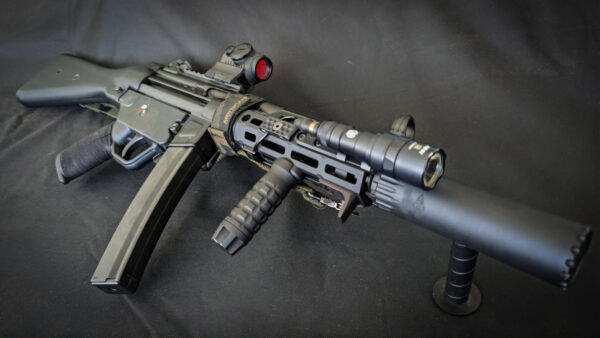
Constitutional attorney Mark Smith, host of The Four Boxes Diner, is calling attention to the latest and perhaps most glaring example: the government’s July 27 supplemental brief in Brown v. Bureau of Alcohol, Tobacco, Firearms and Explosives. The case, pending in the U.S. District Court for the Eastern District of Missouri, challenges the National Firearms Act’s continued regulation and registration of short-barreled rifles and suppressors.
After the Supreme Court decided Wolford v. Lopez, the district court ordered the parties to explain what effect that ruling has on the NFA challenge.
DOJ’s answer could hardly have been more dismissive:
“In short, Wolford does not meaningfully affect how this Court should resolve plaintiffs’ Second Amendment challenge.”
That is an extraordinary position for a supposedly pro-Second Amendment administration to take.
The same Justice Department that supported the challengers in Wolford is now telling a lower court that the Supreme Court’s clarification of the Second Amendment framework provides “no meaningful guidance” when that guidance threatens a federal gun-control program.
DOJ Says Wolford Is Basically Irrelevant
DOJ attempts to distinguish Wolford by arguing that the case concerned where firearms may be carried, while Brown concerns what weapons the government may regulate.
The brief states:
“Wolford thus concerns how a government may permissibly regulate where firearms are possessed.”
According to DOJ, that question is “conceptually distinct” from the issues presented in Brown. But that framing sidesteps the central point raised by Smith.
Wolford did more than strike down Hawaii’s default ban on carrying firearms on private property open to the public. The decision also clarified the sequence courts must follow under New York State Rifle & Pistol Association v. Bruen.
First, courts examine the Second Amendment’s plain text. Does the law apply to “the people”? Does it concern “Arms”? And, does it restrict keeping or bearing those arms? When the text applies, the challenged law is presumptively unconstitutional. The government must then establish that its restriction is consistent with the Nation’s historical tradition of firearm regulation. That division between text and history matters enormously in Brown.
The government wants courts to place the “common use” question at the first stage, forcing gun owners to prove that a particular weapon is sufficiently popular before the burden ever shifts to the government. But whether an arm is “dangerous and unusual” is a historically derived limitation. It belongs in the historical inquiry, where the government bears the burden.
As Justice Amy Coney Barrett explained in her Wolford concurrence, courts may not “smuggle additional limits” drawn from regulatory tradition into the plain-text stage.
Smith’s criticism is straightforward: DOJ is doing precisely what the Supreme Court warned courts not to do.
DOJ Stretches Miller Beyond Its Holding
The government next argues that United States v. Miller and District of Columbia v. Heller foreclose the challenge to the NFA’s regulation of short-barreled rifles.
DOJ writes:
“As Miller and Heller make clear, ‘the Second Amendment does not protect those weapons not typically possessed by law-abiding citizens for lawful purposes, such as short-barreled shotguns.’”
The brief then claims that the principle applied to short-barreled shotguns in Miller “applies equally to short-barreled rifles.”
Miller involved a short-barreled shotgun. It did not involve a short-barreled rifle. It did not involve a suppressor. The Supreme Court heard no argument on behalf of the defendants, and the decision was rendered on an undeveloped record. The Court did not establish a blanket rule that every weapon Congress placed under the NFA falls outside the Second Amendment.
Heller itself demonstrates why DOJ’s argument is wrong. If Miller had already resolved the constitutional status of weapons outside some government-defined category, there would have been no need for the Supreme Court in Heller to examine whether handguns were commonly possessed by Americans for lawful purposes. Instead, the Court considered the specific arms banned by the District of Columbia and determined that handguns were overwhelmingly chosen for lawful self-defense.
The district court in this case must likewise analyze short-barreled rifles as short-barreled rifles–not simply pretend they are constitutionally indistinguishable from the shotgun involved in Miller.
Compact rifles, including pistols in rifle calibers, are owned by large numbers of Americans and are used for lawful purposes including home defense, vehicle defense, training, hunting and recreation. DOJ cannot evade that reality by stretching a 1939 decision beyond the weapon and record actually before the Court.
DOJ Wants Gun Owners to Carry the Government’s Burden
The Justice Department also insists that Wolford does not override Eighth Circuit precedent placing common use at Bruen’s first step.
The brief states:
“Wolford never mentions this inquiry … much less addresses how it fits within Bruen’s analytical framework.”
DOJ further argues that judges continue to debate whether common use belongs at the first or second step. That may accurately describe an ongoing judicial disagreement, but it does not answer the originalist argument. The plain-text inquiry determines whether the object is an “Arm”—a weapon customarily used for offensive or defensive purposes.
Whether an arm may be excluded as dangerous and unusual comes from historical tradition. “Common use” is relevant because an arm possessed by ordinary Americans for lawful purposes cannot reasonably be called unusual. That analysis must occur after the text is satisfied. Otherwise, the government can impose a ban or registration requirement, suppress ownership through that restriction and then argue that the arm is not common enough to receive constitutional protection. That is circular and it rewards the government for successfully burdening the right.
The Second Amendment does not protect only those arms that citizens can first prove sufficiently common to a judge. It protects the right of the people to keep and bear arms, placing the burden on the government to justify infringements through history.
DOJ Calls the NFA a “Shall-Issue Licensing Scheme”
The most disturbing portion of the brief may be DOJ’s attempt to rebrand the National Firearms Act.
The government asserts:
“The NFA is a presumptively constitutional shall-issue licensing scheme.”
That description would be laughable if the consequences were not so serious. The NFA requires Americans to obtain government approval before making or receiving covered firearms. It requires the firearm to be registered to its possessor and imposes severe criminal penalties for possessing an unregistered NFA item.
The brief concedes the central feature of the system:
“The NFA requires, among other things, that the firearm be registered to whomever will possess it.”
Yet DOJ insists the plaintiffs are wrong to distinguish registration from licensing because the registration is merely one condition for receiving government permission. That argument proves too much. A license generally establishes that a person is legally eligible to exercise a regulated activity. Registration records specific property and connects it to a particular citizen in a government database.
The NFA does both, but its firearm registry is neither incidental nor imaginary.
Then-Judge Brett Kavanaugh drew that distinction in his Heller II dissent. Kavanaugh concluded that the District of Columbia’s broad firearm-registration requirement lacked support in the Nation’s historical tradition and was substantially more burdensome than traditional licensing or dealer recordkeeping.
Kavanaugh’s opinion was a dissent and therefore not binding precedent, but his historical analysis presents the question DOJ would rather avoid:
Where is the American tradition of forcing peaceable citizens to register lawfully possessed arms with the federal government?
One Bad Brief Can Tarnish the Entire Record
Smith compares these lower-court filings to a bug landing in an otherwise excellent bowl of soup. The administration may build a strong record on the Second Amendment, but Americans will remember the cases in which its own attorneys defended federal registries, shifted constitutional burdens onto gun owners and minimized Supreme Court precedent.
DOJ lawyers do not swear an oath to preserve every federal statute. They swear an oath to the Constitution.
When the government must choose between defending inherited federal power and honoring the original public meaning of the Second Amendment, there should be no confusion about which comes first. The Trump administration has repeatedly said it intends to protect the right to keep and bear arms. The filing in Brown v. ATF does the opposite.
About Duncan Johnson:
Duncan Johnson is a lifelong firearms enthusiast and unwavering defender of the Second Amendment—where “shall not be infringed” means exactly what it says. A graduate of George Mason University, he enjoys competing in local USPSA and multi-gun competitions whenever he’s not covering the latest in gun rights and firearm policy. Duncan is a regular contributor to AmmoLand News and serves as part of the editorial team responsible for AmmoLand’s daily gun-rights reporting and industry coverage.
from https://ift.tt/M7tRzVJ
via IFTTT

No comments:
Post a Comment