
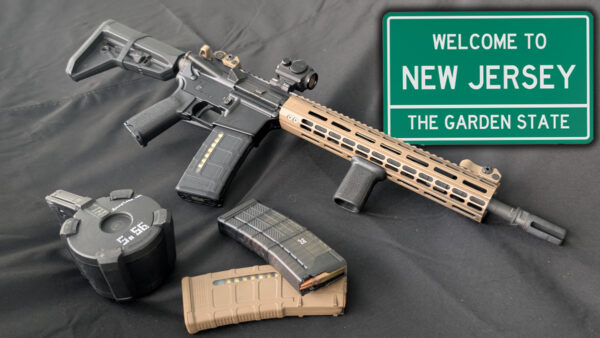
New Jersey’s AR-15 ban and 10-round magazine limit have suffered a major federal appellate defeat.
Sitting en banc, the U.S. Court of Appeals for the Third Circuit ruled July 17 that New Jersey’s so-called “assault firearm” ban violates the Second Amendment as applied to every semiautomatic rifle covered by the law. The court also struck down the state’s prohibition on magazines capable of holding more than ten rounds.
Ten of the court’s 15 judges joined the judgment invalidating the rifle and magazine provisions in the consolidated challenges brought by the Association of New Jersey Rifle & Pistol Clubs, individual gun owners, and the Firearms Policy Coalition. Judge Arianna Freeman wrote the opinion of the court.
The decision goes substantially further than the lower court’s 2024 ruling. U.S. District Judge Peter Sheridan had limited his decision against the rifle ban to Colt-manufactured AR-15s while upholding New Jersey’s magazine restriction. The Third Circuit expanded that judgment to all semiautomatic rifles regulated by the challenged provisions and reversed the ruling on magazines.
John Commerford, executive director of the National Rifle Association Institute for Legislative Action, released the following statement celebrating the win:
“Today marks a historic victory for the NRA, the Second Amendment, and law-abiding Americans. The Third Circuit has struck down these unconstitutional so-called assault weapons bans and magazine bans in New Jersey, affirming what we’ve always known: the right to keep and bear arms, including commonly-owned rifles and standard-capacity magazines, is fundamental and cannot be infringed by politicians who prioritize control over constitutional freedoms. This ruling protects the rights of millions of responsible gun owners in the Garden State and serves as another benchmark in our efforts to dismantle gun control across the country.”
Semiautomatic Rifles Are Protected “Arms”
The majority began with a point that should not be controversial: A semiautomatic rifle is a firearm, and a firearm is an “Arm” protected by the Second Amendment.
“Because semi-automatic rifles are firearms, they are ‘Arms’ within the meaning of the Second Amendment,” the court held. “The Constitution thus ‘presumptively protects’ individuals’ right to keep and bear semi-automatic rifles.”
That conclusion forced New Jersey to prove its prohibition was consistent with the nation’s historical tradition of firearm regulation. The state failed to do so.
The record showed that approximately 24 million AR-15s and similar rifles are in circulation. Americans possess them for self-defense, hunting, target shooting, and pest control. Their accuracy, light recoil, and ergonomics also make them practical defensive firearms.
New Jersey attempted to get around those numbers by arguing that semiautomatic rifles are rarely fired during documented defensive gun uses. The court rejected that sleight of hand. The Second Amendment protects the right to “keep” arms, meaning the right to possess them. A gun owner does not need to shoot an attacker before his choice of defensive firearm receives constitutional protection.
The majority also made clear that self-defense is not the only lawful purpose protected by the Second Amendment. Hunting and other lawful uses count as well.
“Regardless of where those lines may be drawn, the many millions of semi-automatic rifles in circulation for lawful purposes are plainly in common use,” the court wrote.
That is a direct rejection of the argument anti-gun states have increasingly pushed: that an arm can be banned unless gun owners prove it is frequently fired in self-defense. The Constitution protects keeping and bearing arms, not merely pulling the trigger during a crime recorded in a government database.
New Jersey Could Not Produce a Historical Rifle Ban
Once the court determined that New Jersey had imposed a de facto ban on a class of commonly possessed arms, the historical question became straightforward.
The state offered gunpowder-storage laws, trap-gun restrictions, Bowie-knife laws, and later regulations of pistols and clubs. None supported what New Jersey enacted.
Founding-era gunpowder laws were fire-safety measures governing how large quantities of powder could be stored in crowded buildings. They were not bans on possessing commonly owned weapons. Most Bowie-knife laws arrived decades after the Founding and regulated concealed carry rather than possession. Georgia’s lone outright possession ban was later held unconstitutional except insofar as it regulated concealed carry.
The majority also refused to let New Jersey invoke “unprecedented societal concerns” as a shortcut around the historical test. Criminals misusing weapons to harm innocent people is not a new problem. The Founders addressed dangerous individuals through laws directed at threatening or criminal conduct, not by disarming millions of peaceable citizens.
“Together, Heller and Bruen teach that bans or broad prohibitions on possessing or carrying of a class of weapons in common use for lawful purposes fail to find support in our Nation’s tradition of firearm regulation,” the court explained. “That is so even when the regulations are passed with the intention of reducing gun violence.”
The majority ultimately held that “New Jersey’s complete prohibition on the possession of semi-automatic rifles runs afoul of the Second Amendment’s protections.”
Ten Rounds Is a Political Line, Not a Constitutional One
The Third Circuit delivered an equally strong rejection of New Jersey’s magazine ban.
The state argued that magazines holding more than ten rounds were either unprotected accessories or a separate category of “large capacity” arms. The majority rejected both claims. Magazines feed ammunition into firearms and are required for many modern guns to function as designed. They are therefore protected “Arms.”
The court also recognized that “large capacity magazine” is a political label whose definition changes whenever lawmakers choose a new number. New Jersey originally allowed magazines holding up to 15 rounds before lowering the limit to ten in 2018.
“It would defy reason for a label devised by New Jersey’s legislature to govern the reach of the Second Amendment’s text,” the majority wrote.
The court then went directly at the state’s arbitrary cutoff:
“It cannot be that a magazine that can hold ten rounds is an ‘Arm’ covered by the plain text of the Second Amendment but a magazine that can hold eleven rounds is not.”
The record contained evidence of more than 100 million 30-round AR-15 magazines in circulation. AR-15-style rifles commonly ship with 20- or 30-round magazines, making them standard equipment for one of America’s most popular rifles.
Quoting an earlier decision and expressly agreeing with it, the majority observed: “There may well be some capacity above which magazines are not in common use but, if so, the record is devoid of evidence as to what that capacity is; in any event, that capacity surely is not ten.”
The court concluded that New Jersey’s magazine provisions violate the Second Amendment.
Judge Matey Blasts New Jersey’s Word Games
Judge Paul Matey, joined by Judge Jennifer Mascott, wrote separately to argue that New Jersey has already received more than enough time to defend its restrictions.
Matey described the state’s law as “blunderbuss legislation” and accused New Jersey’s attorneys of “prioritizing histrionics over history.” He also rejected the terminology lawmakers use to make ordinary rifles and magazines sound sinister.
“Sixteen rounds was large yesterday, eleven rounds is large today,” Matey wrote. “Nor does any limiting principle guide the State’s definition of ‘assault weapons.’”
Although the state may market its gun-control agenda using politically effective slogans, he added, “the rights of our Republic are built on sturdier stuff.”
Matey and Mascott would move quickly on the remaining portions of the case rather than give New Jersey another lengthy round of litigation.
Third Circuit Creates the Circuit Split SCOTUS Needed
The national importance of this ruling is difficult to overstate. Other federal appellate courts have upheld semiautomatic-rifle or magazine bans by treating commonly owned rifles as military weapons, minimizing lawful possession, or stretching late historical regulations beyond recognition.
Judge Cheryl Ann Krause’s dissent acknowledged exactly what the majority accomplished. She complained that the ruling makes the Third Circuit “the only Court of Appeals in the Nation to afford constitutional protection to AR-15s and LCMs.”
That admission identifies the real story. There is now a clean federal appellate split over whether the government may ban AR-15-style rifles and commonly owned magazines.
The Supreme Court has already agreed to hear the consolidated Viramontes v. Cook County and Grant v. Higgins cases, which ask whether the Second and Fourteenth Amendments protect the right to possess AR-15-platform and similar semiautomatic rifles. The Third Circuit has now given the justices a detailed roadmap grounded in Heller, Bruen, Rahimi, Hemani, and Wolford.
What the Decision Does—and Does Not—Resolve
The ruling invalidates New Jersey’s “Assault Firearm Provisions” as applied to the semiautomatic rifles covered by the law. It also holds that the state’s restrictions on magazines holding more than ten rounds violate the Second Amendment.
The Third Circuit remanded the challenges involving semiautomatic pistols, semiautomatic shotguns, and other weapons covered by New Jersey’s definition because the record was less developed regarding those firearms. Bump stocks were not part of the challenge. The court also did not decide the separate Takings Clause claim because the Second Amendment ruling resolved the magazine dispute.
New Jersey gun owners should not treat the publication of the opinion as an immediate green light to disregard existing statutes. The appellate mandate, further district-court proceedings, and any request by the state for a stay must still be watched closely.
But the constitutional result is unmistakable: New Jersey cannot erase the Second Amendment by attaching an inflammatory label to a common rifle or by declaring that the eleventh round in an ordinary magazine suddenly transforms protected property into contraband.
For the first time, an en banc federal appellate court has squarely rejected both games.
About Duncan Johnson:
Duncan Johnson is a lifelong firearms enthusiast and unwavering defender of the Second Amendment—where “shall not be infringed” means exactly what it says. A graduate of George Mason University, he enjoys competing in local USPSA and multi-gun competitions whenever he’s not covering the latest in gun rights and firearm policy. Duncan is a regular contributor to AmmoLand News and serves as part of the editorial team responsible for AmmoLand’s daily gun-rights reporting and industry coverage.
from https://ift.tt/gBuZ4cM
via IFTTT

No comments:
Post a Comment