
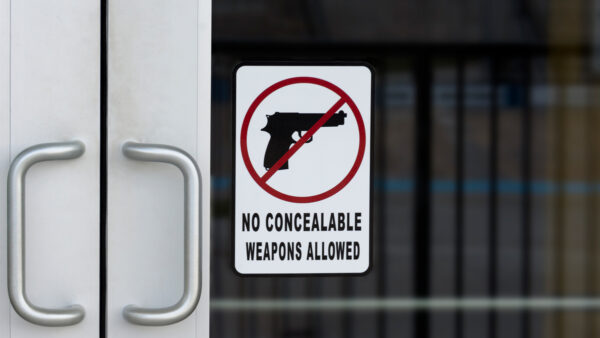
The Hawaii Firearms Coalition is urging businesses across the Aloha State to think twice before posting “No Firearms Allowed” signs following the U.S. Supreme Court’s landmark decision in Wolford v. Lopez.
The ruling struck down Hawaii’s default ban on carrying firearms onto private property open to the public without the owner’s express consent. Instead, businesses must now decide for themselves whether to allow licensed concealed carry or prohibit it by posting signs. As business owners weigh that decision, the Hawaii Firearms Coalition has released an open letter arguing that “No Guns” signs won’t stop criminals but they will drive away law-abiding customers.
The coalition’s letter focuses on the economic consequences of banning lawful carry. Hawaii is home to more than 150,000 registered firearm owners, representing roughly one in five households. HIFICO warned that many of those gun owners may simply take their business elsewhere rather than patronize establishments that prohibit lawful concealed carry.
“We fully recognize that private property owners have the right to set their own policies,” the coalition wrote. “We simply ask that you make that decision with a full understanding of the potential consequences.”
But there is another question business owners should consider before posting those signs: if you choose to disarm your customers, what responsibility do you assume for protecting them?
An Open Letter to Hawaii Businesses and Business Owners
As businesses across Hawaii consider whether to post “No Firearms Allowed” signs, we ask that you take a moment to carefully consider the long-term impact of that decision.
Hawaii is home to more than 150,000 registered… pic.twitter.com/obS41a2Zhh
— Hawaii Firearms Coalition (HIFICO) (@hificoorg) July 7, 2026
Disarming Customers Doesn’t End a Business’s Responsibility
A business has every right to prohibit firearms on its property. But rights come with responsibilities.
When an owner tells law-abiding citizens they cannot provide for their own defense, the obvious question becomes: what security is the business providing instead? If tragedy strikes, that question could become far more than rhetorical as attorneys examine whether the business took reasonable steps to protect the very people it chose to disarm.
Businesses generally owe customers a duty to maintain reasonably safe premises. Under premises liability law, property owners can face negligent security lawsuits if they fail to take reasonable precautions against foreseeable criminal acts.
Whether a business provided adequate security depends on numerous factors, including prior criminal activity at the location, crime trends in the surrounding area, lighting, surveillance systems, security personnel, employee training, and other protective measures.
If a business decides that customers cannot provide for their own defense, a plaintiff’s attorney could argue that the business assumed greater responsibility to provide reasonable protection through other security measures. Whether such an argument succeeds depends on the facts of the case and applicable state law, but it is a legal theory businesses should understand before adopting restrictive firearm policies.
Security Isn’t Just About Signs
Some businesses appear to believe that posting a “No Guns” sign is, by itself, a safety policy. It isn’t.
A sign does not screen customers for criminal intent. It does not prevent armed robbery. It does not stop a violent attacker from entering a store.
Actual security requires investment. Trained personnel, surveillance, emergency planning, and other measures appropriate for the business and its location.
Businesses that prohibit lawful concealed carry while providing little or no additional security may eventually find themselves answering difficult questions after a violent incident.
A Decision With Multiple Consequences
The Supreme Court’s decision restored the ability of Hawaii’s concealed carry permit holders to lawfully carry firearms onto most private property open to the public unless the owner chooses to prohibit them.
That means the decision now rests squarely with individual business owners.
Some will undoubtedly decide to post “No Firearms Allowed” signs. Others may conclude that welcoming law-abiding, licensed gun owners is the better choice for both customer relations and personal safety.
HIFICO’s letter encourages businesses to consider the economic consequences of turning away responsible customers. That’s a reasonable point.
But business owners should also recognize that a firearm prohibition is not a substitute for real security. If they decide to disarm lawful patrons, they should also evaluate whether the security measures they have in place are adequate to protect the customers they have chosen to protect themselves.
When the unthinkable happens, a sign on the door won’t be the only thing anyone examines.
About Duncan Johnson:
Duncan Johnson is a lifelong firearms enthusiast and unwavering defender of the Second Amendment—where “shall not be infringed” means exactly what it says. A graduate of George Mason University, he enjoys competing in local USPSA and multi-gun competitions whenever he’s not covering the latest in gun rights and firearm policy. Duncan is a regular contributor to AmmoLand News and serves as part of the editorial team responsible for AmmoLand’s daily gun-rights reporting and industry coverage.
from https://ift.tt/qvTW2Rx
via IFTTT

No comments:
Post a Comment