Wednesday, April 22, 2026

Virginia’s Assault Weapons Bills Head Back to Governor’s Desk Without Modification

AR-15 Rifle
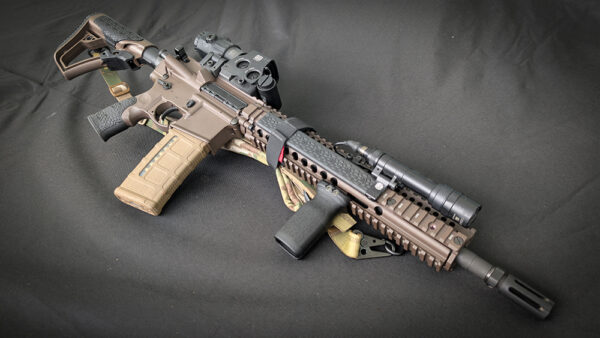
Governor Abigail Spanberger’s recommended changes to SB 749 and HB 217 may widen the reach of Virginia’s pending ban on many commonly owned semi-automatic firearms and magazines over 15 rounds. Image Duncan Johnson

The Virginia General Assembly passed both SB 749 and HB 217 earlier this year. The identical bills would ban the future transfer, sale, and manufacture of many commonly owned semi-automatic firearms classified as “assault firearms,” along with standard-capacity magazines holding more than 15 rounds. These restrictions would not apply to firearms or magazines lawfully owned before the July 1, 2026, effective date.

The bills reached Governor Abigail Spanberger’s desk, but the former CIA agent returned them to the legislature with recommended amendments. The General Assembly is now considering whether to accept or reject those changes. If lawmakers reject the amendments, they can still allow the original bills to pass by taking no further action.

Governor Spanberger’s recommendation would make an already constitutionally questionable bill significantly more restrictive. Specifically, it would remove the word “fixed” from the definition of an assault firearm.

Under the original language, a semi-automatic centerfire rifle or pistol with a fixed magazine capable of holding more than 15 rounds would be banned for transfer. The governor’s change would broaden the ban to cover many more semi-automatic firearms that accept detachable magazines exceeding 15 rounds, effectively restricting a wider range of commonly owned handguns and rifles and further limiting their lawful carry in public.

With the bills now “passed by” in their amended form, they will return to the Governor’s desk.

Spanberger can sign them into law, veto them, or take no action, allowing them to become law automatically after 30 days. Most believe that a veto is almost guaranteed not to happen, meaning that these bills will become law.

Many legal observers view this process as a potential stall tactic designed to shorten the window for legal challenges before the laws take effect on July 1, 2026. Organizations including Gun Owners of America (GOA), the Virginia Citizens Defense League (VCDL), and the Firearms Policy Coalition (FPC) have vowed to file lawsuits immediately upon enactment. Because suits cannot be brought until the bills are officially signed or become law without signature, the delay reduces the time available for courts to issue injunctions against the new laws.

Legal challenges are expected in both federal and state courts.

Virginia’s Constitution provides robust protection for the right to keep and bear arms through Article I, Section 13, which explicitly states that the right belongs to the people and is not limited to military service. The provision, strongly influenced by George Mason, reflects the founders’ deep concerns about tyranny and standing armies.

Article I, Section 13 of the Virginia Constitution reads: “That a well regulated militia, composed of the body of the people, trained to arms, is the proper, natural, and safe defense of a free state, therefore, the right of the people to keep and bear arms shall not be infringed; that standing armies, in time of peace, should be avoided as dangerous to liberty; and that in all cases the military should be under strict subordination to, and governed by, the civil power.”

Whether or not the amendments were accepted by the Virginia General Assembly doesn’t mean the battle is over. The core fight over these bills continues.

Virginia has served as ground zero for the national gun-rights debate in recent years, and this latest round of legislation ensures the battle will intensify in the months and years ahead.

Virginia Redistricting Vote and Spanberger Gun Bans Fuel 2A Backlash


About John Crump

Mr. Crump is an NRA instructor and a constitutional activist. John has written about firearms, interviewed people from all walks of life, and on the Constitution. John lives in Northern Virginia with his wife and sons, follow him on X at @right2bear, or at www.crumpy.com.

John Crump


from https://ift.tt/NZPhFyI
via IFTTT

Wyoming HB14 Shows the Second Amendment Is Still a Second-Class Right

Long Island Dentist Sues Nassau County Police For Illegal Firearms Seizure
HB14 would have protected citizens forced to defend themselves and then fight for their freedom in court. Wyoming’s failure to pass it shows the Second Amendment still gets second-class treatment. iStock-1304844629

Supreme Court Associate Justice Clarence Thomas spoke at my alma mater a few days ago. After his speech, he sat down for a Q&A with William Inboden, the executive vice president and provost at the University of Texas at Austin.

Those of us hoping for some insider insight into the current antics at 1 First Street, NE came away empty-handed. Thomas’ speech and comments didn’t have much to say about the Second Amendment at all. Of course, it’s possible there was an agreement to avoid questions about the court’s prolonged inactivity.

It was Thomas’ repeated judicial and extra-judicial comments about the treatment of the Second Amendment as a “second-class right” that resonated with me as I read Dean Weingarten’s report on the failure of the Wyoming House to advance House Bill 14, Protecting Self-Defense-Reimbursement.

HB14 would have helped citizens acquitted of charges arising from using deadly force in self-defense. It would have allowed the citizen to recover some of their legal expenses from the prosecuting county and would have applied to both acquittals and dropped charges. There was even a provision to expedite expungement: There would be no records to haunt the citizen in the future.

Though Wyoming is one of the reddest states, House Bill 14 failed to advance. Twenty-nine Republicans voted for it; 26 Republicans and six Democrats killed it. It’s likely cost was a factor. Eight of Wyoming’s 23 counties have fewer than 10,000 residents, and it wouldn’t take a particularly large settlement to bankrupt them.

It’s a pity we can’t cut to the chase and enact this as a federal law. The cost of defending oneself from charges such as this can easily run into the tens or even hundreds of thousands of dollars and would bankrupt most people. But any such law passed by Congress would apply only to federal cases. [Note: The one big exception could be clarifying the interstate transportation of firearms under the Firearm Owners Protection Act and adding sanctions like those in Wyoming HB14 to discourage malicious enforcement and prosecution by certain states we all know and loathe.]

In reality, contrary to the “second-class right” meme, a more accurate description would be “steerage.”Steerage is the lowest class of passenger on a ship. It was usually called “third-class,” but in practice it was more like “fourth-class.”

Sounds about right.

The foundation of our system of justice is the presumption of innocence until proven guilty. Gun control turns this on its head. Far too many politicians and their fellow travelers assume the only reason anyone wants a gun is so they can commit evil with it.

In a similar vein, a citizen should be free to exercise all of their Enumerated Rights unless it can be proven beyond the shadow of a doubt they have misused or abused the right. No prior restraint, such as permits for purchase or possession. No usurpation of property rights by fiats designating private property open to the public as gun-free zones.

Public property is just that: Property owned or used in the name of, or for the benefit of, the public. There must be a compelling reason to deny the public the right to exercise their core civil liberties. Prohibiting members of the public from personally exercising their right to defense, especially when compelled to be in that place, means the government assumes full responsibility and liability for the citizen’s defense. No hiding behind South v. Maryland, Warren v. District of Columbia, DeShaney v. Winnebago County, or City of Castle Rock v. Gonzales.

It’s foolish to say there are no possible exceptions. Courtrooms when the court is in session; jails, prisons, legislative, county, or municipal chambers while in session or during official meetings.

Prohibitions on lawfully carried firearms in public schools should be subject to the same requirements. A provision for an armed responder at all times on every campus or an opportunity for qualified carry by designated citizens.

One thing an awful lot of people fail to understand — and even more people refuse to accept — is that the Second Amendment is an integral part of the U.S. Constitution, the supreme law of the land. With the ratification of the Fourteenth Amendment in 1868 and the amendment’s incorporation under the Due Process Clause in 2010, the Second Amendment, as written and ratified, outranks every federal, state, county, or municipal law or ordinance.

Massie Tells Senate the Second Amendment Exists to Thwart Tyranny


About Bill Cawthon

Bill Cawthon first became a gun owner 55 years ago. He has been an active advocate for Americans’ civil liberties for more than a decade. He is the information director for the Second Amendment Society of Texas.Bill Cawthon


from https://ift.tt/pXzict7
via IFTTT

Tuesday, April 21, 2026

Kaine-Warner Gun Control Bill Would Take Virginia Restrictions Nationwide

Kaine-Warner Gun Control Bill Would Take Virginia Restrictions Nationwide
New anti-gun federal legislation introduced by Virginia Senators Tim Kaine and Mark Warner amounts to a direct attack on the Second Amendment. iStock-483315547

Federal legislation introduced this month by perennial anti-gun Senate Democrats Tim Kaine and Mark Warner, both from Virginia—where embattled gun owners are facing legislative demagoguery as freshman Gov. Abigail Spanberger seems determined to ignite a new Civil War with the Justice Department over gun rights—would spread the Commonwealth’s efforts to erode the Second Amendment nationwide.

Kaine and Warner’s “Virginia Plan to Reduce Gun Violence Act” was announced in a press release extolling the “virtues” of both Capitol Hill gun prohibitionists. They remind the media, and anyone else who bothers to read their self-serving announcement, that last year, they “reintroduced the Assault Weapons Ban of 2025, legislation that would revive the 1994 nationwide ban on assault weapons two decades after the original ban expired in 2004.”

They then go on to say, “In 2022, Warner and Kaine helped pass the Bipartisan Safer Communities Act, legislation that contains many provisions of the Virginia Plan, including improving background checks, strengthening safeguards for victims of domestic violence, and incentivizing states to implement their own Extreme Risk Protection Orders to remove firearms from individuals who pose a high risk of harming themselves or others.”

Here are the tenets of their “new” plan, taken directly from their news release, which is an expansion of every gun prohibitionist’s dream scheme to trample the right to keep and bear arms:

  1. One-Handgun-a-Month: Limits purchases of handguns to one per month to curtail the stockpiling and trafficking of firearms, promoting domestic and international security.
  2. Reporting of Lost or Stolen Firearms: Requires gun owners to report lost or stolen firearms to the appropriate state or local law enforcement agency within 48 hours. State and local law enforcement agencies would be directed to report the collected data to the FBI’s National Crime Information Center.
  3. Preventing Firearm Access to Minors: Promotes responsible gun ownership and safe storage practices by holding individuals liable for leaving a loaded, unsecured gun in a place a minor could access it. This will prevent the most common cause of accidental shooting deaths among children.
  4. Protection Order Prohibitions: Strengthens safeguards for victims of domestic violence by closing the “boyfriend loophole,” which currently allows abusive non-spousal partners to possess firearms, and expands firearm laws to prohibit persons convicted of stalking or subject to a domestic violence restraining order from possessing firearms.
  5. Extreme Risk Protection Orders: Establishes a federal extreme risk protection order process to temporarily remove firearms from individuals who pose a high risk of harming themselves or others and incentivizes states to implement their own extreme risk protection laws and court protocols.
  6. Lucia’s Law: Establishes criminal liability for a caregiver who gives a child in their care access to a firearm when they are aware that the child is a danger to themselves or others.
  7. Assault Weapons Sale Prohibition: Prohibits the sale, manufacture, and importation of assault weapons.
  8. Assault Weapons Age Restriction: Prohibits the possession of assault weapons by someone under the age of 18, with exceptions if the child is under the supervision of a parent, grandparent, or legal guardian, or participating in an educational or training program.
  9. Prohibition of Ghost Guns: Bans the purchase, sale, importation, or possession of complete or incomplete firearms without a serial number and anyone enabling someone to create such a firearm. Updates the definition of an “Undetectable Firearm” so the definition covers firearms that are not detected by machines commonly used at airports, government buildings, schools, correctional facilities, and other locations for security screening.
  10. Secure Storage of Firearms in Unattended Vehicles: Requires gun owners to securely store a handgun if it is left in an unattended vehicle. Every nine minutes, a firearm is stolen from an unattended vehicle.
  11. Domestic Violence Firearms Relinquishment: Creates a grant program incentivizing states to establish a process to confirm that any firearms possessed by someone newly prohibited from possessing a firearms because they were convicted of a misdemeanor of domestic violence or they are subject to a domestic violence restraining order is no longer in that individual’s possession, because it was transferred to someone who can legally possess the firearm, or it was removed by law enforcement.
  12. Prohibition on Firearms in or near Hospital and Mental Health Services Facilities: Creates a “Mental Healthcare Facility Zone” similar to current gun-free school zones, prohibiting the possession of a firearm within 1000 feet of a hospital or mental health facility that provides mental health services or developmental services.
  13. Enhances Safety at Public Higher Education Institutions: Prohibits the possession of firearms in public college & university buildings unless the firearm is being used for an approved educational purpose or in support of public safety.

In their joint release, Warner and Kaine declare this 53-page proposal “would build on Virginia’s commonsense framework to reduce gun violence.”

In reality, the requirements outlined in their announcement would literally turn the right to keep and bear arms into a government-regulated privilege. The only thing missing is a permit-to-purchase restriction, a nasty mandate which Democrats lately have embraced in Colorado and Washington.

It translates into an open declaration by Democrats that their party’s war on the Second Amendment has entered a new phase in which they’re not even trying to disguise their intentions.

The legislation may not move during the remainder of this session, but if Democrats recapture the Senate in November, it’s a safe bet they will try ramming it through in 2027. Whatever else the Kaine/Warner bill might be, it amounts to a warning to gun owners they better not skip voting this fall.

Virginia Redistricting Vote and Spanberger Gun Bans Fuel 2A Backlash


About Dave Workman

Dave Workman is a senior editor at TheGunMag.com and Liberty Park Press, author of multiple books on the Right to Keep & Bear Arms, and formerly an NRA-certified firearms instructor.Dave Workman


from https://ift.tt/ta83XzY
via IFTTT

Anti-Gun States Want to Disarm Citizens While Arming Non-Citizens

Police handgun symbolizing anti-gun states arming non-citizen officers while restricting citizens’ gun rights
If a state says law-abiding Americans cannot be trusted with firearms, why is it willing to arm certain non-citizens with badges, guns, and arrest powers? iStock-140257402

There is something deeply backward about a state that works overtime to disarm its own citizens while moving to arm non-citizens with badges, guns, and the power to arrest the very people whose rights it keeps trying to crush.

Across the country, anti-gun states have spent years treating the law-abiding American citizen as the problem. These are the same states that push magazine bans, “assault weapon” bans, carry restrictions, waiting periods, permitting schemes, and every other obstacle they can dream up to make it harder for ordinary Americans to exercise their right to keep and bear arms.

At the same time, some of those very same jurisdictions have moved to let certain non-citizens serve as police officers, so long as they have federal work authorization and can meet the state’s requirements. Illinois changed its law to allow certain non-citizens to become police officers and deputy sheriffs, and New Mexico enacted a similar change in 2025. Think about that for a second.

The law-abiding American citizen is treated with suspicion for wanting to own a rifle, carry a handgun, or defend his family. But a state government that does not trust its own people with freedom suddenly has no problem trusting a non-citizen with a badge, a firearm, arrest powers, and the authority of the state.

That tells you everything you need to know about the mindset behind modern gun control.

It must also be noted that major federal law enforcement agencies still require U.S. citizenship for core police and investigative roles. So why are anti-gun states moving in the opposite direction?

Why, then, should the requirement be relaxed for those who seek employment as police officers in the states?

If non-citizens can carry a gun and if they have the power of arrest over citizens, then the bright line that exists between citizens and non-citizens becomes blurred and eventually shattered.

The idea that some states would grant police power to a non-citizen is foolish, for the same reasons non-citizens cannot serve as police officers in the federal government. Why would Blue-State Progressive Governors suddenly be so willing to arm non-citizens, ostensibly to fight crime, and yet frustrate if not curtail the exercise of the right to armed self-defense of actual citizens?

More to the point, if, as is the case, the problem of increasing criminal violence in a community is due to a state leadership’s obsequious attitude and conduct toward the criminal element responsible for that violence, then what is to be gained by a mere numerical increase of police officers to a state’s police force?

What is gained, exactly, by widening state police authority while still treating the armed citizen as the real threat?

When a state fills its police ranks with non-citizens while insisting ordinary citizens cannot be trusted with firearms, it has already lost the plot. At that point, it is not building public confidence. It is fueling justified anger from a citizen population that sees its own rights restricted while the government arms non-citizens and gives them the power to arrest Americans.

This is where the anti-gun narrative really starts to fall apart. The same political class that treats the armed citizen as a danger to society is often forced to ignore the reality that ordinary Americans are not the problem. In fact, law-abiding armed citizens have repeatedly shown that they can and do act to protect themselves and others when violence breaks out. That makes the state’s hostility toward armed self-defense even harder to justify, especially when those same officials are willing to expand armed government authority in other hands.

This practice is not only audacious and self-defeating but also bespeaks contempt for the people to whom government owes an obligation to serve—the American citizenry.

If there are shortages of Police Officers, then why are some Progressive State Governors, such as Michelle Lujan Grisham of New Mexico, so quick to arm and give a badge to non-citizens, and, simultaneously, to frustrate American citizens’ right to keep and bear arms for personal self-defense?

It goes back to “control” and to Progressive-Marxist suspicion of “The Common Man”—i.e., the Citizen of the United States—and the refusal to acknowledge or even comprehend the concept of ‘Personal Safety’ as the citizens’ fundamental right.

“Blue” States adamantly refuse to accommodate “Armed Personal Safety.” It doesn’t exist for them. Still, they should accommodate the Armed Citizen if they were serious about dealing effectively with rising criminal violence in their jurisdictions.

The citizen’s exercise of “Armed Personal Safety” is not incompatible with, does not clash with, and does not undermine the state’s role in providing for “Public Safety.” Rather, the Armed Citizen complements the state’s role in providing “Public Safety” through the state’s use of its “Police Power.”

Blue states need the Armed Citizen. In practice, these states do an extremely poor job of providing Public Safety due to misplaced priorities or a misunderstanding of what policing in our Country is about.

Birthright Citizenship Directly Impacts the Second Amendment


ROGER J. KATZ, ATTORNEY AT LAW

Roger is an attorney licensed to practice law in Ohio and Arizona, and he is CEO of Arbalest Group, LLC.

He is a graduate from Cleveland State University, Cleveland Marshall College of Law, and was an Editor of Law Review, and he has earned a Master of Public Administration Degree from Cleveland State University. Roger also holds several degrees from The Ohio State University: a Master of Arts degree in Philosophy, a Bachelor of Arts degree in English, and a Bachelor of Science in Education degree in Secondary English Education.

Roger has worked as a high school English teacher and as a university administrative assistant. On earning a law degree he worked for several years as a Trademarks Examining Attorney with the United States Patent and Trademark Office in Washington D.C., and later worked as an attorney for a boutique intellectual property law firm in New York City.

Roger’s goal, working full-time on the Arbalest Quarrel website, involves preparing comprehensive and detailed analyses of case law pertaining to First and Second Amendment issues, and analyses of Federal and State laws and bills impacting the Bill of Rights, generally, and the Second Amendment, particularly.

Roger takes as axiomatic that, to maintain a free Constitutional Republic, our Bill of Rights must be preserved. If the latter falls, the former falls.


from https://ift.tt/YC5AajO
via IFTTT

Monday, April 20, 2026

NSSF, Gun Rights Groups Oppose Maryland’s New Glock-Style Pistol Ban

Glock 17 Gen 6 9mm Pistol. Img Duncan Johnson

Maryland Democrats are not stopping at banning illegal Glock switches. They are moving to ban the sale and transfer of common striker-fired handguns used by countless law-abiding Americans, and now the opposition is starting to line up. NSSF said Monday it is prepared to take legal action if Gov. Wes Moore signs the legislation, while Maryland Shall Issue and NRA-ILA have already been warning that the bill sweeps far beyond criminals and squarely at ordinary gun owners.

The Maryland bill at the center of the fight is SB 334, cross-filed as HB 577. According to the Maryland General Assembly, the legislation would, beginning January 1, 2027, prohibit the manufacture, sale, offer for sale, purchase, receipt, or transfer of a “machine gun convertible pistol,” while directing the Department of State Police to publish a list of prohibited models. The bill passed the Senate 28-16 on March 19 and the House 92-39 on April 8 before heading to the governor.

Maryland lawmakers are not merely punishing possession of illegal conversion devices. Those devices are already illegal under federal law. Importing, possessing, making, or selling a machinegun conversion device can bring up to 10 years in prison and up to a $250,000 fine. Instead of hammering criminals who use illegal switches, Maryland is trying to choke off access to a whole class of commonly owned handguns.

NSSF did not mince words. The trade group said it is prepared to sue if Moore signs the bill, arguing that Maryland would be banning “the most popular selling handguns” by loosely defining them as “machine gun convertible pistols.”

NSSF’s release also stressed that the proposed prohibition would cover the same general style of pistols carried by Maryland State Police and the Baltimore Police Department, even while law enforcement is exempt from the ban. That is the usual anti-gun formula: deny the public what the government still insists its own agents need.

Maryland Shall Issue has been making a similar case from inside the state. In formal written testimony opposing SB 334 and HB 577, MSI President Mark Pennak argued the bill targets Glock-pattern pistols through the “cruciform trigger bar” language and warned that the definition reaches beyond criminals who misuse illegal devices. The revised fiscal note confirms the bill contains explicit carveouts for current law enforcement, qualifying retired law enforcement, and several transfer exceptions, including immediate-family transfers and temporary servicing by dealers or gunsmiths.

NRA-ILA has also been publicly urging opposition, warning that SB 334 and HB 577 use “vague and overly broad language” that could sweep in many commonly owned semiautomatic handguns, including Glock pistols, even though the underlying conversion devices are already illegal. After final passage, NRA-ILA urged Maryland gun owners to contact Gov. Moore and demand a veto.

Maryland is not acting alone, and anti-gun supporters of SB 334 openly told lawmakers the bill “follows the model recently enacted in California.”

California already passed AB 1127, which takes effect July 1, 2026, and prohibits licensed dealers from selling or transferring “semiautomatic machinegun-convertible pistols.” NSSF has already issued a compliance alert to members on California’s law, and NRA-ILA says it has already challenged that statute in court alongside Firearms Policy Coalition, the Second Amendment Foundation, a retailer, and individual plaintiffs in Jaymes v. Bonta.

California’s law is especially revealing because it shows exactly where this strategy goes. The state did not stop at banning illegal switches. It created a separate legal category for pistols with a cruciform trigger bar and imposed dealer-transfer restrictions, while still preserving exceptions for law enforcement, the military, private-party transfers, repairs, and preexisting dealer inventory under certain conditions.

In other words, anti-gun lawmakers are building a framework to wall off common handguns from the retail market while pretending they are only addressing criminal conversion devices.

If anti-gun states can use the criminal misuse of illegal add-on parts as the excuse to ban ordinary semiautomatic pistols in common use, they will do it again and again.

California already has. Maryland wants to be next.

These are some of the most common handguns in America, owned by millions of law-abiding citizens for self-defense, concealed carry, home protection, and everyday lawful use. Under Heller, arms that are in common use for lawful purposes sit at the core of the Second Amendment’s protection, not somewhere out on the fringe waiting for state approval.

Anti-gun lawmakers are trying to exploit the criminal misuse of illegal conversion devices as a pretext to cut ordinary Americans off from some of the most popular pistols on the market. If a state can point to criminal abuse of an already-illegal accessory and use that as an excuse to ban common handguns, then no widely owned firearm is truly safe from the next manufactured “public safety” rationale.

Maryland Democrats Move to Ban Glock-Style Pistols


About Duncan Johnson:

Duncan Johnson is a lifelong firearms enthusiast and unwavering defender of the Second Amendment—where “shall not be infringed” means exactly what it says. A graduate of George Mason University, he enjoys competing in local USPSA and multi-gun competitions whenever he’s not covering the latest in gun rights and firearm policy. Duncan is a regular contributor to AmmoLand News and serves as part of the editorial team responsible for AmmoLand’s daily gun-rights reporting and industry coverage.Duncan Johnson


from https://ift.tt/E7fI8w0
via IFTTT

Gun Owners Should Write President Trump & Demand a Pardon for Patrick “Tate” Adamiak

Gun Owners Should Write President Trump & Demand a Pardon for Patrick “Tate” Adamiak
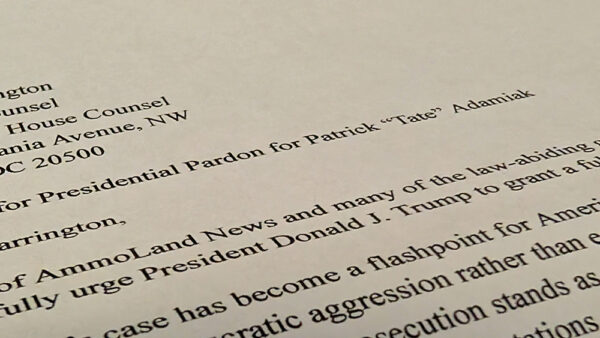
A formal letter urging President Donald Trump to grant a pardon for Patrick “Tate” Adamiak.

The case of Patrick “Tate” Adamiak has become, for many in the gun-rights community, one of the clearest examples of what happens when the ATF and federal prosecutors are weaponized against gun owners and treat them as criminals for constitutionally protected activity.

Adamiak is currently serving a 20-year federal prison sentence after a jury conviction that included machinegun and unregistered destructive-device counts, though one part of his case was later remanded on double-jeopardy grounds by the Fourth Circuit.

Now there is a new push to bring Adamiak’s case directly to President Donald J. Trump. There is a public call asking supporters to send letters urging Trump to pardon Adamiak.

For gun owners, this is not just about one man. It is about whether the federal government can continue turning collectors, enthusiasts, hobbyists, and ordinary Americans into examples for hostile administrations. It is about whether politically weaponized enforcement will be rewarded or corrected. And it is about whether a president who has publicly aligned himself with restoring constitutional government is willing to act when one of the most controversial ATF prosecutions in recent memory lands on his desk.

Adamiak had no prior criminal record, was an active-duty U.S. Navy sailor with orders to BUD/S, and there were no victims in the case. None of the evidence was functional or complete, and the items involved are still legally sold online. There were serious issues in the case, and the broader controversy surrounding the evidence and charging decisions has only intensified criticism from gun-rights advocates and organizations backing clemency.

This is where gun owners can do something practical instead of merely complaining online. Write. Put your name on paper. Tell the White House that Patrick “Tate” Adamiak deserves a full pardon.

Tell the administration that Americans are tired of seeing the ATF destroy lives through aggressive, agenda-driven enforcement. Tell President Trump that if his administration is serious about checking federal abuse and protecting the right to keep and bear arms, this is exactly the kind of case that demands action.

Letters should be sent to:

Mr. David Warrington
White House Counsel
Office of White House Counsel
1600 Pennsylvania Avenue, NW
Washington, DC 20500

U.S. Department of Justice
Office of the Pardon Attorney
950 Pennsylvania Avenue NW
Washington, DC 20530

Gun owners should keep the letters respectful, direct, and personal. Explain why this case matters. Explain why federal agencies must not be allowed to play games with our constitutional rights. Explain why a pardon here would send a message that Americans are no longer willing to accept selective enforcement and bureaucratic persecution as normal.

A movement that claims to believe in liberty has to act like it when liberty is on the line. If gun owners want to help free Patrick “Tate” Adamiak, the time to write is now.

Our letter is below; we are mailing it today.

AmmoLand News
P.O. Box 700003
Sebastian, FL 32970
April 20, 2026

Mr. David Warrington
White House Counsel
Office of White House Counsel
1600 Pennsylvania Avenue, NW
Washington, DC 20500

Re: Request for Presidential Pardon for Patrick “Tate” Adamiak

Dear Mr. Warrington,

On behalf of AmmoLand News and many of the law-abiding gun owners who make up our readership, I am writing to respectfully urge President Donald J. Trump to grant a full presidential pardon to Patrick “Tate” Adamiak.

Mr. Adamiak’s case has become a flashpoint for Americans who believe federal firearms enforcement has too often been driven by bureaucratic aggression rather than equal justice. To countless gun owners, collectors, and Second Amendment advocates, this prosecution stands as a disturbing example of how technical classifications, disputed evidence, and expansive agency interpretations can be used to secure devastating penalties against an American who, by all public accounts, was not a violent criminal.

Public court records show that Mr. Adamiak was sentenced to 20 years in federal prison. His case has drawn sustained criticism from respected gun-rights advocates, attorneys, and journalists who believe he was wrongfully targeted and excessively punished.

This is not merely a case about one man. It is about whether the federal government will continue to use the machinery of prosecution to crush citizens under vague standards, shifting interpretations, and politically charged enforcement priorities.

Mr. Adamiak served his country in the United States Navy. He had no criminal history. His case did not involve the kind of criminal conduct most Americans associate with a 20-year prison sentence. Yet he remains behind bars while many violent offenders receive less time and less attention from the federal government.

President Trump has an opportunity to correct a grave injustice and send a clear message that his administration will not tolerate abusive or overreaching federal action against law-abiding Americans. A pardon for Patrick “Tate” Adamiak would be an act of justice. It would show that this White House recognizes the difference between true criminality and a prosecution that many Americans view as emblematic of ATF excess.

We respectfully ask President Trump to review this case personally and grant Patrick “Tate” Adamiak a full and immediate pardon.

Sincerely,

Duncan Johnson
Editor-in-Chief
AmmoLand News

ATF Gun Registry Exposed, Senate Hearing Raises Alarm Over 1 Billion Records


About Duncan Johnson:

Duncan Johnson is a lifelong firearms enthusiast and unwavering defender of the Second Amendment—where “shall not be infringed” means exactly what it says. A graduate of George Mason University, he enjoys competing in local USPSA and multi-gun competitions whenever he’s not covering the latest in gun rights and firearm policy. Duncan is a regular contributor to AmmoLand News and serves as part of the editorial team responsible for AmmoLand’s daily gun-rights reporting and industry coverage.Duncan Johnson


from https://ift.tt/MlLXIkW
via IFTTT

Saturday, April 18, 2026

DOJ Warns Virginia on Gun Bills as Harmeet Dhillon Expands 2A Civil Rights Push

The Department of Justice has launched an unprecedented campaign to dismantle state and local gun restrictions across the country, deploying the federal government’s civil rights apparatus in defense of Second Amendment rights.

Assistant Attorney General Harmeet Dhillon, who leads the DOJ’s Civil Rights Division, has publicly declared her intention to challenge every state regulation inconsistent with pro-Second Amendment Supreme Court precedent, aiming to have them struck down, settled, or withdrawn before she leaves office.

The latest battleground is Virginia, where Gov. Abigail Spanberger faces a direct federal challenge over a sweeping package of more than 25 gun reform bills passed by the Democrat-controlled General Assembly during its 2026 legislative session.

Dhillon tweeted a pointed warning to the new governor. “@SpanbergerForVA is on notice: 2A rights SHALL NOT BE infringed. We are closely watching—in the event any unlawful legislation is enacted, we will sue. @CivilRights will protect the 2A rights of law-abiding citizens in Virginia. 2A Section Lawyers are standing by…”

On April 10, 2026, Dhillon sent a formal letter to Governor Spanberger putting her and the Commonwealth “on notice.” The letter stated plainly that “This letter provides formal notice that the Civil Rights Division will commence litigation in the event the Commonwealth of Virginia enacts certain bills that unconstitutionally limit law-abiding Americans’ individual right to bear arms.” Dhillon specifically cited President Trump’s Executive Order 14206, which directed the administration to actively protect Second Amendment rights.

The centerpiece of Virginia’s gun package is SB 749 and its companion HB 217, which would criminalize the purchase, sale, manufacture, import, or transfer of AR-15-style rifles in Virginia starting July 1, 2026. Other bills targeted ghost guns, expanded red flag laws, restricted firearms in public spaces and hospitals, and tightened rules around domestic abusers. Many of these same bills had been vetoed by the previous Republican governor, Glenn Youngkin.

Despite the DOJ warning, Spanberger proceeded to sign a batch of gun bills, including ghost gun regulations, domestic violence firearm protections, and gun industry liability legislation. On the night of April 13, facing her legislative deadline, Spanberger declined to sign or veto the assault weapons bill and instead sent it back to the General Assembly with amendments — a move that keeps the bill’s central framework intact while making some adjustments to its definition of “assault firearm.”

Dhillon’s confrontation with Virginia is part of a broader strategy that has reshaped the DOJ’s Civil Rights Division. In December 2025, she created an entirely new Second Amendment Section within the division — a first in DOJ history. The concept treats the Second Amendment as a civil right equivalent to speech or religion, deploying the DOJ’s litigation power to challenge state-level gun restrictions.

The DOJ has already filed lawsuits against Washington, D.C., the U.S. Virgin Islands, Los Angeles County over their gun restrictions. The division is also monitoring Colorado, New Jersey, and New York for potential legal action.

Dhillon has been hiring aggressively, building what she calls a “cadre of lawyers trained in enforcing these laws all over the country.” Recent additions include Barry Arrington, the former Texas Gun Rights Board Chairman and Chief Legal Counsel for the National Association for Gun Rights.

Dhillon’s campaign rests on a series of Supreme Court decisions that have dramatically expanded Second Amendment protections over the past two decades. The 2008 District of Columbia v. Heller ruling established that the Second Amendment protects an individual right to possess firearms for self-defense in the home, overturning D.C.’s handgun ban.

The 2022 New York State Rifle and Pistol Association v. Bruen decision went further, striking down New York’s “proper cause” requirement for concealed carry permits and mandating that all gun regulations must be rooted in the nation’s historical tradition of firearm regulation going back to 1791. This standard has rendered many existing state laws, rooted in twentieth-century public safety logic, legally vulnerable.

Dhillon’s letter to Spanberger also cited the Court’s June 2025 ruling in Smith and Wesson v. Estados Unidos Mexicanos — a PLCAA liability case that incidentally described AR-15s as “widely legal and bought by many ordinary consumers” — and Justice Kavanaugh’s statement on the Court’s denial of certiorari in Snope v. Brown, in which he wrote that “tens of millions of Americans own AR–15s” and called the Fourth Circuit’s upholding of Maryland’s AR-15 ban “questionable.”

The Supreme Court has not yet issued a definitive national ruling on “assault weapons” bans, but Dhillon and pro-gun advocates believe the Court’s existing language strongly suggests such bans are unconstitutional. The Illinois case Barnett v. Raoul at the 7th Circuit, where Dhillon personally argued in September 2025, could accelerate clarity on this question.

Dhillon’s office is targeting several specific types of state obstruction. In Los Angeles, the DOJ’s investigation revealed that the Sheriff’s Department had approved only 2 out of more than 8,000 concealed carry applications, with interview wait times stretching up to two years after receipt of a completed application.

The U.S. Virgin Islands required home inspections and “proper cause” showings nearly identical to what the Supreme Court already struck down in Bruen. Massachusetts bans the commercial sale of many common handguns, including popular Glock models, through its “Approved Firearms Roster” scheme, which the DOJ argues is flatly unconstitutional.

Washington D.C.’s categorical ban on AR-15s and similar semi-automatic rifles prompted a direct DOJ lawsuit, with Dhillon arguing these are the most commonly owned rifles in America and thus constitutionally protected.

For gun rights advocates, the DOJ’s intervention represents a historic shift. Pro-gun activists have spent years litigating against state governments largely as private plaintiffs. Having the full weight of the U.S. Department of Justice argue alongside them, and even initiate suits on their behalf, is unprecedented.

The confrontation with Virginia encapsulates this new reality. The federal government, acting through its civil rights enforcement apparatus, is now actively threatening to sue states that enact gun restrictions the administration considers unconstitutional. Governor Spanberger and other Democratic governors face a choice between their policy preferences and the prospect of expensive federal litigation.

Massie Tells Senate the Second Amendment Exists to Thwart Tyranny


About José Niño

José Niño is a freelance writer based in Charlotte, North Carolina. You can contact him via Facebook and X/Twitter. Subscribe to his Substack newsletter by visiting “Jose Nino Unfiltered” on Substack.com.

José Niño


from https://ift.tt/g62Euv1
via IFTTT

Wyoming Self-Defense Reimbursement Bill Dies in House Vote

handgun self defense glock pistol iStock-VasilevKirill 1053113926

Wyoming lawmakers introduced a bill this year that would have given real protection to people dragged through the criminal justice system after using lawful self-defense. House Bill 14, titled Protecting self-defense-reimbursement and amendments, would have required counties to reimburse defendants who were found not guilty, had charges dismissed, or were otherwise released from prosecution because they reasonably used defensive force under Wyoming law.

But the bill did not make it out of the House. HB0014 failed introduction on February 10, 2026, by a 29-32-1 vote.

HB0014 was aimed at one of the most abusive realities of modern self-defense law: even when a peaceable citizen does everything right and ultimately beats the charge, the state can still leave that person financially wrecked. Lawyer bills, bail costs, lost work, and the stigma of arrest do not disappear just because a prosecutor loses.

This bill tried to address that by making the government pay when the system comes after someone who lawfully defended himself, his family, another person, or property. The bill text says the county “shall reimburse” reasonable costs, including attorney fees, bail costs, loss of time, and even costs tied to seeking expungement. From wyoleg.gov:

If a person who is subject to criminal prosecution is found not guilty, has had the charges dismissed or is otherwise released from custody or further prosecution because the person reasonably used defensive force in accordance with W.S. 6‑2‑602, the county where the person was charged or subject to criminal prosecution shall reimburse the person for all reasonable costs, including loss of time, bail costs, attorney fees and other costs and expenses involved in the person’s defense, including the costs of seeking or receiving an expungement under W.S. 6‑2‑605.

Under proposed W.S. 6-2-604, reimbursement would have been available when a defendant was found not guilty, when charges were dismissed, or when the person was otherwise released from custody or further prosecution because the person reasonably used defensive force in accordance with W.S. 6-2-602. That is broader than a simple acquittal-only rule and would have covered cases that never made it to a full trial.

If a defendant was acquitted at trial, the trier of fact would decide whether the person was eligible for reimbursement because the acquittal rested on lawful self-defense, but the court would determine the amount of the award. In dismissal or no-prosecution cases, the defendant could file a petition in the county court where the case arose, and the court would decide both eligibility and the reimbursement amount. In other words, the bill did not make the jury set the dollar value of the award.

HB0014 also would have added an expungement mechanism tied specifically to successful self-defense cases. A person found not guilty, released, or whose charges were dismissed because of lawful defensive force could petition for expungement in the county where the prosecution occurred. If the person was acquitted because of lawful self-defense, the bill says the court would advise that person upon acquittal of the right to immediately file for expungement. There would be no filing fee for the expungement petition.

(g)  If the court enters an order of expungement under this section, the person shall be deemed to have never been arrested, charged or prosecuted with respect to the matters and charges that are subject to the order of expungement, and the person may so swear under oath.

Bill HB14 is sponsored by 23 representative(s): Brown, G, Allemand, Banks, Brady, Campbell, K, Guggenmos, Haroldson, Heiner, Hoeft, Knapp, Locke, Lucas, Ottman, Riggins, Schmid, Smith, S, Strock, Styvar, Wasserburger, Webb, Webber, Wharff and Winter. The bill is sponsored by 4  Senator(s): French, Ide, Laursen, D and Pearson.

The Wyoming Senate has 31 members: 29 Republicans and 2 Democrats. The Wyoming House of Representatives has 62 members: 56 Republicans and 6 Democrats.  Governor Gordon of Wyoming took time to appear at the Governors Forum at the SHOT Show. He appeared to be a strong supporter of the Second Amendment. He does not appear to have made a statement for or against this bill.

Wyoming is following Washington State’s lead. In Washington, there is a self-defense reimbursement statute, RCW 9A.16.110. The Washington statute is used infrequently. The Wyoming bill goes a bit further than the Washington statute, as it includes particulars for expungement. The bill’s supporters expect it will also be used infrequently. The bill is expected to prompt prosecutors to be more careful in prosecuting self-defense cases.

For gun owners, the principle behind HB0014 is easy to understand. The right to armed self-defense means less if the state can prosecute a lawful defender, fail to convict, and still leave him bankrupt and branded. Anti-gun politicians and activist prosecutors love to talk about “process,” but process itself becomes punishment when the innocent are forced to spend months or years and tens of thousands of dollars proving what should have been obvious from the beginning.

A reimbursement statute does not give anyone a free pass for criminal violence. It simply tells the government that if it comes after a person who lawfully used defensive force and loses, taxpayers—not the innocent defendant—should bear the cost.

HB0014 is dead for now, but the idea behind it is sound. If states are serious about recognizing self-defense as a fundamental right, they should also recognize that an innocent person cleared on self-defense grounds should not be left holding the bill for his own vindication. Wyoming had a chance to move in that direction this year. The House chose not to.


About Dean Weingarten:

Dean Weingarten has been a peace officer, a military officer, was on the University of Wisconsin Pistol Team for four years, and was first certified to teach firearms safety in 1973. He taught the Arizona concealed carry course for fifteen years until the goal of Constitutional Carry was attained. He has degrees in meteorology and mining engineering, and retired from the Department of Defense after a 30 year career in Army Research, Development, Testing, and Evaluation.

Dean Weingarten


from https://ift.tt/7TcBWCw
via IFTTT

Friday, April 17, 2026

ATF Gun Registry Exposed, Senate Hearing Raises Alarm Over 1 Billion Records

The Biden-era ATF spent years insisting it was not building a federal gun registry. That line gets a lot harder to sell when congressional testimony says the agency has amassed nearly 1 billion firearm records, with 94 percent already digitized, and senators are openly asking what else you would call that besides a registry.

Those figures were laid out in prepared testimony by Gun Owners of America Senior Vice President Erich Pratt at the Senate Homeland Security and Governmental Affairs Committee’s April 15, 2026, hearing on “The Second Amendment.”

If the federal government is sitting on a mountain of gun-owner records approaching a billion files, and almost all of it is digitally searchable in one form or another, gun owners have been correct all along. Basically, if it stinks like sh**, that’s because it is.

The federal government possesses an enormous, digitized pool of firearm transaction records that can be used to identify guns and, potentially, the people connected to them. Pratt’s testimony explicitly argued that ATF’s accumulation of those records amounts to “gun owner registration pure and simple.”

Gun owners have always understood that registration is not some harmless administrative exercise. Registration is how a government moves from regulating arms to tracking them. Tracking is how it moves from tracking to targeting. And targeting is how confiscation ends up at your front door.

Pratt drove that point home in his testimony when he warned senators that this is “not a registry in name only” but “a confiscation list waiting to be used.” That language is strong, but the historical concern behind it is very real. Gun control advocates have spent years dismissing registry fears as paranoid, even as past and present examples show exactly why Americans refuse to hand the government a ready-made inventory of lawfully owned arms. Pratt’s testimony pointed senators to the historical example of New York City’s long-gun registration regime and later bans, while Hawley referenced Australia’s registry and mandatory buyback structure as another warning sign gun owners should not ignore.

This is where the ATF’s recent behavior makes the whole thing even harder to shrug off.

This is the same agency that tried to turn millions of brace owners into potential felons with the stroke of a pen. It is the same agency that has fought in court over the pistol-brace rule, the “engaged in the business” rule, and the frames-and-receivers rule. Even in 2026, litigation over those Biden-era policies is still shaping the fight over how far federal firearms bureaucracy can reach. AmmoLand has already covered the DOJ’s recent retreat from defending the “engaged in the business” rule, along with the government’s latest reversal on the frames-and-receivers rule.

Pratt told senators that GOA obtained ATF materials showing the system could be searched by manufacturer, model, and serial number. He also testified that former ATF Director Steve Dettelbach had indicated the agency paid extra to suppress searchability by purchaser name, which only raised the obvious question: what happens if a future administration decides to stop paying for that limitation or otherwise changes the rules?

The ATF is not some neutral records custodian that gun owners have reason to trust. It is the same agency that tried to reclassify braced pistols by executive fiat, threatening millions of peaceable owners with felony exposure overnight. It is the same agency that has spent years defending Biden-era overreach in court, from the pistol-brace rule to the “engaged in the business” rule and the frames-and-receivers rule.

GOA obtained ATF materials showing the records system could be searched by manufacturer, model, and serial number, Pratt claimed. In the hands of an agency with a recent history of trying to criminalize ordinary conduct through regulation, that kind of search capability looks like the infrastructure for future enforcement.

Further, in Pratt’s testimony, he stated that former ATF Director Steve Dettelbach said the agency paid extra to suppress name-based searches, which only makes the point more alarming: if that safeguard depends on policy choices or software settings, then it is not much of a safeguard at all.

All it would take is one hostile administration, one internal change, or one bureaucratic decision to turn a supposedly limited records system into something far more dangerous.

In his dissent in Heller II, then-Judge Brett Kavanaugh argued that D.C.’s gun-registration system failed the history-and-tradition test because there is no American tradition of registering all lawfully possessed firearms. That dissent has become increasingly relevant in the post-Bruen era, where text, history, and tradition are supposed to govern Second Amendment analysis instead of balancing tests dressed up as constitutional law. Mark Smith focused on that point in the video, and it is one worth emphasizing: registration of ordinary, lawfully possessed firearms has always stood on shaky constitutional ground because it is not part of this nation’s historical tradition of firearms regulation.

Congress does have a direct option on the table. Pratt used his testimony to call for the passage of Sen. Jim Risch’s S.119, the No REGISTRY Rights Act, which would stop further federal retention of certain firearm transaction records from discontinued FFLs and require the destruction of records already collected under the bill’s framework. The Senate version was introduced in January 2025, and allied lawmakers described it as legislation aimed at blocking a federal gun registry and dismantling what they view as ATF overreach.

Whether Congress actually has the stomach to do that is another matter.

Gun owners have heard enough excuses, enough word games, and enough promises that there is nothing to worry about. If the federal government is sitting on a massive digitized archive of firearm records that can be searched and repurposed by hostile bureaucrats, then the time for polite concern is over. Congress needs to act, the database needs to be destroyed, and the ATF’s backdoor registry scheme needs to be shut down for good.

Pratt was right to warn senators that this issue carries political consequences. In his testimony, he made clear that if Republicans want gun owners energized for the midterms, they need to stop tolerating a DOJ and ATF that continue defending and preserving Biden-era infringements.

Gun owners are one of the most reliable voting blocs in the country, but that loyalty is not unconditional. If nothing changes, and if Washington keeps treating the right to keep and bear arms like a bargaining chip instead of a constitutional command, Republicans should not be surprised when enthusiasm drops, and the gun vote starts looking for fighters, not talkers.

If there is an illegal gun registry, it must be destroyed.

ATF’s Hidden Gun Registry: How a ‘Tracing System’ Became a Billion-Record Database


About Duncan Johnson:

Duncan Johnson is a lifelong firearms enthusiast and unwavering defender of the Second Amendment—where “shall not be infringed” means exactly what it says. A graduate of George Mason University, he enjoys competing in local USPSA and multi-gun competitions whenever he’s not covering the latest in gun rights and firearm policy. Duncan is a regular contributor to AmmoLand News and serves as part of the editorial team responsible for AmmoLand’s daily gun-rights reporting and industry coverage.Duncan Johnson


from https://ift.tt/YeKC7qt
via IFTTT

5.7 Million Suppressors Registered: ATF Data Shows Massive Growth in Ownership

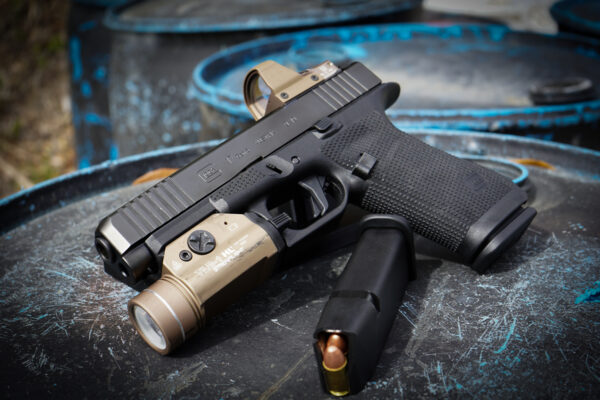
Springfield Echelon 9mm handgun equipped with a SilencerCo Spectre 9 Suppressor and a Shield RMSc red dot.

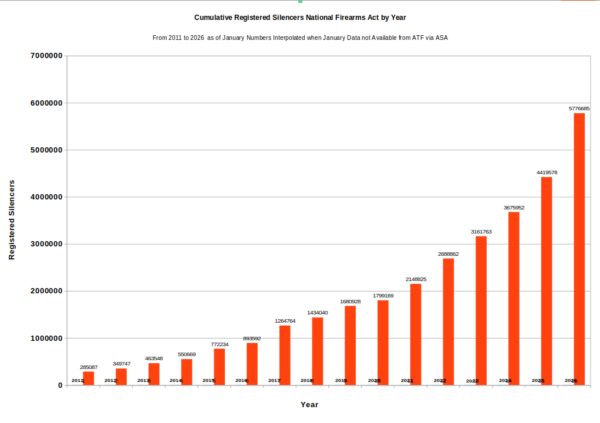
According to the American Suppressor Association (ASA), the number of silencers/suppressors registered in the United States of America was 5,776,685 as of the time the Bureau of Alcohol, Tobacco, Firearms, and Explosives (ATF) responded at the SHOT Show in January of 2026.

This correspondent obtained information from the ATF on January 22, 2026. At that time, it was stated that the information had already been released and that over 150K National Firearms Act (NFA) applications had been approved through January 2026.

The graph of registered silence numbers was created using cumulative January counts from 2011 to 2026. When numbers were unavailable for January, linear interpolation was used to estimate the January number. Each year had at least one reference number. 2017 had three reference numbers, none of them for January.

Cumulative Registered Silencers National Firearms Act by YearImage by Dean Weingarten

The number of registered silencers has been growing at about 22.6% per year.  That rate is roughly equivalent to doubling every 3.2 years.  If such a rate continues, there will be about 50 million registered silencers ten years from now.

It is unlikely there will be 50 million registered silencers ten years from now. This correspondent believes the registration requirement will be removed well before 10 years. It could be removed within two years, given the lawsuits now in play. 50 million silencers in the hands of American gun owners, ten years from now, is plausible.

Silencers are very popular firearm safety accessories when they are not restricted by oppressive governmental policies.  Silencers can be made inexpensively with economies of scale. Even the best, most technologically advanced silencers/suppressors will come down in price as economies of scale come into play.  In New Zealand, silencers had, until 2019, been an over-the-counter commodity, similar to purchasing a rifle scope in the United States. Silencers were relatively cheap.  From a Gun Watch article in 2015:

Silencers are often referred to as suppressors. The best descriptive term is gun muffler. In New Zealand, which has a strong tradition of gun ownership, gun mufflers are unregulated and cheap. They are for sale over the counter or in the mail. The above ads or similar ones can be seen on the online buying and selling site for New Zealand, trademeco.nzFrom trademe.co.nz . . .

This Silencer will fit any centrefire rifle with 17CM of exposed barrel with a diameter smaller than 19mm.

Takes away the loud crack (down to about a 22 magnum noise) and helps protect your ears from permanent hearing loss.

Super strong tooling grade alloy construction designed to withstand bursts of Full Auto fire, making it virtually indestructible on a hunting rifle and keeping the weight down to just 370 grams.

There is no licence required to purchase these in New Zealand.

Rimfire gun mufflers are commonly available for under $20. Consider that a New Zealand dollar is current valued a .65 U.S. dollars.

Silencer prices in New Zealand have increased, but they are still available through the mail.  The exchange rate is now about .59 USD to 1 New Zealand Dollar. At the current exchange rate, quality .22 rimfire suppressors can be had for about $36 USD, and quality high power rifle suppressors can be purchased for prices ranging upward from $120. The highest price showing was about $450 USD.  The New Zealand market is tiny compared to the United States. About 400,000 people in New Zealand are firearms owners, with about 1.77 million firearms.

Current prices for a silencer in the United States run about $350 to $2000. Those prices will drop with deregulation and economies of scale.

There are over a hundred million gun owners in the United States, with over 540 million firearms. A market for 50 million silencers in the United States, once the regulatory burden is removed, is entirely possible.


About Dean Weingarten:

Dean Weingarten has been a peace officer, a military officer, was on the University of Wisconsin Pistol Team for four years, and was first certified to teach firearms safety in 1973. He taught the Arizona concealed carry course for fifteen years until the goal of Constitutional Carry was attained. He has degrees in meteorology and mining engineering, and retired from the Department of Defense after a 30 year career in Army Research, Development, Testing, and Evaluation.

Dean Weingarten


from https://ift.tt/KZ7kGXh
via IFTTT