Tuesday, December 30, 2025

Firearms Instructors Talk Changes Coming in 2026

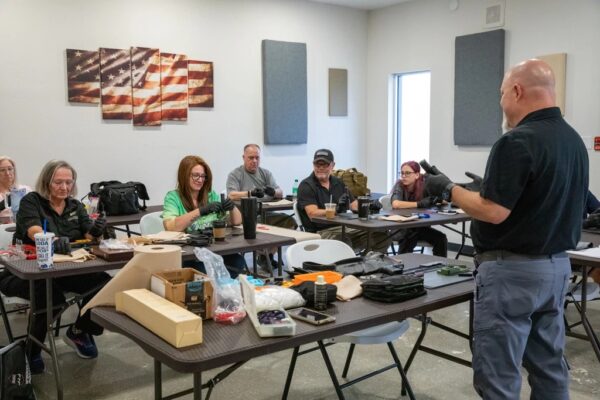
Longtime firearm instructor Mike Magowan teaching at Self Defense Emporium. (Photo courtesy Mike Magowan).

Our country was much more troubled and dangerous when Joe Biden was president, but thankfully times have changed, according to several current and former firearm instructors.

“There was a lot more concern about how things were going to go,” said Mike Magowan, chief operations officer for Florida’s Self Defense Emporium. “There’s not as much panic now as there was then.”

Magowan has taught more than 30,000 students how to shoot safely over his 30-year career. He started as a sniper in the U.S. Army’s 101st Airborne Division and has earned a host of national certifications and accreditations.

He and several other instructors discussed current trends and predicted what will happen in 2026.

Suppressors were a common topic, especially if they finally end up outside of federal purview and can be purchased easier. Everyone mentioned teaching a fully-suppressed class.

The largest national trend that’s occurring right now involves smaller 9mm high-capacity handguns specifically made for concealed carry. Everyone predicts their popularity will continue to grow throughout the new year.

There are dozens of models available from a large portion of the firearms industry, and prices range from several hundred dollars to several thousand. These smallish shooters, everyone said, will dominate the market.

“People are looking for smaller pistols with more capacity,” Magowan said. “We’re still riding the Sig P365 wave. There are a lot of people coming in for CCW training and permits. The trend is definitely small pistols that hold lots of bullets.”

The firearms market has become much more stable now that Biden is out of office, according to retired instructor and gun shop owner Mike Young.

“The market was always the same whenever there was a Democrat in office. Prices would go up and things would get scarce,” Young said. “I remember when Obama was elected. You couldn’t even get .22. It’s always weird when you have a Democrat leading the White House, and smooth sailing when you don’t.”

The biggest national trend, Young said, will be the ability to buy guns, ammunition and related products without having to worry that the government will try to take them away.

“That’s a big win for all of us,” he said.

Finding the right instructor, everyone said, can be difficult, but it is well worth the time and effort. The key is talking with them before you meet at the range.

“I would ask how long they’ve been teaching and why are they teaching,” Young said. “I loved selling guns but loved teaching classes much more. You’d see that person get it and the light would turn on. It made it the best. That should be the biggest question: Why are you doing this? Do you love it or are you trying to earn a paycheck? I loved it and miss it every day. I miss the interaction with students and customers.”

Magowan mentioned that one of his former students recently walked out of another instructor’s $600-per-day class because he did not feel safe.

“What I tell people is to make sure your instructor actually cares about what you’re getting out of it,” he said. “I would rather teach for free than not have students get their money’s worth. I want an instructor who is going to move me forward with the right techniques and tactics. I want someone who actually cares about me, not a big résumé guy. I’ve seen guys with massive résumés who actually suck at teaching.”

Everyone warned about online or “Instagram instructors” who can actually harm the industry.

“They’re people who just want to do flashy things with no purpose,” Magowan said. “These are guys who shoot fast but don’t ever show you their targets.”

This story is presented by the Second Amendment Foundation’s Investigative Journalism Project and wouldn’t be possible without you. Please click here to make a tax-deductible donation to support more pro-gun stories like this.


About Lee Williams

Lee Williams, who is also known as “The Gun Writer,” is the chief editor of the Second Amendment Foundation’s Investigative Journalism Project. Until recently, he was also an editor for a daily newspaper in Florida. Before becoming an editor, Lee was an investigative reporter at newspapers in three states and a U.S. Territory. Before becoming a journalist, he worked as a police officer. Before becoming a cop, Lee served in the Army. He’s earned more than a dozen national journalism awards as a reporter, and three medals of valor as a cop. Lee is an avid tactical shooter.

Lee Williams


from https://ift.tt/WhDgi0f
via IFTTT

What Happened to the Homicide Rate After the Supreme Court’s Bruen Decision?

An embarrassing report at RealClear Investigations has revealed the FBI has had to "quietly" revise its violent crime report for 2022 upward. iStock-1481901203
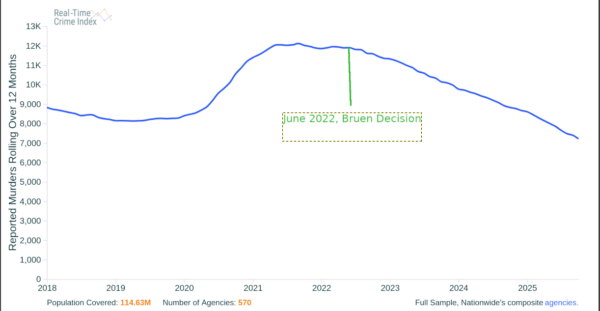
According to the latest numbers from the Real Time Crime Index as of October 2025, the 12-month running average of violent crime has decreased by 14% since June 2022. iStock-1481901203

On June 23, 2022, the Supreme Court of the United States (SCOTUS) issued a decision in N.Y. State Rifle & Pistol Ass’n v. Bruen. Prior to the Bruen decision, Courts of Appeal in Progressive-dominated Circuits, such as the Ninth and Second circuits, had refused to honor Second Amendment precedent established in the Heller and McDonald decisions. Bruen admonished the lower courts for creating a procedure to treat the Second Amendment as a second-class right. Bruen created a simple test to determine if a statute was allowed by the Second Amendment.

The Bruen case clarified that “bear” in the “right to keep and bear arms” protected the right to be armed in public places with arms that can be carried by or on a person. The limitations to this right were stated to be the same limitations as they were understood by the public in 1791 when the Bill of Rights was ratified.  Anti-Second Amendment pundits predicted more violent crime and homicides.

As of the latest numbers from October 2025, the 12-month running average of violent crime has dropped 14% since June 2022. The drop in murders is even more pronounced at 39%. The numbers are from the tools provided by the Real Time Crime Index.

Chart produced with tools provided at Real Time Crime Index. Time of Bruen decision added

The index does not track all crime. It tracks a sample using the numbers provided by 570 agencies. The relative proportions of the sample are said to track within 2% of the proportions of FBI numbers in the Uniform Crime Reports.  Agreement to within 2% of overall proportions, in this sort of measurement, is quite good. If the Real Time Crime Index shows a rise or fall in crime numbers, it essentially mimics what is happening in the FBI numbers. The 570 reporting agencies cover over half of the crimes reported in the United States.

After the initial wave of anti-Second Amendment propaganda subsided, approval of the Bruen decision returned to about 2/3 of the respondents. The Second Amendment is popular in the United States of America.

The drop in violent crime and in homicides is coincident with the implementation of the Bruen decision. It started before President Trump was elected to his second term. It is also coincident with the election of a Republican majority in the House of Representatives, which placed some restraint on the excesses of the Biden administration. 2022 is also coincident with a retreat from some of the anti-police and pro-criminal policies pushed by what became known as “Soros” prosecutors, such as Kimberly Gardner in Saint Louis, Missouri.

Cause and effect are not easy to determine. A return to the rule of law is clearly effective in reducing crime.  The far-left notion of police as the cause, rather than the cure for crime, has not held up in real-world situations. It cannot be proven that the Bruen decision was instrumental in reducing violent crime and homicides. The fact that violent crime and homicides fell after the Bruen decision makes it unlikely that the restoration of rights protected by the Second Amendment increases violent crime.

It is more likely that the restoration of rights protected by the Second Amendment is a contributor to lower violent crime and homicide rates.


About Dean Weingarten:

Dean Weingarten has been a peace officer, a military officer, was on the University of Wisconsin Pistol Team for four years, and was first certified to teach firearms safety in 1973. He taught the Arizona concealed carry course for fifteen years until the goal of Constitutional Carry was attained. He has degrees in meteorology and mining engineering, and retired from the Department of Defense after a 30 year career in Army Research, Development, Testing, and Evaluation.

Dean Weingarten


from https://ift.tt/mnahJYP
via IFTTT

Bill Bachenberg, NRA President, Addresses Magazine Distribution

Doug Hamlin and Bill Bachenberg at the 2025 Liberty Bell Friends of the NRA Dinner – Credit John Petrolino

In October, we reported on changes coming to the National Rifle Association. NRA President Bill Bachenberg recently revisited the topic as members have been seeking answers on magazine distribution changes.

Fiscal Responsibility

As previously reported, the October announcement had to do with balancing the NRA’s budget and being good stewards of members’ donations. Part of those changes included migrating NRA Publications into a new division, NRA Media. Waste was cut and funds go further under a leaner NRA. Unfortunately, some furloughs came with the changes at the Association.

Bachenberg is leveraging the positions that many Board of Director members have. The Association is well-positioned; many directors have experience in the business world.

“We’ve got really great business people,” Bachenberg said during October’s interview. “Our Finance Chairman, I think he’s turned around five different companies, right? So he’s acquired failing companies and turned them around.”

What About Inflation?

If the NRA had kept up with inflation, Bachenberg said, a $35.00 membership from the early 1990s would cost members $62.00 today. A life membership that has remained $1,500.00 for over three decades would cost $3,700.00.

In order to continue to provide value to members without increasing membership costs is what Bachenberg attributed to in part for the cuts.

Cutting Magazines

“There has been a lot of chatter on the Magazine changes,” Bachenberg said in an email to AmmoLand News. “Here is some background for your readers.”

Bachenberg said in a letter he shared that the cutting back from four to two magazines was a difficult decision. The two titles that NRA will maintain are “American Rifleman” and “American Hunter.” Magazines will be cut from a monthly to a quarterly distribution Bachenberg said.

A Focus on Digital

Older members are used to getting hard copies of the magazine, Bachenberg admits being one. However the focus is shifting with current trends and the new generation of gun owners are living in a digital world. The benefits of focusing on video and other embedded content options were highlighted by Bachenberg.

Bachenberg’s Letter

The letter that Bachenberg shared with AmmoLand News, he said, was sent to the members of the Board of Directors. “It went to the board without restriction for the members,” Bachenberg said and he encouraged directors to share his message.

The Letter in Full

Why there was a change to magazine distribution?

Dear NRA Member:

Many members are asking why the changes in magazine circulation, here is a little background of what got us here today.

In the early 1990s an annual NRA membership was $25, just to keep up with inflation an annual membership would be around $62, today an annual membership is available for as low as $35 a year.  Similarly, a Life membership was $1,500 back then. Today, with inflation, a Life membership would be $3,700 dollars. Today a Life membership is still $1,500.

For around 10 cents a day, your annual member dues help defend your God-given Second Amendment rights and provide great programs in Education & Training, Women & Youth programs, Edie Eagle®, Refuse to be a Victim® and Women-On-Target® to name a few, plus a great magazine.

NRA has been producing a magazine starting in 1885 called The Rifle that continues today as the American Rifleman. American Hunter was first published in October of 1973. During the 1980s and ’90s the NRA published additional targeted magazines. Back then, paper and postage was relatively cheap, and gas was 36 cents a gallon. Today paper is about six to seven times more expensive, and a first-class stamp went from 6 cents to 78 cents, a 13 times increase. NRA has been subsidizing the cost of production for the magazines for many years, it has now gotten to a point that we cannot in good conscious continue funding the magazines instead of fully funding our programs that members are demanding.

This was not an easy choice on how to cover publishing costs without significantly increase membership dues or charging 20 plus dollars for a magazine subscription. Leadership has a responsibility to our members to be efficient and effective with your dues and donations. Our older members (like me) want paper and the younger generations want a digital experience. We endeavored to meet each demographic need, four physical magazines and 12 digital magazines for all members. What is exciting about digital magazines is that we can include video and sound in the articles. Your digital experience can now contain more current news, not news that is two months old due to publishing deadlines. Our advertisers can now advertise like on TV instead of one-dimensional paper ads.

As we have publicized, the publication group at NRA will be moving content from the discontinued magazines to the American Rifleman or the American Hunter and to the digital delivery format, so not all is lost. We knew for some this would not be popular, but we had to make the hard decisions so we could still publish a paper magazine, maybe not on the frequency you were used to, but you are getting a paper magazine four times a year when most organizations have discontinued their magazine.

Again, while this was a gut wrenching decision, we believe it was made in the best interest of the members.  Please give the digital format a try on your computer or mobile device.

Thank you,

Bill Bachenberg
NRA President

The NRA President Wants to Hear From You!

In September we reported on the NRA President’s page that Bachenberg released. In attempts to increase transparency and connect with members in a more meaningful way, Bachenberg created — and paid for himself — a president’s webpage where the members can get information from him directly. Members who are interested can visit NRAPresident.com and check it out for themselves.


About John Petrolino

John Petrolino is a US Merchant Marine Officer, writer, author of Decoding Firearms: An Easy to Read Guide on General Gun Safety & Use and NRA certified pistol, rifle, and shotgun instructor living under and working to change New Jersey’s draconian and unconstitutional gun laws. You can find him on the web at www.johnpetrolino.com on twitter at @johnpetrolino, facebook at @thepenpatriot and on instagram @jpetrolinoiii .John Petrolino


from https://ift.tt/TaU5yMt
via IFTTT

CCRKBA: Penalize N.Y. for Freeing Criminals Who Offend in Other States

Jail-Court-iStock-1135489412

Liberal Congressional hopeful Jack Schlossberg—grandson to President John F. Kennedy—wants to make political hay by demanding that states with so-called “weak gun laws” should be penalized because guns from those states end up used in crimes in New York, but the Citizens Committee for the Right to Keep and Bear Arms says he has it backwards.

Schlossberg is campaigning to succeed Democrat Jerrold Nadler, longtime representative from New York’s 12th District, who is retiring and will not run in 2026. Schlossberg made headlines in the New York Post by declaring, “There’s an illegal flow of guns into states across the country from a couple states with weaker gun laws. We should at least have a penalty to make sure that we can fund enforcement of this common sense idea.”

However, CCRKBA Chairman Alan Gottlieb countered, “How about penalizing New York for all the criminals they release on cashless bail, who then commit crimes in other states?”

The veteran gun rights advocate said New York doesn’t have a “gun problem, it’s got a criminal justice problem.”

Earlier this year, President Trump signed an executive order directing Attorney General Pam Bondi to submit a list of states and local jurisdictions which “substantially eliminated cash bail as a potential condition of pretrial release from custody for crimes that pose a clear threat to public safety and order, including offenses involving violent, sexual, or indecent acts, or burglary, looting, or vandalism.”

“Schlossberg is pandering to far-left Democrats with his gun control idea,” Gottlieb observed, “rather than acknowledge it is liberal Democrat policies which have allowed repeat offenders to roam the streets of America, committing crimes and bringing misery to honest people, many of whom have purchased firearms to protect themselves from recidivist criminals who should be doing time in Empire State jails and prisons.

“New York’s criminal justice system is a train wreck,” he added, “and everybody knows it. While prosecutors and courts go light on repeat offenders, politicians in Albany and New York City go hard on law-abiding citizens for exercising their Second Amendment rights. It’s time to hold the New York political establishment accountable for the trouble it causes, instead of penalizing states which recognize the rights of law-abiding citizens.

“President Kennedy, who was Schlossberg’s grandfather and an NRA member, is probably shaking his head and rolling his eyes in Heaven,” Gottlieb concluded.


Citizens Committee for the Right to Keep and Bear Arms

With more than 650,000 members and supporters nationwide, the Citizens Committee for the Right to Keep and Bear Arms (www.ccrkba.org) is one of the nation’s premier gun rights organizations. As a non-profit organization, the Citizens Committee is dedicated to preserving firearms freedoms through active lobbying of elected officials and facilitating grass-roots organization of gun rights activists in local communities throughout the United States.Citizens Committee for the Right to Keep and Bear Arms


from https://ift.tt/tDZ20BQ
via IFTTT

Monday, December 29, 2025

By Denying Information in FOIA Request, Pirro and DOJ Refuse to Define Restoration of Rights Eligibility

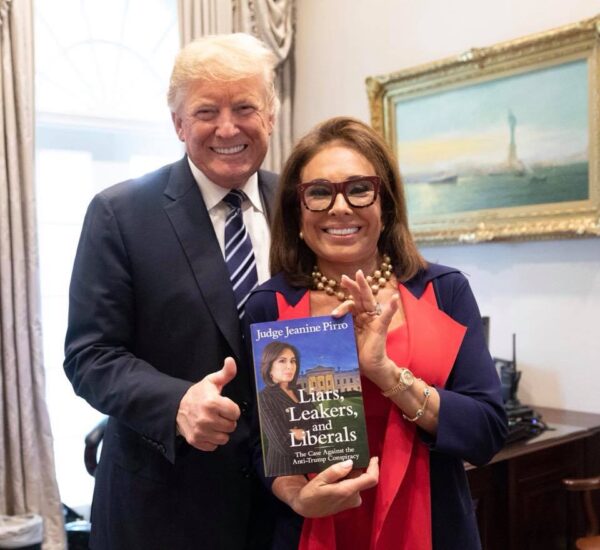
Why do gun owners even need a FOIA request and a lawsuit to find out what they need to do to have their rights restored by a “pro-gun” administration? Why won’t they just tell us? (Judge Jeanne Pirro/Facebook)

“No response is required…  Plaintiff is not entitled to compel the production of any record… This Court lacks subject matter jurisdiction… Plaintiff is neither eligible for nor entitled to attorney’s fees [and] Plaintiff’s request is improper to the extent is it unduly burdensome,” US Attorney Jeanine Ferris Pirro and Assistant US Attorney John J. Pardo  argue in the Department of Justice’s answer, filed Dec. 19 in the United States District Court for the District of Columbia. The response was to a complaint filed by attorney Stephen Stamboulieh on behalf of this correspondent after a Freedom of Information Act request to determine rights restoration eligibility criteria was ignored.

Because it’s so easy to end up on the prohibited persons list (including the innocent pleading out to avoid great expense and threatened draconian punishment if they lose), it seemed in the interests of gun owners to know what criteria were used and who is likely to be eligible for consideration. DOJ, despite publicizing its championing of rights restoration, officially disagrees.

The initial request was submitted in April after the Justice Department had announced it had “identified ten (10) individuals for firearm restoration [actor Mel Gibson among them],” and said that the “Attorney General has reviewed all the relevant facts for each individual … including the materials that each individual submitted seeking either a pardon or relief from federal firearms disabilities…”

Left undefined was what criteria citizens seeking similar relief would need to meet to be considered for equal treatment. To that end, a FOIA request was filed asking for:

  • All records “reviewed” by the Attorney General for each individual listed in the filing;
  • All records “that each individual submitted” to receive relief under 18 U.S.C. 925(c); and
  • All other records not “submitted” by the list of individuals but relied upon by the Attorney General in establishing that “each individual will not be likely to act in a manner dangerous to public safety and that the granting of the relief to each individual would not be contrary to the public interest.”

Receipt of the request was acknowledged by DOJ in early May, but was not fulfilled within the 20  business days period required by law, so a complaint asking for  “injunctive and other appropriate relief and … the disclosure and release of agency records improperly withheld from Plaintiff … regarding the department’s decision-making criteria for firearm disability relief actions,” was filed on September 25. That the response was not made sooner is due to the government shutdown of October and November.

DOJ’s December 19 standard denial answer submitted to the court says it has no intention of providing its criteria for rights restoration unless ordered to do so, and Stamboulieh will meet and confer with the Assistant US Attorney on the case to discuss what the next steps are.

Pirro’s position is consistent with not just the DOJ’s bipolar inconsistency on the Second Amendment, but also her own.

In 2000, as Westchester County (NY) District Attorney, she administered a “gun buyback/amnesty” program. In 2004, she joined with New Yorkers Against Gun Violence “to commemorate the five-year anniversary of the Columbine High School Massacre… and strengthening of the federal assault weapons ban.”  By 2006, with her sights set on higher political office, she began trying to distance herself by touting her gun owner creds. By 2013, she was wowing the crowd at NRA’s Second Amendment Leadership Conference, and then in 2019, she was arguing for “expanded background checks” while asserting, “I’m in Australia, they don’t have problems like this. This is starting to be a uniquely American situation. I am a gun owner and strong Second Amendment person.”

None of this is to disparage good and unprecedented positions being taken by DOJ that would never have happened under any other administration to date, but that does not require Second Amendment advocates to turn a blind eye to when those positions turn cognitively dissonant. Without pointing those out, much damage and bad precedent from “friendly fire” can hurt gun owners just as much, if not more, than infringements enacted by flat-out gun prohibitionists.

Even if DOJ does manage to come up with a clearly defined rights restoration process (and if Republicans survive the midterms and retain the presidency in ’28), don’t look for that to be the end of anything. Expect Democrat states to not recognize restored rights and for further legislation and court battles to go on and on and on. Which is why gun owners serious about their rights will never be able to relax regardless of who’s “in power,” and must forever commit themselves to “Guard with jealous attention the public liberty. Suspect everyone who approaches that jewel.”

“Everyone.” Not just Everytown.

The DOJ answer to the complaint follows:


About David Codrea:

David Codrea is the winner of multiple journalist awards for investigating/defending the RKBA and a long-time gun owner rights advocate who defiantly challenges the folly of citizen disarmament. He blogs at “The War on Guns: Notes from the Resistance,” is a regularly featured contributor to Firearms News, and posts on Twitter: @dcodrea and Facebook.

David Codrea


from https://ift.tt/zUtpLm7
via IFTTT

Minnesota Governor Resorts to Executive Power After Losing Legislative Support

Minnesota Governor Resorts to Executive Power After Losing Legislative Support

Gov. Tim Walz confronted a stark political reality when he recently signed two executive orders dealing with gun control, a move that exposed his inability to advance his gun control agenda through the Minnesota State Legislature. The executive actions represent an acknowledgment that Walz lacks the votes necessary to pass his proposed restrictions on firearms and ammunition through normal legislative channels, thereby forcing him to pursue unconstitutional executive power grabs.

The governor took action on December 16, 2025, after months of failed attempts to build legislative support for restrictions on so-called “assault weapons” and high-capacity magazines. His orders create a statewide safety council to examine gun violence and call for tracking the costs of firearm-related incidents while funding gun storage education programs. One measure promotes red flag laws, court directives that temporarily remove firearms from individuals deemed dangerous.

The political mathematics behind Walz’s executive strategy became clear when examining the composition of the Minnesota State Legislature. Democrats maintain only a precarious 34-33 advantage in the State Senate, while Republicans command a 67-65 majority in the State House. This divided government reality means Walz cannot advance gun control legislation through both chambers, leaving executive orders as his only remaining option to pursue his firearms agenda.

Walz attempted to frame his actions as protective rather than restrictive. “These actions today don’t limit your freedoms at all. Being shot dead in your school certainly does,” Walz said. “There’s no one fix to this, but there are certainly things that we know. There are certain things we’ve learned globally that make a difference, and these two actions will be another step in that direction.”

The governor’s efforts originated from the deadly mass shooting at Minneapolis’ Annunciation Catholic Church and School in late August. For months following that tragedy, Walz pursued legislative support for a special session dedicated to passing new gun laws, but those attempts collapsed amid Republican opposition and uncertainty about whether all Democrats would support his proposals in the evenly divided chambers.

Republicans dismissed the executive orders as political theater that avoided addressing underlying causes of violence. Senate Minority Leader Mark Johnson of East Grand Forks criticized the approach in a written statement. “Executive action to study and educate the public on gun safety are not actual solutions to keeping kids safe in school,” Johnson said. “Addressing mental health, intervening before a crisis turns violent, and active safety protocols are real solutions that Republicans support to keep our kids safe.”

The Minnesota Gun Owners Caucus characterized the orders as deliberately modest to avoid provoking legal challenges. Bryan Strawser, the caucus chair, declared in a statement that “What we got today were low-impact orders that serve more as political cover than meaningful policy. It’s a distraction from the fact that the governor couldn’t build support for his agenda within his own party.”

Minnesota GOP Chair Alex Plechash described the executive orders as a “clear admission of weakness” reflecting Walz’s failure to secure support from his own party for a special session that would have pursued “an extreme, partisan gun ban.” Republicans repeatedly challenged Walz to produce formal legislation detailing which specific firearms he sought to prohibit and implementation procedures, demands the governor never fulfilled.

Walz had vowed to pursue gun control measures “one way or another” after the Annunciation shooting and discussed calling a special session throughout the fall. However, House Republicans rejected the prospect of a session focused exclusively on the governor’s priorities, and questions persisted about whether Walz commanded unanimous Democratic support in both the narrowly divided chambers.

The governor expressed frustration with the legislative stalemate while committing to renewed efforts when lawmakers reconvene in February 2026. Of the affected families attending Tuesday’s announcement, Walz said, “There’s frustration, and I have told them it’s my responsibility to do all I can to move it. will do what I can do. We did a lot of research on these. It’s taken a while to make sure we were locked in on what we were able to get, but we’ll continue to do more of it. It’s the proliferation of parents. They expect action. They expect us to do things.”

The executive orders stand as evidence that Walz’s gun control ambitions have collided with the structural realities of Minnesota’s divided legislature, where neither party possesses the unified control necessary to advance sweeping firearms restrictions. For the time being, gun owners in Minnesota can breathe a sigh of relief knowing that gun control won’t be expeditiously passed in the near future.


About José Niño

José Niño is a freelance writer based in Charlotte, North Carolina. You can contact him via Facebook and X/Twitter. Subscribe to his Substack newsletter by visiting “Jose Nino Unfiltered” on Substack.com.

José Niño


from https://ift.tt/JPoDma2
via IFTTT

The Necessity of Protecting Private Arms Possession in the United States: A Defense of Rights and Security

Opinion by Alan J Chwick

The Necessity of Protecting Private Arms Possession in the United States: A Defense of Rights and Security, iStock-917198934

In the ongoing debate surrounding gun ownership in the United States, one fundamental question persists: Why is it necessary to protect private arms possession? The answer to this question is far from simple, as it is deeply intertwined with the nation’s history, cultural values, and individual rights. Protecting private arms possession serves several vital purposes, from individual security to the broader principle of liberty itself.

The right to bear arms is enshrined in the Second Amendment of the U.S. Constitution, which reads: “A well regulated Militia, being necessary to the security of a free State, the right of the people to keep and bear Arms, shall not be infringed. While the historical context of this clause is often debated, it is widely understood that the framers of the Constitution saw an armed populace as a safeguard against tyranny.

Beyond the historical precedent, the right to own firearms is an expression of personal liberty. In many ways, it is an extension of self-determination, allowing individuals to defend themselves, their families, and their property. Whether against natural disasters, criminal activity, or even the overreach by an oppressive government, private arms ownership offers an important layer of autonomy that allows individuals to protect their lives and freedoms.

In a world where law enforcement can’t always be at the scene of a crime, and it is also important to understand that law enforcement does not have a legal obligation to protect an individual citizen unless a special relationship has been established, such as through an arrest or a promise of protection. Their duty is generally to protect the public as a whole rather than specific individuals. So, the ability to defend one’s self is a cornerstone of personal security.

While the vast majority of gun owners do not use their firearms for illegal purposes, they possess their weapons for self-defense, hunting, or sport shooting, activities that have been part of American life and culture for generations. When we examine crime statistics, one of the most compelling reasons for private gun ownership is the deterrent effect firearms can have. Criminals are less likely to target homes or individuals who may be armed and capable of defending themselves.

A survey from the National Research Council found that firearms are used in self-defense anywhere between 500,000 and 3 million times per year in the United States, though the latter number is disputed. Nevertheless, it suggests that private gun ownership does play a crucial role in deterring crime and ensuring personal safety, especially in situations where waiting for law enforcement intervention would be too late.

The protection of private arms possession is also essential to maintaining a balance of power in society. Governments, even those founded on democratic principles, have historically abused their authority when unchecked by an armed populace. The argument is not that the United States is on the brink of tyranny, but rather that the presence of an armed citizenry serves as a check against potential abuses of power.

While the chances of a totalitarian regime emerging here is slim, the mere idea that citizens are empowered to resist overreach provides a sense of security in the nation’s foundational principle of self-governance. This is not to suggest that all gun owners would take up arms against the government, but rather that the right to bear arms ensures that power is always held in balance and that citizens have the means to protect their liberties if necessary.

Beyond security and philosophical considerations, the right to own firearms has a deep economic and cultural impact on the United States. The firearms industry contributes billions of dollars annually to the U.S. economy, providing jobs, tax revenue, and goods that support related sectors such as manufacturing, retail, and tourism. Many states also rely on hunting and shooting sports as important sources of both revenue and community identity.

Gun ownership, in its various forms, also fosters a sense of responsibility, self-discipline, and community. Programs such as firearm safety courses and shooting competitions teach participants not just about weapons, but about respect, responsibility, and how to handle power with care. For many, these activities are more than hobbies; they are a vital part of their cultural heritage.

While it is clear that the right to own firearms should be protected, this does mean that responsible ownership is necessary. The challenge here lies in striking a balance between public safety and respecting constitutional rights. Gun control measures may help to mitigate the risks associated with firearm ownership, but any measures that infringe the rights of law-abiding citizens must be avoided at all costs. REMEMBER, the Second Amendment is a natural, God given, RIGHT, and NOT A GOVERNMENTAL PRIVILEGE!

The key to responsible gun ownership, which requires individuals to understand the potential risks involved, is to act within a framework that promotes safety and accountability. Increased investment in education, mental health services, and community-based violence prevention programs could go a long way toward ensuring that firearms are kept out of the wrong hands, while still preserving the RIGHTS of those who use them responsibly.

The protection of private arms possession in the United States is more than just a matter of politics; it is a matter of principle. At its core, the right to own firearms is tied to the very ideals of personal freedom, security, and the preservation of liberty. The Second Amendment was not written for a time when muskets were the only form of weaponry, but for a society where citizens must remain vigilant in protecting their rights.

While the debate over gun control will likely continue for the foreseeable future, we must recognize that protecting the right to bear arms is essential to maintaining the freedoms that define the American experience and its culture. By ensuring responsible ownership and reasonable regulation, we can uphold this right while also making strides toward a safer, more secure society.

See also:

“Congress Shall Make No Law” vs. “Shall Not Be Infringed”

U.S. Second Amendment: Means ALL Weapons & ZERO Infringements ~ VIDEO

Your Moral Right To Keep & Bear Firearms In The United States


About Alan J. Chwick:

Alan J. Chwick, A.S., B.S., FL/NY/SC Paralegal is known for his involvement in legal articles usually related to firearm regulations and for his contributions to discussions on gun rights. Retired Managing Coach of the Freeport NY Junior Marksmanship Club (FreeportJuniorClub.org). Escaped New York State to South Carolina and is an SC FFL & Gunsmith (Everything22andMore.com).


from https://ift.tt/gdyOqcK
via IFTTT

Sunday, December 28, 2025

“Aloha Spirit” or the Second Amendment? Hawaii’s Fantasy Hits the Supreme Court in January

The state of Hawaii has finally filed its Respondent’s Brief in Wolford v. Lopez, which is scheduled for oral arguments before the Supreme Court on January 20, 2026.

At issue is Hawaii’s broad expansion of “sensitive places” to all private property, making it a de facto gun-free zone. The Hawaii law (and the state’s brief) does not differentiate between private property open to the public (stores, restaurants, etc.) and private homes. This means anyone carrying a firearm must first obtain the permission of the property owner or the owner’s representative before they can enter the premises.

Hawaii was one of the states that exploited what it considered to be loopholes in the Supreme Court’s ruling in New York State Rifle and Pistol Association v. Bruen.* Indeed, the state’s brief asserts Hawaii was doing the public a service by saving them the trouble of saying “no.”

The 44-page brief contends Hawaii’s law is consistent with the Second Amendment — if you look at it the right way or have a very unusual definition of “shall not be infringed.”

The state’s attorneys present some state laws, including a post-Civil War Jim Crow law from Louisiana. They claim these prior statutes are sufficiently analogous to meet the Bruen standard.

This is going to be one of the most critical outcomes of Wolford. Bruen set a standard; Rahimi blurred it: Can the Supreme Court set a benchmark that will be a bit more difficult for anti-gun politicians and judges to pervert?

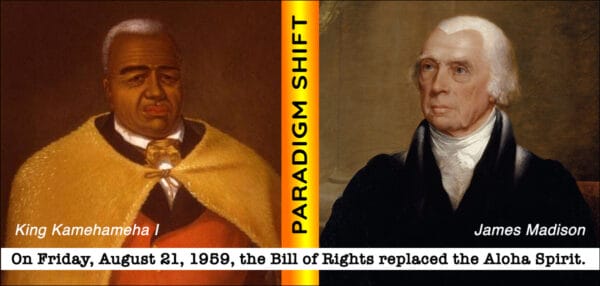
As is SOP in these cases, the attorneys invoke Hawaiian culture, saying polls show most Hawaiians oppose public carry. This is consistent with the “Aloha Spirit” theme used by the Hawaii Supreme Court’s 2024 ruling in Wilson v. Hawaii.

In a flight of judicial fantasy worthy of Samuel Taylor Coleridge at his opium-addled best, Hawaii’s top court said the state’s constitution did not include an individual right to keep and bear arms and so Hawaii didn’t have to recognize the right in the federal constitution. The court also invoked 19th-century Hawaiian kings and their edicts, which generally prohibited possession and carrying of dangerous weapons. Over multiple generations, this became embedded in general society. The Hawaii Supreme Court called it the “Aloha Spirit” and said it meant Hawaii didn’t have to adhere to the federal version.

History shows that Hawaii is not only bound by the federal constitution, more than 90% of its citizens approved it. It wasn’t really all that new: Hawaii had been a U.S. territory since 1893.

Act of March 18, 1959 (now Public Law 86-3, 73 STAT 4) An Act to provide for the admission of the state of Hawaii into the Union.

Passed by the Senate on March 11, 1959; passed the House on March 14; signed into law by President Eisenhower on March 18, 1959; overwhelmingly approved by popular vote of Hawaiian citizens on June 27; proclamation of admission signed by President Eisenhower on August 21, 1959.

“§3. The constitution of the State of Hawaii shall always be republican in form and shall not be repugnant to the Constitution of the United States and the principles of the Declaration of Independence.”

I feel certain the “Aloha Spirit” would be repugnant to the Constitution and the Declaration of Independence would be at least somewhat miffed by the Hawaii Supreme Court’s cavalier disregard of a fundamental human right.

That’s the whole agreement between the United States and Hawaii as it pertains to the Constitution. Note there’s not a single mention of the “Aloha Spirit.”

As of December 15, 1791, the Bill of Rights, including the Second Amendment, was incorporated into the Constitution. As of June 28, 2010, the Second Amendment was incorporated into the Fourteenth Amendment under its Due Process Clause, making the peoples’ right to keep and bear arms binding on Hawaii. Still no mention or carve-out for the “Aloha Spirit.”

In fairness, it is within the realms of possibility Hawaii’s legal eagles overlooked Article IV, Clause 2 of the U.S. Constitution. After all, it’s pretty short and it’s buried in with all those other sections and clauses. Nonetheless, it’s fairly important: Most people know it as the Supremacy Clause:

“This Constitution, and the Laws of the United States which shall be made in Pursuance thereof; and all Treaties made, or which shall be made, under the Authority of the United States, shall be the supreme Law of the Land; and the Judges in every State shall be bound thereby, any Thing in the Constitution or Laws of any State to the Contrary notwithstanding.”

Could this mean the “Aloha Spirit” is irrelevant when it comes to the Second Amendment? Why, yes, it could.

Did Hawaii’s state attorneys find their law degrees in boxes of Cracker Jack or did they get them through correspondence courses at the University of Green Stamps? In either case, they should be recognized for their complete lack of shame over filing this response.

*[Considering how frequently legislators and jurists spin those words and phrases into something completely different, it might be handy for the Supreme Court to start producing a ‘dummies” version with each decision.]


About Bill Cawthon

Bill Cawthon first became a gun owner 55 years ago. He has been an active advocate for Americans’ civil liberties for more than a decade. He is the information director for the Second Amendment Society of Texas.Bill Cawthon


from https://ift.tt/x18MPLD
via IFTTT

Friday, December 26, 2025

Deflating Another Gun Control Bogeyman

Deflating Another Gun Control Bogeyman

There is a problem with the term “gun violence.” Not just the term itself, but the whole idea that firearm-related injuries and deaths are qualitatively different or special. Violence is violence regardless of the weapon or method used.

Gun violence is a handy bogeyman for gun control and other groups advancing similar agenda. By lumping homicides, suicides, and accidents together, gun grabbers of every stripe can use this family-sized phantasm to alarm the public. Even better, it can be used to make a variety of claims since the overwhelming percentage of Americans won’t check the underlying numbers.

Gun control addicts use this to confidently claim there is an “epidemic” of gun violence. In June 2024, Vivek Murthy, Joe Biden’s surgeon general, declared “firearm” violence was a public health crisis. Murthy went on to recommend the adoption of the gun-grabbers’ wish list despite the fact that none of those measures have been shown to be effective based on results reported by the U.S. government.

When most people hear the word “violence” they associate it with one individual deliberately using force to harm another individual, i.e. assault or murder. It’s also the type of violence most alarming to the public. Supporters of 2A restrictions focus their rhetoric and “remedies” on exploiting this fear.

But there is a problem with this: Far from being a looming threat, the U.S. homicide rate has been declining.

FBI statistics for the 65 years from 1960 to 2024 prove this. The decade from 2010 to 2019 had a lower average murder rate than any comparable period going back to the last year of Eisenhower’s term. In fact, the 2010-2019 average was 12% lower than in the previous decade.

COVID-19 and widespread civil unrest in 2020 produced a sharp spike in the rate that peaked in 2021. However, the rate fell in 2022 and has continued to fall. The FBI’s estimated homicide rate for 2024 was 5.00 per 100,000, the same as the rate in 2019. In addition, the 2024 rate was 51% lower than the peak rate of 10.29 per 100,000 reported in 1980.

42^ There is a real public health crisis: Suicide. Before the red flag brigade gets too excited, this isn’t the bonanza you’ve dreamed about. The crisis is the 33% jump in the total U.S. suicide rate over the 20-year period from 2004 to 2023. Over that period, guns were used in about 52% of suicides. Put another way, during those years, an average of 21,484 people ended ther lives with a firearm each year; 20,191 used some other method. Twenty thousand people is a lot to ignore but that’s what the gun-grabbers do every year. They don’t even offer thoughts and prayers.

Over the two decades from 2004 to 2023, homicides and suicides accounted for 61% of firearm-related deaths and 37% of violent deaths. But that’s about where their propaganda value ends.

Homicide and suicide are fundamentally different acts. Even their primary impact is on different demographics: Males ages 15 to 34 have homicide victimization rates roughly twice those of the general population. However, focusing on firearm homicides, the rate for non-Hispanic White males is 20.42 per 100,000; the rate for non-Hispanic, urban Black males is 94.58 per 100,000, 4.6 times the White rate.

As mentioned earlier, suicides rose 33% in the 20 year from 2004 to 2023. Firearm suicides outpaced that growth, rising 42%. Even the group of states with red flag laws had a higher percentage of suicides carried out with firearms.

The key demographic in suicide is elderly White males, especially those aged 70-plus. They make up less than 5% of the population but the number of firearm suicides in this group is equal to about 10% of the total number of U.S. suicides in 2023, regardless of the method or mechanism used.

In homicide, one has to consider social pressures and other socioeconomic factors; firearm regulation; informal channels for weapon distribution and acquisition; bias in prosecution and the courts — and that’s the short list.

Suicides are always a matter of why; the how is mostly irrelevant. In 2023, the CDC listed 14 methods Americans used to end their lives. If the question of why isn’t addressed, there’s an abundance of choices to anwer the question of how.

These are each big problems but they don’t have a common solution. There is no “one-size-fits-all” solution, even if Gabby Giffords’ “Guns gone” fantasy came true.

The gun control zombies and Democrats wave their blow-up bogeymen and shed oceans of crocodile tears while shrieking “Gun Violence” and pushing the same old dog-eared, moth-eaten, simple-minded gun control laws they’ve been pushing for decades.

“Gun violence” isn’t about public safety or saving lives. If it was, they would be pushing a very different agenda and perhaps then their results wouldn’t be quite so abysmal.

As it is, we need to resist not only more vigorously, but more effectively. George Patton famously said: “Nobody ever successfully defended anything, there is only attack and attack and attack some more.”

[Note: All statistics sourced from publicly-available information released by the Centers for Disease Control and Prevention and the Federal Bureau of investigation.]


About Bill Cawthon

Bill Cawthon first became a gun owner 55 years ago. He has been an active advocate for Americans’ civil liberties for more than a decade. He is the information director for the Second Amendment Society of Texas.Bill Cawthon


from https://ift.tt/gHjBOcX
via IFTTT

Wednesday, December 24, 2025

Penn/Swalwell Movie Flap Raises Questions of Consistency, Integrity, and Loyalty

What infringements on the right to keep and bear arms has to do with the American flag is left unsaid. (Congressman Eric Swalwell/Facebook)

“Crew Walks Off Set of Anti-Gun Film Backed by Sean Penn and Eric Swalwell,” Daily Wire reported Friday. “About 40 people demanded a union contract.”

That’s a huge contradiction of their publicly professed values. Penn is notorious for far-left activist, right down to his friendship with the late “socialist” Venezuelan dictator Hugo Chavez (he revealingly demanded those who called him a dictator should be jailed!). And Swalwell, currently a congressman with sights set on California’s governorship, is a prominent Democrat whose political career has depended on endorsements from major union groups. That they’re involved in a project where they are enriched and those they purport to champion have to strike to demand a “fair share”  seems a major disconnect.

“‘Workers of the world unite’ — unless it affects our bottom line?”

As for the movie being “anti-gun,” that’s hardly a surprise, albeit with its plot being one cop “accidentally” shooting another cop (and then hitting on the widow), it’s tough to see how it makes the case that police should be the “Only Ones” with guns.

Penn (with his connections no doubt bolstered when he played former  San Francisco Democrat political icon– and “Rev.” Jim Jones pal– Harvey Milk) was as one of the few residents able to get a carry permit denied to all his “fans,” and then losing both guns he was licensed for when he left them in his car, which was broken into. That he was not disqualified from owing them after it was reported he beat former wife Madonna with a baseball bat may be due to elitist privilege or simple envy for  job well done, but in any case, he gave up his “cowardly killing machines” and had them “decommissioned” to satisfy Charlize Theron, a gal with issues of her own, who then promptly ghosted him.

Swalwell’s another gun prohibitionist with cognitive dissonance realities, starting with his once having been given an “A” grade and endorsed by NRA before turning into an avowed “enemy” (his words). It’s fair to wonder what he promised the Association he stood for on its candidate questionnaire, especially since now that he has political power he not only opposes everything the membership stands for, but has even floated the idea of “nuking” gun owners who resist confiscation.

As for what motivates Swalwell to lend his name to the project, his comparatively small net worth to other Democrat politicians suggests it’s not just power he’s pursuing, and his name could open doors with the “right” people. What other qualifications does he have to be listed as an “executive producer,” one who insists he has “had no involvement in the business decisions”? What else has been expected of him? He gets name credit and doesn’t have to do anything? One could almost speculate it’s a workaround from campaign contribution and/or expenditure laws.

“The move apparently prompted Penn’s Projected Picture Works and its partners to remove their names from the film, the Daily Caller article continues, and Swalwell is not far behind in once more abandoning allies in favor of self-interest.

“Should [fair outcome] not be achieved, I will remove my name from the film’s screen credits,” he promises.

Removing his name from being seen in the credits is one thing—being an executive producer involves contracts and lawyers. Will it also remove financial obligations, and can that be done unilaterally without provoking a lawsuit?

In any case, adding this to his dissolution with NRA, his first wife, and Chinese spy Fang Fang, severing relationships appears to be one thing he’s good at, making it fair to wonder why any constituent would trust him to remain true to them.


About David Codrea:

David Codrea is the winner of multiple journalist awards for investigating/defending the RKBA and a long-time gun owner rights advocate who defiantly challenges the folly of citizen disarmament. He blogs at “The War on Guns: Notes from the Resistance,” is a regularly featured contributor to Firearms News, and posts on Twitter: @dcodrea and Facebook.

David Codrea


from https://ift.tt/kfNEZpP
via IFTTT

We are Living in a Golden Age. Thank God!

We are Living in a Golden Age. Thank God! iStock-589124042

We live in a golden age that far surpasses all previous golden ages. Some call it the Industrial Revolution. Some say it is the digital revolution. This correspondent refers to it as the petroleum age.

The cost of firearms and ammunition, in terms of labor, is near an all-time low. .22 Long Rifle cartridges can be had for under six cents a round, with free shipping, on the Internet.  The all-time low, in constant dollars, would be about five cents per round, not including sales and seconds, from 1993 to 2006. Nominal prices are higher, but costs in labor are much lower.

.22-caliber semi-automatic rifle can be purchased for $150 or less. A serviceable AR-15 type rifle can be had for under $300.  The cost of effective arms for the common man has never been so low. Multiple, effective centerfire pistols are available for less than $200, on sale.

Those who live in golden ages seldom consider themselves to be living in a golden age. To them, having been born in, and growing up in a golden age, it is simply normal, what is. Some, perhaps after the golden age is gone, may reflect on what was lost.

The petroleum age differs from all previous ages because it is where we learned to extract energy from the earth and make that energy available to the vast majority of people.  The precursor was the age of coal. Coal had replaced wood as the primary heating source in many cities by 1850. By 1900, 270 million short tons were being produced in the United States. That was 3.5 tons for every person in the United States. But coal was not nearly as accessible to most people as petroleum has become.

Enormous benefits accrued to many people during the age of coal. The benefits are small compared to those brought by petroleum. Coal is still important in the petroleum age. Today we consume 27 tons of oil and 1.7 tons of coal for every person in the United States every year.

The benefits accrued from the availability of cheap energy have become common in the golden age of petroleum. They include:

  • Indoor plumbing and a clean, indoor, pressurized water supply.
  • Electric utility service capable of powering our many labor-saving devices, including safe, flame-free lighting, air conditioning, and communication devices that work at the speed of light.
  • Fresh, healthy food available all year round. Food is checked at multiple points to ensure the absence of parasites, germs, and toxins. Malnutrition is a rarity caused by mental illness, drug use, or war.
  • Clothes are so cheap that many people keep large closets full of apparel. Specialty shoes, weather gear, and “sports” clothes are common.
  • Medical care is available to nearly all for most ailments. Numerous diseases have been conquered and nearly eliminated. Many current diseases are the product of prosperity. Obesity is not a problem in countries subject to famine. Obesity was associated with wealth, not poverty.
  • Increase in life span. The average lifespan has increased from 48.0 years in 1900 to 78.7 years today, an increase of 64%, or 30 years gain in 125 years.
  • The ability to search and find information thousands of times faster than any library system that existed before 1980.
  • Individual-to-individual communication throughout most of the world is easy, quick, and relatively reliable, and cheap enough for the common man or woman. Translation for free on demand.
  • World commerce with the ability to buy and sell between continents with ease.
  • Worldwide travel is available to most, with intercontinental travel time measured in hours, not years or months or weeks, or even days.
  • The average person in the First World has luxuries commonly available that pharaohs, kings, and emperors before 1800 could barely comprehend or dream of.
  • “Retirement” is available to most.  Between 1880 and 2000, old people “outside the labor force” grew from 22% of men over 65 to 82.5% of men and women over 65. In 1880, “retirement” meant a “few years of dependence on children at the end of life”. In 2000, “retirement” meant an “extended period of self-financed independence and leisure”.

In the 134 years between 1890 and 2024, the gross domestic product (GDP) per capita increased from  $3430 to $45,742, in 1996 dollars, or more than thirteen times as much.  Nearly all of this growth has happened because we have harnessed energy that exists under the ground to benefit people today. The United States has done this better and more efficiently than any other nation on the planet. In this correspondent’s lifetime, the gross domestic product/capita increased 4X!

Will the petroleum age end? Of course it will. The amount of petroleum available is finite. We do not know how long it will last. The golden age need not end for a very long time. Nuclear fission can supply energy for a couple of hundred years, and nuclear fusion, once harnessed, offers thousands of years beyond that, just from resources available on planet earth. Elon Musk is showing we can access the resources of the solar system. The Moon, alone, offers the potential of fusion energy for a hundred thousand years. In the next hundred or thousand years, we may find a way to access the stars. As Elon Musk has noted, solar energy in space is continuous and reliable. The optimum orbit to harness solar energy changes constantly with available technology.

This correspondent believes God, not man, is ultimately in charge. Perhaps God’s plan includes using humanity to spread life across the universe. God has work for us to do in the new heaven and on the new earth.


About Dean Weingarten:

Dean Weingarten has been a peace officer, a military officer, was on the University of Wisconsin Pistol Team for four years, and was first certified to teach firearms safety in 1973. He taught the Arizona concealed carry course for fifteen years until the goal of Constitutional Carry was attained. He has degrees in meteorology and mining engineering, and retired from the Department of Defense after a 30 year career in Army Research, Development, Testing, and Evaluation.

Dean Weingarten


from https://ift.tt/Cip2VuX
via IFTTT