
The legal fight over so-called “large capacity” magazine bans and semi-automatic rifle restrictions may be heading straight toward the U.S. Supreme Court. A new round of filings from some of the nation’s most experienced constitutional litigators has added serious momentum to that possibility.
Constitutional attorney Mark Smith of the Four Boxes Diner explains the significance of newly filed supplemental briefs in two major Second Amendment cases. Those filings argue that a fresh appellate court ruling has created the kind of legal conflict the Supreme Court typically requires before stepping in.
Attorneys representing gun owners in Duncan v. Bonta and Gator’s Custom Guns v. Wentz have now filed supplemental briefs at the Supreme Court pointing to a critical development.
The filings cite the recent decision in Benson v. United States, where the District of Columbia Court of Appeals ruled that the District’s ban on magazines capable of holding more than 10 rounds violates the Second Amendment.
That decision directly conflicts with rulings from other courts that have upheld similar bans. In particular, the federal Ninth Circuit previously allowed California’s magazine ban to stand in Duncan v. Bonta, while the Washington Supreme Court upheld its state’s restrictions in Gator’s Custom Guns v. Wentz.
This disagreement between courts is known as a “split of authority,” and it is one of the primary triggers that pushes the Supreme Court to grant review. When different courts interpret the Constitution in conflicting ways, the justices often step in to settle the matter once and for all.
Live Inventory Price Checker
| Ruger SR-556/AR-556 223/5.56/300 Blackout 10 Round Magpul PMAG Magazine (Black) | Ammunition Depot | $ 18.99 | ||
| Magpul PMAG Minus 10 Round Limiter for 223/5.56 Magazines - Reduces Mag Capacity | Ammunition Depot | $ 13.99 | ||
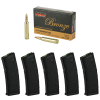 |
Magpul PMAG GEN 2 MOE AR-15 30 Round Magazine (5 Pack) & 100 Rounds of PMC Bronze .223 Remington FMJ 55gr Ammo | The Mag Shack | $ 126.25 $ 94.99 | |
 |
Magpul PMAG D-60 AR-15 .223 / 5.56 60-Round Polymer Drum Magazine | GunMag Warehouse | $ 119.99 |
According to the new briefs, that moment may have arrived.
The ruling in Benson did more than simply strike down Washington D.C.’s magazine restrictions. The court issued a detailed opinion explaining that magazines capable of holding more than 10 rounds are commonly owned and widely used for lawful purposes.
Under the framework established in New York State Rifle & Pistol Association v. Bruen, firearms regulations must be consistent with the nation’s historical tradition of firearm regulation. The D.C. court concluded that bans on commonly owned magazines do not meet that test.
In other words, the court found that these magazines fall squarely within the types of arms protected by the Second Amendment.
That conclusion directly contradicts rulings from courts that have treated magazine bans as constitutionally permissible.
The stakes are particularly high for residents of states like California, New Jersey, and now Virginia, where restrictions on magazines holding more than 10 rounds remain in place.
If the Supreme Court declines to review Duncan v. Bonta, the Ninth Circuit’s ruling could leave millions of law-abiding Americans in legal limbo. Gun owners who legally purchased standard capacity magazines during previous injunction periods could once again face the possibility of becoming criminals simply for possessing common firearm accessories.
Attorneys for the plaintiffs argue that this is precisely why the Supreme Court should act now. With a final judgment already issued in the Ninth Circuit and a direct conflict between courts now on the books, the legal conditions for Supreme Court review appear to be in place.
The magazine cases also intersect with a broader constitutional fight: bans on semi-automatic rifles such as the AR-15.
The Supreme Court has so far declined several opportunities to take up challenges to these restrictions, but some justices have signaled that the issue is likely to reach the Court soon.
Justice Brett Kavanaugh previously wrote that the Court should address bans on commonly owned rifles in the near future. Many Second Amendment advocates believe that resolving the legality of magazine bans could naturally lead the Court to examine rifle bans as well.
After all, both issues revolve around the same fundamental question: whether governments can prohibit arms that are widely owned by ordinary Americans for lawful purposes.
The Supreme Court receives thousands of petitions every year, but accepts only a small fraction. However, cases that involve clear constitutional questions and conflicting appellate rulings often rise to the top of the list.
If the justices grant certiorari in either Duncan v. Bonta or Gator’s Custom Guns v. Wentz, the Court could soon deliver one of the most consequential Second Amendment rulings since Bruen.
Such a decision would not only determine the fate of magazine bans but could also shape the legal future of AR-15-style rifles and other commonly owned firearms.
For gun owners across the country, the next few months could determine whether the Supreme Court is finally ready to resolve one of the most contentious constitutional battles in modern American law.
from https://ift.tt/kSTBryb
via IFTTT

No comments:
Post a Comment