Tuesday, August 5, 2025

ATF Almost Gets One Right. Will it Continue? Should it Continue?

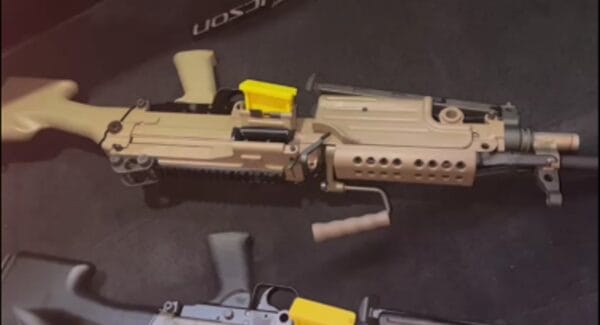
Two of 16 semi-automatic FN M249S rifles purchased by Florida-based illegal firearm traffickers, who sold them to a violent Mexican drug cartel. (Photo courtesy U.S. Attorney’s Office, Middle District of Florida).

Six men who were living in DeLand, Florida have been sentenced for illegally straw purchasing and then trafficking 33 semi-automatic firearms that they sold to a violent Mexican drug cartel, the Cártel de Jalisco Nueva Generación, known as CJNG, which is located in Zitacuaro, Michoacan, Mexico.

According to U.S. Attorney for the Middle District of Florida Gregory W. Kehoe, the ATF began investigating the six men in May 2023. They learned that the group was led by Angel Valazquez Delgado.

“The conspirators purchased high-caliber firearms in the United States for resale to Mexican drug cartels. These cartels were and are criminal organizations engaged in the trafficking of controlled substances into the United States,” a press release states.

One batch of illegally trafficked weapons included 11 Barrett .50 caliber rifles and 16 semi-automatic FN M249S rifles, which the U.S. Attorney’s office claimed, “are easily converted into a machinegun.”

According to the press release, one of the Barretts was recovered after a gunfight that occurred March 22, 2023, between the cartel and Mexican State Police and Mexican military personnel, which claimed two lives.

“After the shooting, a Barrett, model 82A1, .50 caliber rifle purchased by Jesus Hernandez on November 8, 2022, was recovered,” the press release states.

Praise for the investigation came from those involved.

“Dismantling this Central Florida-based firearms trafficking ring is a huge win for public safety in Mexico and America,” said ATF’s Tampa Field Division’s Special Agent in Charge Kirk Howard. “The CJNG is a notoriously brutal transnational criminal organization designated as a foreign terrorist organization that now has less fuel for its violent criminal activities, thanks to this joint team.”

The U.S. Attorney agreed.

“The investigation and prosecution of violent crime is one of the top priorities of my District,” said Kehoe. “These individuals have trafficked high-caliber, military-grade weapons into the hands of dangerous Mexican cartel members and thus have caused a serious risk to the health and safety of others. My office, along with our law enforcement partners, will continue to work to hold those who jeopardize public safety accountable for their crimes.”

According to the press release, the FBI was not involved in the investigation. The case was investigated primarily by the ATF, which was assisted by Homeland Security Investigations, the Drug Enforcement Administration, U.S. Customs and Border Protection, the Volusia Bureau of Investigations and the DeLand Police Department,

The real story

While it is understood that the ATF would like to take all of the credit for this successful investigation, their press release leaves out how they first learned about Delgado and his merry band of straw purchasers.

According to the actual complaint, a Florida gun dealer became suspicious of Delgado after he tried to purchase his fourth Barrett rifle, which can retail for $10,000 or more. As a result, the gun dealer contacted the ATF directly.

“Specifically, on or about April 29, 2023, an employee at a federally licensed firearms dealer located in Crestview, FL, had called Defendant (Delgado) to inform him that he was not approved to purchase a .50 caliber Barrett rifle – because he had already recently purchased three such firearms – and that he should not drive to the store. Defendant informed the employee that he was already close to the store,” the complaint states.

Shortly after the dealer denied the purchase, two other defendants showed up attempting to purchase the Barrett, but the gun store owner denied the sale because he believed they “were attempting to make a straw purchase on behalf of Defendant (Delgado).”

“This suspicious activity triggered the investigation into Defendant and the firearms trafficking organization,” the complaint states.

Takeaways

A Florida gun dealer is responsible for stopping some serious weapons from making their way to a violent Mexican drug cartel. The dealer is the reason the cartel did not receive 11 Barretts, 16 semi-auto M249s and other military-style guns.

ATF’s involvement in the case began only after they answered the phone.

The U.S. Attorney said his office “along with our law enforcement partners” will continue to fight gun crime. That way of thinking is problematic, especially when ATF is one of the law enforcement partners.

It is easy to understand why ATF wants to take sole credit for this case, especially now. Plans to merge them with DEA have been put on hold. ATF’s future is murky at best.

Their track record is abysmal, and their history is blood-soaked.

Nowadays, there are far too many examples of ATF crews laughing and joking with each other as they tear apart the homes of law-abiding folks who had done nothing wrong. Ask Mark “Choppa” Manley, Pastor Russell Fincher, Patrick “Tate” Adamiak or Maer Malinowski, whose husband Bryan was shot and killed by ATF agents last March, if you need more information.

This story is presented by the Second Amendment Foundation’s Investigative Journalism Project and wouldn’t be possible without you. Please click here to make a tax-deductible donation to support more pro-gun stories like this.


About Lee Williams

Lee Williams, who is also known as “The Gun Writer,” is the chief editor of the Second Amendment Foundation’s Investigative Journalism Project. Until recently, he was also an editor for a daily newspaper in Florida. Before becoming an editor, Lee was an investigative reporter at newspapers in three states and a U.S. Territory. Before becoming a journalist, he worked as a police officer. Before becoming a cop, Lee served in the Army. He’s earned more than a dozen national journalism awards as a reporter, and three medals of valor as a cop. Lee is an avid tactical shooter.

Lee Williams


from https://ift.tt/xqlKD7Y
via IFTTT

Monday, August 4, 2025

Artificial Revolution: Why the 2A Community Must Embrace AI

Opinion

By drawing its data from biased human sources, "artificial intelligence" can be used to help crush freedom. iStock-1387900612
By drawing its data from biased human sources, “artificial intelligence” can be used to help crush freedom. iStock-1387900612

A revolution is coming. It is already here, and we find ourselves at a crossroads. We will either trade tit for tat with those who would take our rights from us in the inevitable switching of political parties, or we can embrace this revolution and relegate our opponents to the dustbin of history through complete and total dominance. A choice lies before us, and the key to our success is adoption. Every major problem that we face as an industry can and will be solved as we embrace this new revolution. New demographics, ages, economic strata, etc. This is our key. We simply cannot afford to miss the opportunity and developing tools that sit in front of us in a pending revolution that most don’t recognize yet.

In this op-ed, I am going to show you the revolution that is coming as I see it. We will explore lessons from the last major revolution of this scope, the Industrial Revolution. Finally, we will explore the similarities that I see and how we can follow the guide of history to further not only our Second Amendment but bring new blood and demographics into our fold to continue the fight in a way that has never been possible.

We in the 2A space are no strangers to being pushed out of the conversation. The media, Hollywood, and politicians have pushed us out to such an extreme that we have formed our own distribution networks. As an industry, we have developed written distribution through articles, editorials, and investigative journalism. We have an entire YouTube infrastructure (of which I am a part of with my channel Langley Outdoors Academy) built around testing, new product releases, experimentation, legal analysis, breaking news and activism.

One could truly say that the gun rights advocates no longer need any legacy organization for support, as we have built our own ecosystem. 

We must get in front of the next leg of distribution that is on the horizon. There is a revolution coming, only mirrored by the industrial revolution of the 1800s in scope and scale. We must seize this opportunity and harness the power of this new revolution, which has already started and guarantees generational change.

The revolution that is coming is the AI revolution.

It will change everything in our world: content creation, legal research, grassroots organizing, etc. While it is currently in the novelty phase, it is no doubt coming whether we like it or not.

We are on the cusp of a 2A revolution… the question is will we take the chance and grab it?

As we progress through this idea, I would like to highlight a few pieces of historical data that will put the revolution in front of us in perspective. For reference, the Industrial Revolution is considered between the years of 1760 – 1870. This time frame would be considered the “second” industrial revolution, but it will be the focus of my article. Here is a look at “before” and “after” of the Industrial Revolution.

Before the Industrial Revolution (1760s-1820s):

  • The US economy was primarily agricultural, with about 90% of the population engaged in farming and subsistence production.
  • Manufacturing was largely artisanal and small-scale, conducted in homes or small workshops using hand tools and basic machinery.
  • GDP per capita grew slowly at approximately 0.5-1% annually, with total GDP estimated at around $12-15 billion in 1800 (in 2012 dollars).
  • Production was limited by human and animal power, seasonal constraints, and local market access due to poor transportation infrastructure.

After the Industrial Revolution (1820s-1870s):

  • Manufacturing output increased dramatically, with textile production alone growing by over 1000% between 1820-1860.
  • Railroad mileage expanded from virtually zero in 1830 to over 30,000 miles by 1860, revolutionizing transportation and market access.
  • GDP per capita growth accelerated to 1.5-2% annually, with total GDP reaching approximately $98 billion by 1870 (in 2012 dollars).
  • Steel production increased from negligible amounts in 1850 to over 1 million tons by 1880, enabling massive infrastructure development/
  • The workforce shifted significantly, with manufacturing and services growing from 10% to nearly 40% of employment by 1870.

As you can see from the data above, the growth that occurred during and after the Industrial Revolution was staggering. When the Industrial Revolution hit, manufacturing wasn’t just improved—it was transformed. Textile production alone grew by over 1000% between 1820 and 1860. This wasn’t a gradual change; it was an exponential disruption.

The same exponential potential exists with AI tools for our community… In the areas of content creation, legal research, grassroots organizing, etc., everything will adapt. One thing that I want to specifically highlight is the amount of movement in people, jobs, and their approach to their lives. This is where the power of the coming AI Revolution will shine for the 2A community. The shifting of people and expertise that will come from the changes in design, administration, creation, etc., in our space is going to be significant.

This is where a word of caution must be introduced. History shows us what happens when transformative technology meets early adopters. During the Industrial Revolution, GDP per capita growth doubled from 1% to 2% annually. Railroad infrastructure exploded from zero to 30,000 miles in just 30 years. If we apply this pattern to AI adoption in the 2A space, we could see unprecedented growth in new products, models, demographics, market penetration, message penetration, and activism engagement. However, if we ignore or resist this, we will harm our industry, population, and movement. It is imperative that we adopt these new tools and position ourselves in front of our opposition.

In fact, the similarities between the Industrial Revolution and AI Revolution are much closer than you’d think. Here are just a few examples; you can judge for yourself if you see any common themes.

  • Initial resistance and skepticism from established industries and workers who fear displacement mirror current concerns about AI replacing jobs.
  • Labor markets experience significant upheaval, with some jobs disappearing while new categories of work emerge that require different skill sets.
  • Early adoption creates significant competitive advantages for businesses and nations that embrace the new technologies first.

We certainly have the initial resistance and skepticism down pat. Humans in general are resistant to change; that is not necessarily a bad thing. However, there are times when we can overcome that resistance to outmaneuver our opponents on the left. Upheaval is not a theory; it is a guarantee. There will be jobs and services that will be lost, but we will gain new and more efficient means of furthering our industry. I liken this to a wildfire that clears out a forest, makes fertilizer for all future generations to draw from, and makes way for green shoots and new trees that wouldn’t have a chance without the necessary destruction and resources provided.

This last bullet point is the best one. Early adoption is the key to success. If we are the first to race to the forefront, we will beat our opponents there and put them on the backside of a generational revolution, which they are not even beginning to observe.

In closing, I don’t see this addition of tools and technology as an option, but a must. We simply must embrace the changes that are coming that will 100% be a part of the future. This is not a hypothesis; this is a guarantee. We have seen it before in the Industrial Revolution, and now it is our time to take a front seat in our generation’s revolution. Rather than be a passenger on this grand experiment of our country, let’s grab the wheel and harness the power of new possibilities. Together, we will drive our Rights forward, infuse new generations in our Rights fight, and position ourselves well beyond our opponents. The question really boils down to, will you?


About Braden Langley

Braden Langley is a Christian, husband, father, and American-born patriot. The worst nightmare of the left is a bible carrying, gun-toting, rush baby. Braden has carved a name for himself in the 2A Gun Rights / News / political analysis gun space on YouTube through his channel Langley Outdoors Academy. With over 200 million views, 3400+ videos and almost 600k subscribers, Braden focuses multiple times daily on 2A updates, the politics that surround it, and the inevitable march to the reclamation of our Rights. “I will never give up, I will never stop fighting for our Rights and I know that there are millions of patriots out there who feel the exact same way. We will fight for our country and take it back together”.Braden Langley


from https://ift.tt/O2tBv8Z
via IFTTT

Supreme Court Asks for Justice Department’s Position on SBRs

7.62x39mm AR-15 SBR
7.62x39mm AR-15s like this SBR utilize a proprietary magazine, but still use a standard AR-15 lower. IMG Jim Grant

A facial challenge to the federal requirement for registration and paying a tax in order to possess short-barreled rifles has made its way to the Supreme Court. A facial challenge is a direct challenge to the statute, claiming the statute itself is unconstitutional.

The case of Jamond M. Rush v. United States started in February 2022 in the Southern District of Illinois. Rush was charged with being a felon in possession of a firearm, an Anderson Manufacturing AR-15 .223 rifle. The court suppressed the original charge.

A superseding indictment, substituting a new charge for the old charge, was issued on August 16, 2022. The latest indictment was for the possession of an unregistered firearm, under the National Firearms Act (NFA), presumably for the same Anderson Arms AR-15 type rifle with a 7.5″ barrel.

Rush entered a conditional guilty plea to possessing the rifle under the National Firearms Act (NFA), with the proviso that the case could be appealed on the basis of the law being unconstitutional under the Second Amendment and the Bruen decision. The Seventh Circuit upheld the Circuit Court decision, primarily using the 1934 Miller case, which failed to find the 1934 National Firearms Act unconstitutional. For many reasons, Miller was not a clear statement on the Second Amendment and had many flaws.

Rush then asked the Supreme Court to grant a writ of certiorari, which would allow the case to be appealed before the Supreme Court. On June 13, 2025, writing for the United States Government, the US Solicitor General, D. John Sauer, waived its right to file a response to the petition for a writ of certiorari.

On July 31, 2025, the Supreme Court requested (ordered) the US Government to file a response to the petition.  Mark W. Smith, the noted AmmoLand contributor, attorney, expert on Second Amendment law, and popular commentator on his YouTube channel, the Four Boxes Dinner,  notes this shows a significant interest in the case by the Supreme Court.  The United States Department of Justice has submitted this statement in the Peterson case in the Fifth Circuit, as footnote 9 on page 8:

 Because ordinary firearms, unlike suppressors, are not peculiarly susceptible of criminal misuse, registration laws or taxes targeting such firearms likely would not serve or be proportionate to any legitimate public-safety purpose. See, e.g., Heller v. District of Columbia, 670 F.3d 1244, 1291 (D.C. Cir. 2011) (Kavanaugh, J., dissenting) (“requir[ing] registration of individual guns” generally does not serve any legitimate purpose and is usually “aimed at deterring gun ownership”). In addition, a law regulating or taxing the firearm itself would impose a more severe burden on the right to keep and bear arms than regulations on useful but non-essential accessories such as suppressors.

Apply this statement to the Rush case, and it could influence the Supreme Court to grant a writ of certiorari (take the case on appeal).

The case is a straightforward possession case against the registration and tax requirements of the NFA. The federal government has recently reduced the tax requirement to zero, going into effect on January 1, 2026. The question may devolve as to whether registration of firearms, by the federal government, commonly possessed for lawful purposes, is allowable under the Second Amendment. There is no historical precedent in the law which shows registration of firearms was commonly required in the founding era. 

Over a million short-barreled firearms are already registered in the United States under the NFA. Nearly 900,00 are rifles. That should easily be sufficient to indicate common use for lawful purposes.

Supreme Court justices read the news and listen to the political debate. They know short-barreled firearms only remain in the National Firearms Act because the Senate Parliamentarian ruled they could not be removed as part of the reconciliation bill.

It will be very interesting to see how the DOJ responds to the Supreme Court’s request (order). The DOJ has until September 2nd to submit its reply.


About Dean Weingarten:

Dean Weingarten has been a peace officer, a military officer, was on the University of Wisconsin Pistol Team for four years, and was first certified to teach firearms safety in 1973. He taught the Arizona concealed carry course for fifteen years until the goal of Constitutional Carry was attained. He has degrees in meteorology and mining engineering, and retired from the Department of Defense after a 30 year career in Army Research, Development, Testing, and Evaluation.

Dean Weingarten


from https://ift.tt/g9Zp4Lu
via IFTTT

SHOCKING: NJ Politicians Move to Exempt Themselves from Gun Control Laws They Enforce on You

FPC, SAF, NJ2AS Challenge New Jersey Handgun Carry Ban
File Photo

In a jaw-dropping display of hypocrisy, New Jersey lawmakers have introduced a bill that would give themselves and their top staffers sweeping firearm privileges—privileges they continue to deny the average law-abiding citizen.

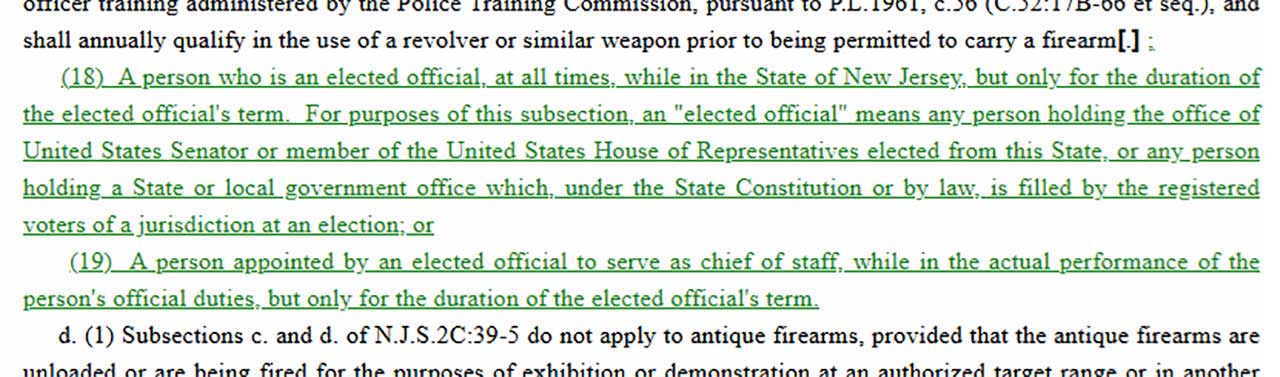
Assembly Bill A5958, introduced on July 24, 2025, by Assemblymen Robert Auth (R-39) and Gregory Myhre (R-9), with co-sponsorship from Assemblyman Sean Kean, seeks to exempt elected officials and their chiefs of staff from nearly all of the state’s draconian gun laws. Under the proposal, they would be allowed to carry handguns without a permit, possess rifles and shotguns without a Firearms Purchaser ID, and transport firearms throughout the state—all as long as they complete a state-approved training course.

This comes even as the rest of New Jersey residents continue to be bound by some of the most burdensome gun laws in the nation.

A Two-Tier System of Rights

Assembly Bill A5958 Screenshot 8-4-2025

As it stands, ordinary New Jerseyans must navigate a bureaucratic maze just to exercise basic Second Amendment rights—enduring long waits, multiple and endless background checks, permitting processes, and potential criminal penalties for violations.

Yet A5958 creates a privileged class of gun carriers: politicians and their chosen aides.

The bill plainly states that “a person who is an elected official… shall be exempt from the provisions of N.J.S.2C:39-5,” which currently criminalizes most forms of firearm possession without government-issued credentials or carved out exceptions. This immunity would last the full duration of the politician’s term. Their appointed chief of staff would also gain the same immunity, but only while “in the actual performance of [their] official duties.”

“This is a giant slap in the face to every law-abiding gun owner in New Jersey,” said Grant Clarkson, Northeast Regional Director for Gun Owners of America, in an alert sent to members. “They’re giving themselves rights while actively working to restrict yours.”

If They’re Afraid, Why Shouldn’t You Be Armed Too?

Supporters of A5958 argue the exemption is necessary to protect public officials from threats. But critics ask the obvious question: if elected officials feel the need to be armed while walking the same streets as the rest of us, why shouldn’t the public have the same means of self-defense?

The bill does require elected officials and their staffers to complete a firearms training course and qualify annually with a handgun. However, average citizens must already meet similar requirements—plus face costly fees, long delays, and frequent rejections—just to apply for a carry permit.

“In New Jersey, you’re not allowed to carry for self-defense unless you can prove you’re in danger,” said one New Jersey gun rights activist. “Now politicians are writing themselves a pass without proving anything to anyone.”

Hypocrisy in Context

The timing of this proposed exemption couldn’t be more ironic. New Jersey Democrats have been aggressively pushing new gun control laws all year—including bans on so-called “ghost gun” files, new ammunition confiscation rules, and laws that criminalize the mere possession of suppressed firearms or short-barreled rifles, even when those items are legal under federal law.

In fact, just days before A5958 was introduced, two lawsuits were filed against the state’s outright bans on suppressors and compact rifles. One plaintiff in that case is Daniel Francisco, the pro-2A mayor of Englishtown, NJ, who argues that such firearms are ideal for self-defense and widely owned across the country.

Meanwhile, law-abiding residents are still banned from owning suppressors—a piece of safety equipment recognized by the CDC and hearing health professionals—and face up to 18 months in prison for possessing one.

Public Reaction and Legal Fallout

The reaction from gun rights advocates has been swift and severe. A5958 is being blasted as an example of “rules for thee but not for me,” a legislative maneuver that grants special rights to the political class while everyday citizens are left defenseless.

“This bill shows exactly how unserious New Jersey politicians are about the Constitution,” said commentators. “It’s not about public safety—it’s about control and privilege.”

And the courts may soon agree. With recent Supreme Court rulings demanding that gun laws align with America’s historical tradition of firearm regulation—as clarified in Bruen—New Jersey’s modern patchwork of bans, restrictions, and carve-outs is increasingly on shaky ground.

Should A5958 pass in its current form, it may serve as yet another trigger for constitutional challenges—this time on equal protection grounds.

The Bottom Line

Assembly Bill A5958 is a flashing neon sign that says the political elite in New Jersey trust themselves with guns, but not you. They know firearms are effective tools for personal defense. They just don’t want you to have one.

For New Jersey gun owners, the message is clear: stay alert, stay informed, and never stop fighting for your right to keep and bear arms—no matter who’s trying to exempt themselves from the law.


Follow AmmoLand News for updates on A5958 and other critical Second Amendment issues in the Garden State.

Second Amendment Lawsuits Target New Jersey’s Strict Gun Control Measures

Six Top Gun Rights Orgs File Lawsuit to Overturn NJ’s Hearing-Protection Ban


from https://ift.tt/UnrNT4c
via IFTTT

McCloskeys Re-Armed After 5-Year Battle to Win Back Their AR-15 Rifle

Victory Follows Expungement, Pardon, and Legal Perseverance.

ST. LOUIS, MO – August 3, 2025 – Mark and Patricia McCloskey, the St. Louis couple who made national headlines in 2020 for defending their home with firearms during a Black Lives Matter protest, have officially regained possession of their AR-15 rifle after a grueling five-year legal fight.

“It only took 3 lawsuits, 2 trips to the Court of Appeals and 1,847 days, but I got my AR15 back!” Mark McCloskey wrote in a defiant post on X (formerly Twitter), accompanied by a photo of himself holding the rifle and a video showing him retrieving it from the St. Louis Police Department.

The couple’s case became a flashpoint in the national debate over the right to armed self-defense, prosecutorial overreach, and the political weaponization of the legal system.

After protesters entered the McCloskeys’ private neighborhood on June 28, 2020, by breaking a gate and ignoring “No Trespassing” signs, the couple armed themselves and stood outside their home to deter what they described as a threatening and unruly crowd.

“When you’re facing 350 to 500 people screaming death and arson—‘I’m going to rape and kill your wife, I’m going to burn down your house’—the fact that we were able to hold them off is proof of the value of the Second Amendment,” Mark McCloskey told Newsmax in a prior interview.

No shots were fired and no injuries occurred, but the McCloskeys were quickly targeted by St. Louis Circuit Attorney Kim Gardner, a Democrat backed by progressive donors. Gardner charged them with unlawful use of a weapon. Missouri Attorney General Eric Schmitt attempted to intervene to dismiss the case, but the damage had been done.

Eventually, the couple accepted a plea deal to avoid further political and financial strain—pleading guilty to minor misdemeanors. Former Governor Mike Parson pardoned both McCloskeys in July 2021. Even after the pardons, their firearms were not returned, and officials insisted that the weapons be forfeited. That began another years-long legal battle to reclaim what they argued was unjustly taken property.

Their convictions were finally expunged in June 2024 by Judge Joseph P. Whyte, who noted that the purpose of expungement is to provide second chances. Under Missouri law, an expungement effectively makes it as if the incident never occurred.

That paved the way for the McCloskeys to demand the return of their seized firearms.

Still, authorities resisted. The AR-15 remained with the St. Louis Metropolitan Police Department. The Bryco .380 pistol, which Patricia McCloskey wielded during the confrontation, was held by the St. Louis Sheriff’s Department. Mark McCloskey confirmed that the pistol is expected to be returned within the coming week.

Mark told Fox News Digital, “That gun may have only been worth $1,500 or something, and it cost me a lot of time and a lot of effort to get it back, but you have to do that. You have to let them know that you will never back down, you’ll never give up.”

The AR-15, now returned, is likely to be seen as much more than a firearm—it’s become a symbol of resistance against what the couple and many of their supporters see as an anti-gun legal system intent on punishing law-abiding citizens who dare to stand their ground.

Critics of the prosecution have pointed to the overt political motivations behind the case. Special prosecutor Richard C. Callahan, a Democrat and former Obama appointee, openly admitted the primary goal of the plea deal was to forfeit and destroy the couple’s firearms. “I thought the most important aspect was to forfeit and destroy the guns,” Callahan stated in 2021.

Police investigators, however, reported evidence that some protesters were indeed armed. According to St. Louis PD Sgt. Curt Burgdorf’s summary, members of the group made threats and were seen with weapons and ballistic vests labeled “Human Shield.” Despite this, Callahan downplayed the threat, calling the crowd “peaceful” and “mixed.”

The return of the McCloskeys’ rifle comes amid broader concerns about the use of legal systems to suppress the right to self-defense. Dean Weingarten, writing for AmmoLand News, argued that the McCloskeys’ ordeal is “part of the pattern by the far left to use lawfare to attack anyone who dares oppose the supremacy of far-left street activists.”

The couple has remained politically active. Mark McCloskey launched a short-lived U.S. Senate bid in 2021 and continues to speak out against government overreach. Their experience has galvanized support from gun rights advocates across the country, who see their story as a warning of what happens when self-defense becomes politicized.

“We defended our home, were persecuted by the left, smeared by the press, and threatened with death, but we never backed down,” Mark posted online. “Each and every one of us owns a personal responsibility for our freedom and our democratic republic.”

With their AR-15 now back in hand and their legal records cleared, the McCloskeys’ long fight appears to be nearing its end—but the political and legal lessons of their case are sure to echo for years to come.


McCloskey’s Beat Rap, Claim Victory in Plea Deal with Anti-gun Prosecutor

McCloskey Convictions Expunged, Demand Return of Guns


from https://ift.tt/J0eQVAw
via IFTTT

Friday, August 1, 2025

ATF’s Secret & Illegal Gun Registry Just Got More Dangerous — It’s About to be Powered by Federal Government AI

Opinion

As the federal government rolls out its sweeping artificial intelligence strategy—ingesting “all government data” into machine learning models—gun owners have every reason to be alarmed.

Michael Kratsios, Director of the White House Office of Science and Technology Policy, recently confirmed that “all the government data that the government has is going to be ingested into models” to improve citizen services, including permits, taxes, and healthcare. That’s not just parking passes and passports—that potentially includes firearm transaction records, too.

This raises a red flag for anyone following the ATF’s quiet construction of a digital database of gun owner records—a practice that violates federal law but has continued for years under both Democrat and Republican administrations. Despite clear legal prohibitions against a centralized registry, the ATF currently maintains nearly one billion firearm transaction records, many of them digitized and partially searchable.

The Database That Shouldn’t Exist

According to FOIA responses and internal ATF memos, the Bureau receives millions of out-of-business dealer records every month. These records include sensitive data from ATF Form 4473s—name, address, firearm description, and more. Although ATF claims that this information can’t be searched by name, it’s only because that feature is “disabled”—not deleted. With just a few keystrokes, ATF could turn this passive database into an active weapon against gun owners.

Gun Owners of America (GOA) has gone further, exposing that the ATF has encouraged active FFLs to submit current records voluntarily, even before closing shop, expanding this illegal registry far beyond its already bloated scope

Enter AI: From “Woke Filtering” to Weaponized Data

18 U.S.C. § 926(a)(3)

The Trump administration’s recent executive order aims to prevent “woke AI” in federal procurement. It promises that large language models (LLMs) used by the government will be “ideologically neutral” and “truth-seeking.”

But what about privacy? What about the enforcement of laws like 18 U.S.C. § 926(a)(3), which prohibits the federal government from maintaining a firearms registry?

Nowhere in the policy is there a guarantee that firearms ownership data will be excluded from AI ingestion. No safeguard. No carve-out. Just blind faith that bureaucrats will do the “right thing” with mountains of sensitive information—despite decades of evidence to the contrary.

If firearm transaction records become part of these national AI systems, what’s to stop future administrations—or even foreign actors who compromise the system—from querying this data to locate, target, or harass law-abiding gun owners?

Who Will Hold the Line?

Congress isn’t asleep at the wheel—at least not all of it. In January 2025, Congressman Michael Cloud and Senator Jim Risch reintroduced the No REGISTRY Rights Act, a direct response to the ATF’s illegal stockpiling of gun owner data. The bill would dismantle the ATF’s Out-of-Business Records Imaging System (OBRIS), which currently holds over 920 million firearm transaction records, many of them digitized and indexed for rapid retrieval. Cloud’s investigation into this system, along with a damning report by Gun Owners of America, revealed how easily this database could be misused to build a door-to-door gun confiscation list.

The legislation is refreshingly simple in its goals. First, it requires the complete destruction of the ATF’s existing registry. Second, it allows gun dealers to destroy their records when they go out of business—reversing Biden-era rules that forced permanent retention. And third, it prohibits any federal agency from creating or maintaining a gun registry ever again.

The bill is supported by a coalition of liberty-minded lawmakers and gun rights champions, including GOA, the National Association for Gun Rights, and the NRA. But make no mistake—this fight isn’t over just because President Trump is back in the White House.

The bill still faces resistance in Congress from anti-gun lawmakers and bureaucrats who would rather sweep the registry issue under the rug than deal with it lawfully.

What Can Gun Owners & Advocacy Groups Do?

The only way to force this bill across the finish line is sustained pressure from gun owners across the country. Contact your representatives. Demand passage. The gun registry must not only be defunded—it must be destroyed. And the AI age only raises the stakes. Because if this registry survives, it may not be a human bureaucrat pulling your file—it might be an algorithm doing the government’s dirty work.

  • Call for Immediate Deletion: Demand that any AI system built by the federal government be explicitly barred from ingesting or accessing any firearms-related records—whether paper, scanned, or digitized.
  • Push for Enforcement of Existing Laws: Congress must enforce 18 U.S.C. § 926(a)(3) and hold the ATF accountable for violating it. Any federal employee found knowingly participating in building a gun registry should face consequences.
  • Support REGISTRY Destruction Legislation: The GOA-backed bills are vital. Gun owners should contact their senators and representatives to co-sponsor and support these efforts.
  • Demand Transparency: FOIA requests should continue, especially as new AI projects come online. The public deserves to know which data sources are being fed into these models—and whether your gun record is among them.
  • Educate and Mobilize: Local and state-level activism remains one of the best tools to apply pressure upward. Host town halls, educate other gun owners, and make sure this issue doesn’t fly under the radar.

The fusion of unchecked artificial intelligence with illegally maintained federal firearm records should set off alarms for every freedom-loving American. AI can either empower citizens or enable tyranny—it depends entirely on who controls the data. Right now, gun owners are losing that battle.

The government must not be allowed to digitize our rights away. Let this be a wake-up call. Stay armed with the truth—and stay involved. The future of the Second Amendment may depend on what you do today.


Gun Owners of America Uncover Proof of A Secret Gun Registry

The Fight Heats Up to Destroy ATF’s Illegal Gun Owner Registry ~ VIDEO

ATF Keeping 920+ Million Firearm Records with Almost All Digitized


About Tred Law

Tred Law is your everyday patriot with a deep love for this country and a no-compromise approach to the Second Amendment. He does not write articles for Ammoland every week, but when he does write, it is usually about liberals Fing with his right to keep and bear arms.


from https://ift.tt/DtGOyFc
via IFTTT

Supreme Court Review Sought In Young Adult Handgun Purchase Ban Challenge

Handgun Counter Display Gun Shop Retailer iStock-Filipovic018-512219444.jpg
iStock-Filipovic018

BELLEVUE, Wash. — The Second Amendment Foundation and its partners have petitioned the U.S. Supreme Court for review in Brown v. ATF, SAF’s challenge to the federal ban that prevents adults aged 18 to 20 from purchasing handguns from licensed dealers.

Second Amendment Foundation’s Petition for Certiorari highlights the circuit split that has emerged on the issue, with the Fifth Circuit striking down the law earlier this year in SAF’s Reese v. ATF case, while the Fourth Circuit upheld it in Brown. Joining SAF in the case are the West Virginia Citizens Defense League and a private citizen, Alec La Neve.

“The issue of 18-20-year-olds purchasing handguns is split between two circuit courts across the nation,” said SAF Executive Director and attorney of record in the case Adam Kraut.

“Additionally, the circuit courts are split as to the ability of this age group being able to acquire and carry firearms more broadly. There is no doubt that adults under 21 are part of “the People” and therefore should be afforded the same rights as other adults, and in particular, be able to fully exercise their Second Amendment rights by purchasing a handgun – the ‘quintessential self-defense weapon.’ We are optimistic the High Court will agree to hear the case and end the confusion that permeates the rights of this group of adults once and for all.”

As noted in the cert petition, “The Second Amendment…reflects the sacred national value that part of what it means to be an American is to enjoy the right to defend yourself, your family, and your community with common firearms. By preventing an entire class of Americans—law-abiding 18-to-20-year-olds — from acquiring handguns on the commercial market cuts to the very heart of this fundamental American value.”

“Eliminating the young adult handgun purchase ban is a key component of our broader strategy to restore and expand gun rights,” said SAF founder and Executive Vice President Alan M. Gottlieb.

“Our ultimate goal is to stop this unconstitutional ban which forbids peaceable legal adults, who just so happen to be under 21, from fully exercising their Second Amendment rights.”

5 Circuit Court Strikes Down Federal Laws Prohibiting FFLs From Selling Handguns to 18-to-20-Year-Olds

4th Circuit UPHOLDS Federal Ban on Handgun Sales to 18–20-Year-Olds, Overturning Prior Victory


About Second Amendment Foundation

The Second Amendment Foundation (saf.org) is the nation’s oldest and largest tax-exempt education, research, publishing and legal action group dedicated to safeguarding and promoting the fundamental rights of individuals enshrined in the Second Amendment of the United States Constitution. SAF engages in aggressive legal action to ensure the principles of armed self-defense, personal liberty, and the ownership of arms are defended, secured, and restored. Through public education initiatives, SAF teaches the importance of the Second Amendment to promote a society that values and exercises the right to keep and bear arms. For more information visit SAF.org.


from https://ift.tt/ZynUpxS
via IFTTT