SAF Challenges Third Circuit After Court Dismisses 3D-Printed Gun Files Case, iStock-2191244801
In the latest development in a long-running battle over firearms freedom and digital expression, the Second Amendment Foundation (SAF) has filed a petition for rehearing in Defense Distributed v. Attorney General of New Jersey, urging the full Third Circuit to reconsider a controversial panel decision that effectively dismissed gun owners’ constitutional challenge to New Jersey’s crackdown on 3D-printed firearm files.
The case, originally filed in 2018, challenges the constitutionality of a New Jersey statute that bars the publication of computer code and digital firearms information used to program 3D printers to make guns or gun parts without a federal firearms license. In its petition, SAF argued that the panel opinion contained “analytical errors that run contrary to well-established legal precedent” and severely truncated the opportunity for merits review on the First and Second Amendment claims.
“This appeal challenges the New Jersey Attorney General’s long-running censorship of Second Amendment speech,” SAF said in its filing, characterizing the Third Circuit’s handling of the case as procedural gamesmanship that denied a proper constitutional examination.
A Setback for Digital Firearm Rights
The petition comes in the wake of an earlier ruling by a three-judge panel of the U.S. Court of Appeals for the Third Circuit — a ruling that represented a serious setback for advocates of unrestricted firearms innovation and free speech online. In that February decision, the court affirmed the dismissal of the lawsuit, holding that the plaintiffs had failed to allege facts sufficient to allow courts to decide whether 3D-printed gun files qualify as protected speech under the First Amendment, or whether the restriction directly burdens the right to keep and bear arms.
AmmoLand previously reported how the court rejected the notion that computer-aided design (CAD) and computer-aided manufacturing (CAM) files are inherently expressive speech, declining to apply heightened constitutional scrutiny based on the plaintiffs’ pleadings. The panel also concluded there was no concrete Second Amendment injury because the complaint did not allege that any plaintiff was prevented from personally manufacturing a firearm.
That decision marked a troubling new test for digital firearm rights: judges now may treat code used to make guns as purely functional conduct that falls outside core First Amendment protections unless litigants specifically and articulately plead expressive elements.
Why the Rehearing Matters
SAF’s petition for rehearing is more than procedural formality — it’s a direct challenge to a framework many gun owners and digital rights supporters view as hostile to both free speech and the independent manufacture of arms. The petition argues that the panel’s decision dodged the substantive constitutional issues at its core and instead relied on technicalities and factual deficiencies that could have been cured with a more thorough judicial review.
Alan M. Gottlieb, SAF founder and executive vice president, underscored that the case “has languished in the system since 2018” and criticized the Third Circuit for sidestepping the heart of the constitutional questions presented. If the court is unwilling to correct its analytical errors, SAF’s filing suggests, further appeals may be inevitable.
Looking Ahead
For Second Amendment advocates, the stakes in Defense Distributed’s fight are clear: the ability to share and access digital firearm information has become a flashpoint in broader debates over modern gun rights and online free speech. New Jersey’s statute and similar laws in other states effectively criminalize the distribution of digital files based on where someone lives, raising sharp questions about the limits of state power in an era when 3D printers and digital blueprints are widely available.
If the Third Circuit agrees to rehear the case en banc, it could reset the legal landscape for how courts treat digital firearm information. If not, SAF’s next move may be a petition for Supreme Court review — a path that could redefine how the Constitution applies to code, printers, and the quintessential right to keep and bear arms.
WV Machine Gun Bill Clears Committee – Then Faces Pushback, iStock-619761640
In the final frantic days of the 2026 West Virginia legislative session, a bill unlike any other in modern American history appeared to clear its first major hurdle. On March 2, the Senate Judiciary Committee advanced Senate Bill 1071, the Public Defense and Provisioning Act, by voice vote, sending the measure to the Finance Committee with barely 24 hours to spare before the crossover deadline.
Sponsored by Senators Chris Rose (R-Monongalia) and Zack Maynard (R-Lincoln) and drafted with assistance from Gun Owners of America (GOA), SB 1071 would create a state-run Office of Public Defense inside the West Virginia State Police. That office would purchase modern, fully automatic machine guns, AR-15/M16-platform rifles, M249 squad automatic weapons, MP5 submachine guns, and any other arms “in common use by the military or law enforcement,” and sell them directly to qualified West Virginia residents at every State Police troop headquarters across the state.
The bill is not a modest tweak to existing firearms law. It is a deliberate, carefully constructed attempt to circumvent the 1986 Hughes Amendment, which effectively froze civilian ownership of newly manufactured machine guns after May 19 of that year.
By positioning the State of West Virginia itself as the transferor, SB 1071 invokes the explicit federal exemption in 18 U.S.C. § 922(o)(2)(A) that allows transfers “to or by, or possession by or under the authority of… a State.” The bill’s legislative findings run for pages, quoting District of Columbia v. Heller, Tench Coxe, Henry Campbell Black, and Article III, Section 22 of the West Virginia Constitution to argue that the right to bear “arms of modern warfare” is both a constitutional imperative and a practical necessity for state defense and resistance to tyranny.
If enacted, the practical mechanics are straightforward yet unprecedented. The Office, headed ex officio by the State Police Superintendent, would acquire weapons, prioritizing West Virginia manufacturers where possible, store them in existing barracks and troop headquarters, conduct NICS-style background checks, and complete the transfer. Buyers pay the dealer price plus a mandatory $250 surcharge (plus up to $50 in administrative fees) that flows into a new “Public Defense Fund.” The state issues a sealed certificate proving the transfer was made “by” West Virginia, which the bill declares satisfies federal law. Critically, the legislation shields the state, its officers, and employees from any civil or criminal liability arising from subsequent misuse of the firearms. Records are exempt from the state’s Freedom of Information Act.
The immediate legislative impact is already measurable in the political theater it has generated. Even in one of the nation’s most gun-friendly states, where constitutional carry for those 21 and older has been law since 2021, SB 1071 has exposed fissures.
Sen. Ryan Weld (R-Brooke) voiced open skepticism during the Judiciary hearing, questioning whether the state can unilaterally declare itself immune from decades of federal court precedent interpreting the Hughes Amendment as a near-total ban on new machine guns for private citizens. The president of the West Virginia Troopers Association, Lonnie Faircloth, testified that rank-and-file troopers are personally uneasy about becoming the intermediaries in transfers that he claims could expose both sellers and buyers to federal felony charges. Committee counsel acknowledged that no court has ever blessed a state-to-citizen machine-gun sale of this nature and warned that the Supremacy Clause would likely control any conflict.
Yet supporters, led by GOA’s volunteer state director Alex Shay, insist the bill is not a loophole but a plain-text reading of federal statute. “This actually is federal law,” Shay told the committee. “West Virginia is not flying in the face of federal law.” Chairman Tom Willis (R-Berkeley) called the proposal a “novel legal concept” that finally delivers full Second Amendment parity in the Mountain State.
Though Willis has talked like he has always supported the bill, it took an outpouring of calls from gun owners who live in the Mountain State to force his hand to bring the bill for a vote. Last Friday, the bill was due to be heard, but Willis pulled it at the last minute. Only after an outpouring of outrage was the bill finally given a hearing yesterday, where it passed by a voice vote.
WV BREAKING NEWS
SB 1071 passed out of committee via a voice vote.
We’re at the 11th hour, and need to get the machine gun sales bill to the Senate floor.
WV Gun Owners, please continue to keep the pressure on your Senators by calling (304) 357-7800! pic.twitter.com/QQcdXhPqCd
This stage is where the bill should have been reported out of committee, but Willis failed to do his duty and report it as of early Tuesday Morning. Of all the bills voted out of committee, only SB 1071 was not reported. A West Virginia lawmaker told AmmoLand News that he believed that Willis did not want the bill and only brought it to the committee to quell unrest.
Although most believe that pro-gun organizations would support the bill, one organization whose endorsement was conspicuously absent was the West Virginia Citizens Defense League (WVCDL). A West Virginia lobbyist working for WVCDL threatened to kill the bill over the weekend in a verbal exchange in front of multiple lawmakers. The lobbyist threatened to kill the bill in other states as well, including Kentucky.
AmmoLand News also discovered in closed-door meetings that at the Capitol, the same lobbyist openly worried to lawmakers that if the bill passed, it could lead to police getting arrested for transferring machine guns. Since the transferee would have to go through the National Firearms Act (NFA) process, the police would be in the clear. The ATF could approve or deny the transfer. If the ATF approved, the police officer would transfer the gun with the federal government’s blessing. If they denied the transfer, the firearm would not be transferred, triggering legal battles. The lobbyist also said he was worried about West Virginians “getting hurt.”
AmmoLand News reached out to WVCDL President Kevin Patrick. He confirmed that the lobbyist was working for WVCDL, but WVCDL doesn’t have an official position on the bill. In the organization bill tracker, SB1071 is not listed, and in an email sent out Monday by WVCDL about current gun legislation, the bill was conspicuously absent. On Saturday, Patrick claims he just hadn’t had the time to update the tracker.
AmmoLand News asked Mr. Patrick whether the lobbyist was acting in good faith for WVCDL or acting on his own, using the WVCDL name. Mr. Patrick refused to answer the question and ended the conversation. It is unclear the motivation for trying to kill the bill, or why WVCDL has not even acknowledged its existence.
All bills must clear their respective chambers by Wednesday in what is known as “Crossover Day.” The bill’s non-reporting could kill it for a year, even though West Virginia Governor Patrick Morrisey has indicated he would sign it into law. The West Virginia Senate could change the rules and forgo some of the mandatory readings, but that would require a two-thirds vote, and it’s unclear whether there is enough support for such an action.
SB 1071 tests the outer limits of state authority versus federal gun control. Success would represent the first time since 1986 that civilians in any state could legally acquire brand-new, select-fire weapons without the artificial scarcity premium that has driven pre-1986 transferable machine guns to $20,000–$50,000 apiece. Should the ATF approve even a handful of Form 4 transfers under this framework, the precedent could ripple outward. Wyoming lawmakers have already signaled interest in similar legislation.
The passage would cement West Virginia’s reputation as the most aggressive pro-Second Amendment state in the Union. For Republican lawmakers facing primary challenges from the right, a vote for SB 1071 becomes a litmus test. Mr. Willis is facing a tough primary, and gun owners might see his actions as a betrayal if the bill isn’t reported.
As of March 3, 2026, the bill’s future remains uncertain. Yet the mere fact that such a bill has advanced this far in 2026 speaks volumes about the evolution of Second Amendment jurisprudence post-Bruen (2022) and the growing assertiveness of state legislatures against perceived federal overreach. Whether SB 1071 ultimately arms thousands of West Virginians with modern machine guns or becomes a symbolic footnote in the culture wars, its legislative journey has already reframed the national conversation.
In a nation where gun policy remains bitterly divided, West Virginia is once again proving willing to push the envelope toward what its lawmakers see as constitutional parity between citizen and soldier.
About John Crump
Mr. Crump is an NRA instructor and a constitutional activist. John has written about firearms, interviewed people from all walks of life, and on the Constitution. John lives in Northern Virginia with his wife and sons, follow him on X at @crumpyss, or at www.crumpy.com.
For nearly four decades, American gun owners have been told a simple story: if a machine gun was made after 1986, civilian ownership is flatly illegal. End of discussion. That narrative has been repeated so often it’s treated as an unquestionable fact — in gun shops, in courtrooms, and even in conservative circles.
But what if that story isn’t actually what Congress wrote?
ATF Regulation (27 CFR § 479.105) governs the transfer and possession of machine guns under the National Firearms Act (NFA). It primarily implements the restrictions established by the Firearm Owners’ Protection Act of 1986 (specifically 18 U.S.C. § 922(o), which effectively banned the possession and transfer of machine guns manufactured after May 19, 1986, for most civilians.
For almost forty years, gun owners have been told the same line: if a machine gun was made after 1986, you can’t have it. Period. That claim traces back to the so-called Hughes Amendment, passed as part of the Firearms Owners Protection Act and codified at 18 U.S.C. § 922(o).
But here’s the part most people never hear. The law’s text does not say what the ATF later claimed. The ban we’ve lived under since the 1980s didn’t come straight from Congress. It came from the ATF “interpreting” the statute during the political climate of the 1980s, when the agency was still under the Treasury Department, and anti-gun bureaucrats were flexing hard.
The key language in 18 U.S.C. § 922(o)(2)(A) states that the machine gun prohibition “shall not apply with respect to a transfer to or by, or possession by or under the authority of, the United States or a State.” For nearly four decades, that clause has been read narrowly by regulators and most courts. But the phrase “under the authority of” is not self-defining. It is the pressure point.
One plausible reading — and the one embedded in federal regulation — is that “under the authority of” means possession that is directed, controlled, or specifically requested by a governmental entity. That interpretation appears in 27 C.F.R. § 479.105 (E), which limits post-1986 machine gun registration to firearms manufactured “for the benefit of” a government agency and at its request. Those phrases do not appear in § 922(o) itself. They represent the agency’s understanding of what “under the authority of” must mean.
A competing litigation theory would argue that the statute’s text can bear a broader interpretation. “Authority” ordinarily refers to legally granted power. States routinely exercise authority through licensing regimes, permits, or statutory authorization. Under this view, if a state affirmatively authorizes possession of a specific class of arms, that possession is, by definition, “under the authority of” the state. The statute does not explicitly require the firearm to be manufactured at the government’s request or solely for government use. That limitation comes from ATF regulation, not from the legislative text.
Historically, courts have sided with the narrower interpretation. In Farmer v. Higgins, the Eleventh Circuit upheld ATF’s refusal to register a newly manufactured machine gun for civilian possession. The court treated § 922(o) as at least ambiguous. They relied on legislative history suggesting Congress intended to close the civilian machine gun registry after 1986. The court also deferred to ATF’s interpretation as reasonable. Whether labeled explicitly as Chevron deference or as traditional agency deference. The practical effect was the same: the agency’s narrow reading prevailed.
The legal landscape shifted in 2024 with Loper Bright Enterprises v. Raimondo, where the Supreme Court rejected mandatory Chevron deference. Courts are no longer required to accept an agency’s interpretation merely because a statute is ambiguous. Judges must now exercise independent judgment in determining the best reading of the law.
That change does not automatically invalidate § 479.105. But it does reopen the interpretive question. A future challenge could argue that courts should reevaluate § 922(o) from the ground up. Focusing on ordinary meaning, statutory structure, and constitutional context — rather than starting from decades of regulatory practice.
Such a case would likely arise if a state enacted legislation expressly authorizing possession of post-1986 machine guns under defined conditions and a qualified applicant sought NFA registration. If ATF denied the application under § 479.105, the dispute would present a clean legal question: does “under the authority of a State” permit state-authorized civilian possession, or is it limited to firearms possessed for direct governmental use?
That litigation would force a court to decide, without Chevron’s thumb on the scale, whether the regulatory language requiring manufacture “for the benefit of” a government entity is the best reading of § 922(o) — or whether it reflects a policy judgment layered onto the statute.
Framed this way, the issue is not whether Congress banned machine guns in 1986. It did enact § 922(o). The narrower and more contestable question is how far the exception extends — and whether the regulatory interpretation that has controlled for nearly forty years is textually compelled or historically assumed.
As gun owners, we’ve been living under an agency rewrite of the law for almost forty years. The video breaks down the legal mechanics. The bigger point is simpler. When bureaucrats stretch statutes beyond their plain meaning, rights disappear. When courts stop deferring and start reading the text, freedom has a chance.
1986 wasn’t just a bad year for machine guns. It was the beginning of a regulatory power grab that we’re only now in a position to challenge.
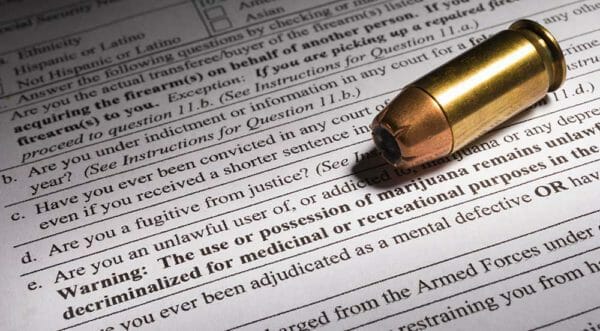
ATF/NICS firearm purchase form showing the marijuana-user exclusion question. iStock-919659526
The U.S. Supreme Court today heard vigorous oral arguments in United States v. Hemani, a high-profile Second Amendment case testing whether a decades-old federal law can permanently disarm Americans who regularly use marijuana or other controlled substances. The justices appeared deeply divided on the scope of historical analogues but broadly skeptical of applying the ban to non-impaired, occasional-to-moderate users, denoting a likely victory for respondent Ali Danial Hemani and potentially millions of cannabis consumers in states where the drug is legal.
The case revolves on 18 U.S.C. § 922(g)(3), part of the 1968 Gun Control Act, which makes it a felony for any “unlawful user of or addicted to any controlled substance” to possess a firearm or ammunition. Marijuana is still a Schedule I substance under federal law, despite legalization or decriminalization in most states and continuing efforts (including under the current Trump administration) to reschedule it to Schedule III.
United States v. Hemani
In 2022, FBI agents raided the Denton County, Texas, home shared by Hemani (a 25-year-old dual U.S.-Pakistani citizen) and his parents as part of a wider investigation. They found a 9mm pistol, a small amount of marijuana, and trace cocaine. Hemani admitted to smoking marijuana “every other day.” He was indicted only on the § 922(g)(3) charge, with no allegation that he was intoxicated at the moment he possessed the gun, and no other charges were filed.
Hemani moved to dismiss, arguing the statute violated the Second Amendment as applied to him. Both the federal district court and the conservative 5th U.S. Circuit Court of Appeals agreed, relying on the Supreme Court’s 2022 decision in New York State Rifle & Pistol Association v. Bruen. That ruling requires modern gun restrictions to be “consistent with this Nation’s historical tradition of firearm regulation.” The 5th Circuit held that § 922(g)(3) can constitutionally apply only when the government proves the defendant was presently intoxicated while possessing the firearm. Habitual or past use alone is insufficient.
The Government’s Defense of the Ban
The United States, represented by Sarah M. Harris, Principal Deputy Solicitor General, defended the law as a “modest, temporary” restriction on a category of people who present special risks when mixing firearms and mind-altering substances. She pointed to founding-era laws disarming “habitual drunkards,” vagrants, and those subject to civil commitment or surety bonds measures that targeted individuals whose frequent intoxicant use created public-safety dangers without requiring proof of intoxication at every moment.
Harris emphasized that the restriction is reversible (rights can be restored upon cessation of use) and that illegal drugs differ from alcohol because of their federal illegality, association with black-market violence, and explicit congressional scheduling judgments about abuse potential and lack of accepted medical use.
Hemani’s Rebuttal: A Historical Mismatch
Hemani’s lawyers, Erin E. Murphy (of Clement & Murphy PLLC, arguing alongside ACLU and other counsel), countered that the government’s analogy fails Bruen’s “relevantly similar” test.
Historical “habitual drunkard” laws focused on severe, life-disrupting intoxication, people who were “falling-down drunk,” neglecting families, or unable to function, not moderate or occasional users. Founding-era Americans, she noted, consumed far more alcohol than modern marijuana users without losing gun rights. Applying the ban to someone who consumes marijuana “a few times a week” is a category error and renders the statute unconstitutionally vague and overbroad.
Murphy urged the Court to limit the “unlawful user” prong to cases of proven functional impairment or to strike it entirely, while conceding that the “addict” prong (loss of self-control) may have firmer historical grounding.
Gorsuch, Barrett Signal Skepticism
Justice Neil Gorsuch repeatedly pointed out the mismatch. He asked whether daily hard cider drinkers like John Adams or nightly whiskey drinkers like James Madison would have been disarmed. When Harris suggested the law targets “habitual” illegal-drug use, Gorsuch quipped about “one gummy bear every other night” and pressed whether that qualifies. He appeared inclined to rule narrowly for Hemani: “Isn’t it just enough to say that is not a habitual drunkard?”
Gorsuch (I think) now pointing out that the founders knew how to party and drank a lot.
And Hemani only smoked “every other day.” What if he just used one pot gummy per day?
Justice Amy Coney Barrett zeroed in on practical absurdity. She asked whether lawful users of Ambien, Xanax, or even Robitussin who exceed dosage become “unlawful users” subject to lifetime disarmament. She questioned whether Congressional scheduling decisions automatically translate into Second Amendment disqualifications. Barrett seemed open to some restrictions, but unconvinced of a blanket rule untethered to actual dangerousness.
Liberal Judges Focus on Dangerousness
Justices Sonia Sotomayor and Ketanji Brown Jackson (who dissented or concurred skeptically in Bruen and Rahimi) expressed concern that the government offered no specific congressional finding that marijuana users as a class are dangerously impaired with guns. Sotomayor stressed that historical drunkard laws required evidence of lost self-control affecting daily life. Both appeared ready to side with Hemani.
Justice Elena Kagan explored hypotheticals involving hallucinogens like ayahuasca, probing whether frequency alone or functional impairment should determine whether gun rights are lost.
Chief Justice John Roberts and Justice Samuel Alito voiced practical worries about the government’s position. Roberts questioned whether case-by-case dangerousness hearings would flood courts. Alito noted modern synthetic drugs post-date the founding and suggested stricter rules might be justified for substances unlike culturally entrenched alcohol. They appeared more receptive to upholding the ban in its entirety.
The overall tone was technical and respectful, with occasional flashes of humor (Gorsuch’s Founding Fathers drinking references drew chuckles). There was broad agreement that the “addict” prong has historical support if properly tied to loss-of-control cases. The fight centered on the far broader “unlawful user” prong, which is likely a good thing for the Second Amendment.
Likely a Narrow Ruling — With Major National Impact
While no final votes were cast today, a majority appeared prepared to rule for Hemani at a minimum, striking the law as applied to him and likely narrowing § 922(g)(3) to require proof of present impairment, addiction, or clear dangerousness. A divided decision is possible, with different justices writing separately on how Bruen’s history-and-tradition test applies to modern substances.
The ruling, expected by late June, would have enormous practical consequences. It could open gun ownership to tens of millions of state-sanctioned marijuana users, force ATF form revisions, and intersect with federal rescheduling efforts. It would also test the durability of the Bruen framework just four years after it upended Second Amendment jurisprudence.
For now, the justices’ questions today suggest the federal government’s categorical ban on gun ownership by marijuana users is on shaky constitutional ground.
Mr. Crump is an NRA instructor and a constitutional activist. John has written about firearms, interviewed people from all walks of life, and on the Constitution. John lives in Northern Virginia with his wife and sons, follow him on X at @crumpyss, or at www.crumpy.com.
Iran’s Power Vacuum Highlights the Importance of an Armed Citizenry, iStock-1178046818
This weekend’s reported surgical military strikes inside Iran have reportedly removed key leaders of the regime, opening what could become a historic moment for the Iranian people. Whether that moment turns into genuine freedom or simply another reshuffling of tyrants remains to be seen.
But as the Citizens Committee for the Right to Keep and Bear Arms (CCRKBA) pointed out in a March 2 news release, one thing is painfully clear: the Iranian people lack the single most important safeguard of liberty that Americans possess—the right to keep and bear arms.
According to CCRKBA Chairman Alan Gottlieb, “Iran does not have an equivalent of our sacred Second Amendment,” and in the current power vacuum, “the Iranian people need it bad”. That statement is not hyperbole. It is a sobering reminder of what the Founders understood and what too many modern policymakers have forgotten.
A Power Vacuum Without Power in the Hands of the People
The Iranian regime has ruled for more than four decades as an authoritarian theocracy, suppressing dissent, jailing critics, and, in recent months, reportedly slaughtering protesters. The regime has also been accused of exporting terrorism and pursuing nuclear weapons ambitions.
Now, with top leaders reportedly removed, millions of Iranians hoping for change face a brutal reality: hope without arms is often just hope.
Gottlieb noted that reports surfaced two months ago of Iranians being arrested for manufacturing firearms, a signal that some citizens were preparing to resist with force. But isolated underground efforts are not the same as a recognized, enumerated right embedded in a constitutional framework. They do not level the playing field.
Without arms, citizens march. They protest. They chant. And history shows us what often follows: body counts.
The Founders Understood This
As Gottlieb stated, “The symbol of freedom in a nation of slaves is the gun, because it enshrines the ability of the people to keep government in check”. That statement may unsettle some in modern political discourse, but it reflects a core truth of American constitutionalism.
Our Founders did not enshrine the Second Amendment because they loved hunting. They did not draft it because they envisioned recreational shooting leagues. It was enshrined because they had just fought a war against centralized tyranny. They understood that liberty without the means to defend it is temporary.
The Second Amendment was not an afterthought. It was not symbolic. It was structural.
Iran’s current turmoil underscores that structure. A disarmed population facing a murderous regime does not possess any power to oppose it.
Peaceful Protest vs. Defensive Capacity
There is a tendency in modern Western discourse to treat peaceful protest as the highest and final expression of political resistance. Peaceful protest is powerful. It is morally compelling. But peaceful protest, when met with unchecked violence, becomes martyrdom.
Gottlieb observed that “marching against tyranny without the means to overthrow it has resulted in little more than body counts”. That is not a call for chaos. It is a historical observation. From the Warsaw Ghetto to countless failed uprisings across the 20th century, disarmed populations rarely prevail against entrenched regimes.
An armed citizenry does not guarantee freedom. But a disarmed one almost guarantees subjugation.
Americans Should Be Paying Attention
It is easy to look at Iran and think, “That could never happen here.” Our institutions are stronger, our constitutional framework is older and more stable, and our political culture is different.
But constitutions only function when the rights they enumerate are preserved in both law and culture.
The CCRKBA release reminds Americans that the Second Amendment is not merely about individual preference; it is about structural liberty. It exists to ensure that ultimate sovereignty rests with the people, not permanently with the state.
Originalism demands that we read the Second Amendment as it was understood at the time of ratification. The right of the people to keep and bear arms was understood as a safeguard against tyranny. It was a recognition that free citizens are not subjects.
When modern politicians dismiss the Second Amendment as outdated or claim it only protects sporting purposes, they ignore both history and the plain text of the Constitution.
Iran is a stark counterexample of what happens when a government monopolizes force.
A Guidepost for the Oppressed
Gottlieb concluded that America’s Constitution “can serve as a guidepost for the oppressed people of Iran, who deserve to live free”. That is not a statement of interventionism. It is a statement of principle.
Freedom is fragile. It is not self-executing. It requires institutions, culture, and—critically—the ability of the people to defend themselves from those who would rule them without consent.
For Americans, the lesson should not be abstract sympathy. It should be renewed appreciation. The Second Amendment is not a relic. It is not a partisan talking point. It is a structural check written into the supreme law of the land.
Events overseas are reminding the world what our Founders already knew: liberty without the means to defend it is an illusion.
The Iranian people may now have an opportunity for change. Whether that opportunity becomes freedom will depend on many factors. But one factor they lack—one we possess—is a constitutional guarantee that recognizes the people themselves as the ultimate guardians of their own liberty.
And that is precisely why the Second Amendment still matters.
Preparing for the Terrorist Threat Here at Home iStock-2251345477
I doubt anyone inside Buford’s Backyard Beer Garden, which is located near the University of Texas—Austin campus, knew they would become part of the war on terror, Sunday night. Senegalese immigrant-turned Islamic terrorist Ndiaga Diagne changed all of that.
Diagne, 53, wore a “Property of Allah” sweatshirt and had a copy of the Koran inside his vehicle, when he started killing innocent Americans.
Austin Police officers confronted him less than a minute after he fired his first round. Still, he was able to kill two innocent Americans and wound too many more before he was shot and killed by officers.
It’s unlikely any of the victims were armed. Texas state law prohibits patrons from carrying a handgun if a bar obtains more than 51% of its income from on-premises alcohol sales. It’s called the “51% rule,” and it’s probably the very reason Diagne chose to attack patrons inside a bar.
The law may have worked fine during peacetime, but now during a war against Iran—the largest state sponsor of terrorism in the world? Should any state law that disarms the public still be followed or even allowed?
The FBI wouldn’t say exactly why Diagne started shooting, even though nearly every American already knew the answer.
“Obviously it’s still way too early in the process to determine the exact motivation, but there were indicators on the subject and in his vehicle that indicate a potential nexus to terrorism,” FBI Special Agent in Charge Alex Doran told the media.
A nexus to terrorism?
Sure.
At a press conference Monday morning, Secretary of War Pete Hegseth was asked about Diagne’s killings. He, too, didn’t say much in his response.
“It doesn’t change the operation at all,” Hegseth said during a press conference. “I know authorities are investigating.”
Secretary Hegseth was technically correct. Diagne’s murders will not affect any ongoing Department of War operations. However, those of us living within the continental United States have more than a few valid reasons to be concerned, especially after Joe Biden allowed thousands of hardcore terrorists to make America their new home.
The big question is whether Diagne was just a lone wolf or the first of many terrorist attackers. This, friends, is something our elected officials will likely not answer, at least not yet.
Therefore, until we know exactly what is coming, I believe it’s time to prepare for the worst. Many of us living in red states have already done so, but those in blue states have some major decisions to make.
These are not minor decisions, either. They could save your life and your family’s lives or lead to criminal charges, if you’re ever caught with a real gun or a real mag.
Fortunately, there is a third option, which is 100% legal: Move.
Vacate the blue states and move somewhere that allows you to prepare for the Diagnes and his loathsome ilk. Get somewhere that doesn’t penalize law-abiding Americans for having magazines that hold more than 10 rounds. Live where you can own ARs and AKs, so you have at least a chance against any terrorist stupid enough to attempt an American jihad.
Bottom line: Live where you can defend yourself and your family extremely well, with modern arms that haven’t been downgraded by asinine state laws.
Diagne’s massacre should be a wake-up call for every blue state politician, who made it difficult for their residents to defend themselves, while making it easier for the terrorists to conduct their sick operations.
I literally pray that Diagne’s murders were an isolated event, something that will not be repeated by the thousands of other terrorists Biden allowed to enter this country. However, I’ve never been one to take chances, especially when the stakes are so high.
Best of luck in your decision-making, friends.
This story is presented by the Second Amendment Foundation’s Investigative Journalism Project and wouldn’t be possible without you. Please click here to make a tax-deductible donation to support more pro-gun stories like this.
Lee Williams, who is also known as “The Gun Writer,” is the chief editor of the Second Amendment Foundation’s Investigative Journalism Project. Until recently, he was also an editor for a daily newspaper in Florida. Before becoming an editor, Lee was an investigative reporter at newspapers in three states and a U.S. Territory. Before becoming a journalist, he worked as a police officer. Before becoming a cop, Lee served in the Army. He’s earned more than a dozen national journalism awards as a reporter, and three medals of valor as a cop. Lee is an avid tactical shooter.
Roberts v. ATF Challenges Post-Tax NFA Registration Scheme in Federal Court. Img Duncan Johnson
In a decisive move that could finally gut one of the most notorious pieces of New Deal-era gun control, a powerhouse coalition of Second Amendment defenders filed a federal lawsuit yesterday challenging the remnants of the National Firearms Act of 1934. Titled Roberts v. ATF, the complaint was docketed in the U.S. District Court for the Eastern District of Kentucky, with U.S. District Judge Chad Meredith assigned. This isn’t just another legal skirmish. It’s a direct, multi-pronged attack on the unconstitutional registration regime that has burdened law-abiding Americans for nearly a century.
The plaintiffs, backed by the American Suppressor Association (ASA), are demanding a federal court declare the NFA’s registration requirements for suppressors, short-barreled rifles (SBRs), short-barreled shotguns (SBSs), and “any other weapons” (AOWs) null and void. They seek a permanent injunction halting enforcement by the Bureau of Alcohol, Tobacco, Firearms and Explosives (ATF), its acting director, the Department of Justice, and Attorney General Pamela Bondi. This filing marks the third major lawsuit in under a year targeting the NFA since President Donald Trump’s One Big Beautiful Bill (OBBB) effectively zeroed out the infamous $200 “tax stamp.”
Roberts v. ATF: A Direct Constitutional Challenge to the National Firearms Act
Leading the charge are individual plaintiffs T.J. Roberts and Zachary Cockrell, everyday Americans who want nothing more than to exercise their God-given right to keep and bear arms without jumping through unconstitutional hoops. Joining them are Meridian Ordnance LLC, a firearms manufacturer eager to innovate without federal meddling; the Buckeye Firearms Association (BFA); the Center for Human Liberty; Jews for the Preservation of Firearm Ownership (JPFO); and the American Suppressor Association Foundation (ASA). Represented by the elite team at Cooper & Kirk.
The NFA’s origins are steeped in the hysteria of the 1930s gangster era. Congress, lacking any enumerated power to outright ban firearms, cleverly imposed a $200 “excise tax” on machine guns, short-barreled firearms, suppressors, and other disfavored arms, equivalent to thousands of dollars today, while requiring intrusive registration with the federal government. The Supreme Court upheld it in United States v. Miller solely as a valid exercise of Congress’s taxing authority under Article I. But that fig leaf has now been ripped away.
Without a Tax, Does Congress Still Have Authority Under Article I?
Thanks to the OBBB signed by President Trump in 2025, the $200 tax stamp was reduced to zero effective January 1, 2026, for suppressors, SBRs, SBSs, and AOWs. The full deregulatory intent of the Hearing Protection Act (HPA) and SHORT Act was shamefully stripped by a Democrat Senate parliamentarian, but the tax elimination survived.
With no tax to collect, the NFA’s registration, background check, and approval requirements stand exposed as naked federal overreach. The complaint brilliantly argues that these mandates now exceed Congress’s enumerated powers under Article I of the Constitution. No taxing power? No commerce clause fig leaf is sufficient to justify a nationwide licensing scheme on items in common use. The registration regime is simply unconstitutional on its face.
But the lawsuit doesn’t stop at structural constitutional limits. It delivers a devastating Second Amendment broadside squarely under the Supreme Court’s Bruen framework. Suppressors and SBRs are quintessential “arms” protected by the plain text of the Second Amendment, “bearable arms” in common use for lawful purposes like self-defense, hunting, and sport. Suppressors protect hearing, reduce noise pollution, and enhance situational awareness, making shooting safer for families and responsible citizens. SBRs offer maneuverability in home defense and vehicle carry without sacrificing ballistic performance. Americans own millions of these items. They are not “dangerous and unusual” weapons.
No Historical Tradition of Federal Firearm Registration
Under Bruen, any regulation must be consistent with this nation’s historical tradition of firearm regulation. The plaintiffs hammer home that no such tradition exists for a federal registration and approval scheme on these arms. At the Founding, citizens freely possessed and carried short firearms, blunderbusses, and even early noise-reducing devices without licenses or registries. The complaint meticulously demonstrates the absence of historical analogues for the NFA’s burdens. This isn’t speculation it’s black-letter constitutional law post-Bruen, Heller, and McDonald.
FPC President Brandon Combs captured the fighting spirit perfectly: “This new case is another critical shot at taking down the National Firearms Act, an immoral, unconstitutional ban scheme that has no place in a free country. FPC is proud to stand with our allies as we drive a nationwide strategy to dismantle this federal regime, and we’ll keep fighting until all peaceable people can exercise their rights when, where, and how they choose.”
Buckeye Firearms Association Executive Director Dean Rieck echoed the optimism, noting BFA’s proud history in landmark victories like Heller, McDonald (2010), and Bruen. “If we win the Roberts case, it will be yet another major victory, not just for Ohioans, but for all U.S. citizens who value and respect the Constitution.”
“The government’s historically claimed constitutional authority for the NFA was its ability to levy taxes,” said SAF Executive Director Adam Kraut. “Once President Trump signed the One Big Beautiful Bill and taxes on silencers and short-barreled rifles were zeroed out, that authority no longer applied. Without it, the remaining registration requirements must be struck down as well. That’s exactly why we are now supporting a third challenge to this law in federal court.”
“The National Firearms Act has been a weight around the neck of law-abiding gun owners for nearly a century,” said Knox Williams, President and Executive Director American Suppressor Association. “With the elimination of the excise tax on suppressors, short-barreled rifles, short-barreled shotguns, and AOWs through the One Big Beautiful Bill, our lawsuit challenges the NFA as an unconstitutional registry of now untaxed firearms. Common sense and the law are on our side, and we look forward to fighting on behalf of all Americans in Federal Court.”
This filing builds momentum from parallel challenges. Brown v. ATF (filed August 2025, Eastern District of Missouri) and Jensen v. ATF (filed October 2025, Northern District of Texas) already test the same post-tax NFA framework. With three federal courts now poised to scrutinize the regime, the pressure on ATF bureaucrats is mounting. A win in any district could trigger nationwide injunctions, freeing millions of Americans from the NFA’s yoke and opening the door for manufacturers to produce affordable, innovative suppressors and compact rifles without federal permission slips.
The implications are profound. For decades, the NFA has served as a de facto ban for many working-class gun owners priced out of the $200-plus fees, paperwork delays, and felony risks. Law enforcement and military personnel have long enjoyed suppressors and SBRs as standard tools; why deny them to civilians who fund their own training and range time? Deregulation would boost American manufacturing, create jobs, enhance public safety through better hearing protection, and affirm that the right to keep and bear arms includes effective, modern tools for self-defense.
Anti-gun extremists will scream “loophole” and “danger,” but facts don’t care about their feelings. Suppressors don’t make guns silent like Hollywood fantasies; they merely bring noise to safer levels. SBRs aren’t “assault weapons”; they’re simply rifles with barrels under 16 inches, often preferred for home defense in tight spaces. The real danger has always been government overreach, treating peaceable citizens like suspects for owning property the Founders would have recognized as protected arms.
Time to Dismantle the NFA
The timing couldn’t be better. With a Trump administration and Republican majorities in Congress, the judiciary is increasingly receptive to originalist arguments. Judge Meredith’s assignment in Kentucky, a state with a strong gun culture, offers hope for a favorable early ruling. Even if appealed, the Supreme Court’s post-Bruen trajectory suggests little tolerance for creative federal power grabs.
This lawsuit isn’t about “loopholes” or technicalities. It’s about restoring the Second Amendment to its rightful place as the supreme law of the land. For too long, the NFA has represented federal arrogance: the idea that Washington knows better than free men and women how to defend their homes, families, and liberty. The plaintiffs in Roberts v. ATF are saying, “Enough is enough.”
Gun owners across America should watch this case closely and support the organizations leading the fight. FPC, SAF, ASA, JPFO, and BFA are proving once again that persistent, strategic litigation can roll back decades of infringement. If successful, Roberts could pave the way for full repeal efforts in Congress and render the NFA’s core provisions a relic of history.
The Second Amendment isn’t a second-class right. It’s the bedrock of our free republic. Yesterday’s filing in Kentucky is a thunderous declaration that Americans will no longer tolerate federal schemes designed to disarm and control the people. The NFA’s days of terrorizing law-abiding citizens are numbered. Liberty is on the march and the courts are finally listening.
Mr. Crump is an NRA instructor and a constitutional activist. John has written about firearms, interviewed people from all walks of life, and on the Constitution. John lives in Northern Virginia with his wife and sons, follow him on X at @crumpyss, or at www.crumpy.com.




 WV BREAKING NEWS