Friday, August 4, 2023

Retaliation: ATF Shuts Down FFL After Gun Store Sues the Same ATF

  • The ATF revoked the Federal Firearms Licenses (FFLs) of Morehouse Enterprises, a gun shop that after they sued the federal government over the now-defunct frames & receiver rule.

  • The ATF cited 5 violations, including 2 paperwork errors & 2 more severe violations related to firearm transfers & background checks.

  • Gun Owners of America (GOA) & Morehouse Enterprises claim that the ATF’s actions are arbitrary, vindictive, & a violation of due process & 1st Amendment rights.
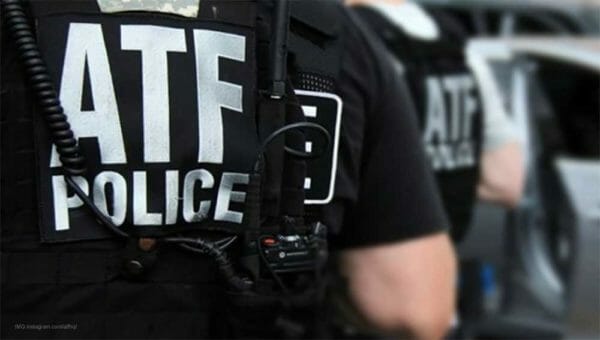
ATF Police Raid IMG 2nd instagram.com/atfhq/
IMG instagram.com/atfhq/

VALLEY CITY, North Dakota — The Bureau of Alcohol, Tobacco, Firearms and Explosives (ATF) has revoked both Federal Firearms Licenses (FFLs) belonging to a gun shop that sued the federal government over the now-dead frames and receiver rule.

Morehouse Enterprises in North Dakota teamed up with Gun Owners of America (GOA) to fight the ATF’s attempt to regulate unfinished frames and receivers through bureaucratic Fiat. The ATF created a rule in response to a White House order to ban 80% firearms that President Joe Biden calls “ghost guns.” This lawsuit was the first case in the country to challenge the now-vacated rule.

Shortly after Morehouse Enterprises filed suit, the ATF launched an inspection of the gun shop. This ATF visit was the first inspection that the store ever received from the ATF. The Industry Operations Inspector (IOI), Jacob Temp, jokingly told the store owner that the ATF discussed whether the inspection would look like retaliation for the court case. The IOI said that the ATF originally would delay any inspection for at least three years, pending litigation, but the Bureau decided to inspect the store anyways.

IOI Temp said that the store did well on their overall level of compliance and expressed approval for the job the shop has done to ensure they followed ATF regulations. Every single firearm was accounted for. All 2700 guns that the store acquired were documented. So were the 2400 dispositions of firearms. The shop felt good about the inspection, but that was all about to change.

Then on March 6, 2023, the ATF issued a “Report of Violations.” The ATF found five policy violations, three of which or simple paperwork errors. The first violation was the store forgetting to record the return of a firearm to a customer that brought the gun in for gunsmithing. The second violation was the store accidentally writing a customer’s Social Security number in the NICS transaction number (NTN) box. A third clerical error was a number left off a NICS transaction number.

The store had two other more serious violations. The store had transferred a handgun to a Georgia resident. FFLs are not allowed to transfer handguns to residents of another state due to the differing gun laws surrounding handguns. In this case, Georgia law is not stricter than North Dakota law.

A second violation was allowing the customer to use a Georgia concealed carry permit in place of a NICS background check. The Brady law allows exceptions to background checks. One of these exceptions is if a state’s concealed carry permit meets or exceeds the same scrutiny as a NICS check. Georgia’s concealed carry permit does that, but it can only be used in lieu of a NICS check in the state of issue.

On May 23, 2023, the ATF informed Morehouse Enterprises of its intent to revoke both of the company’s FFLs, even though the second FFL did not have any violations. President Biden has pressured the ATF to shut down FFLs through his zero-tolerance policies.

FFL revocations are up 500% since Biden took office, but even under Biden’s zero-tolerance policy, the store’s violations do not rise to the level for revocation. Under the president’s policy, the violations only merit a “Warning Conference.”

GOA has once again teamed up with Morehouse Enterprises to defend the company against the ATF’s actions. The gun rights group claims the Bureau’s actions are “Arbitrary, Capricious, an Abuse of Discretion, and Not in Accordance with Law.” The plaintiffs also claim that the ATF is violating the right to bear arms by restricting the acquisition of guns.

The plaintiffs also claim that the ATF is acting in a vindictive manner. They claim that Morehouse’s due process rights have been violated via retaliatory prosecution. They also claim that Morehouse’s First Amendment rights have been violated because the ATF is interfering with the plaintiff’s right to sue the government.

Whether or not the ATF move was retaliatory because of the guns store’s lawsuit is up for debate and will be settled in a court of law, but the optics are not good for the ATF.

Trying to shut down the business of a company suing you looks retaliatory and vindictive regardless of the reason.


About John Crump

John is a NRA instructor and a constitutional activist. John has written about firearms, interviewed people of all walks of life, and on the Constitution. John lives in Northern Virginia with his wife and sons and can be followed on Twitter at @crumpyss, or at www.crumpy.com.

John Crump


from https://ift.tt/RWrlL6I
via IFTTT

Pistol Brace Rule Illegal and Likely Unconstitutional

17 Manufacturing and Design Integrated Folder
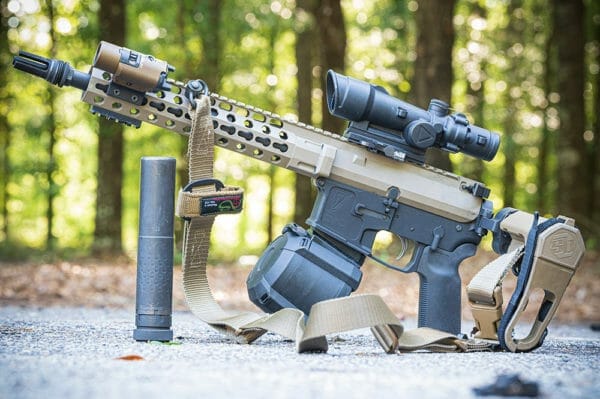
The 17 Manufacturing and Design Integrated Folder helps shrink overall size of this Larue Tactical pistol with Trijicon VCOG, Magpul D60, SB Tactical SBA3 Brace Streamlight VIR II and SilencerCo Saker 762 ASR provided by SilencerShop. IMG Jim Grant

On August 1, 2023, a three-judge panel for the United States Court of Appeals for the Fifth Circuit issued an order which found the “Final Rule” of the ATF concerning pistol braces to be unlawful.  Part of the “Final Rule” claimed pistol braces, combined with legal pistols, made the combination “short barreled rifles” subject to the regulatory requirements of the National Firearms Act (NFA). This contradicted years of previous findings by the ATF. The three-judge panel sent the case back to the trial court for a ruling on a preliminary injunction and on what injunctive relief is called for. The case is Mock v Garland.

The three-judge panel decision was split. Two judges, Don R Willett and Jerry E Smith, were in the majority. Judge Stephen A Higginson dissented. The decision is one of several involving the controversial “Final Rule” of the Biden administration ATF. It may be the Biden Administration will ask the Fifth Circuit to hear the case en banc, or the Biden administration may appeal the decision to the Supreme Court. Of particular interest is the concurrence written by Judge Don Willett. Judge Willet went on record as opining the regulation/law which defines pistols with shoulder stocks as “short barreled rifles” may well be unconstitutional by itself, without the regulatory mismanagement of the ATF in this case. From the order of the Court, page 41:

Don R. Willett,Circuit Judge, concurring: 

I join the majority’s careful opinion in full measure. I write separately because I suspect that the Final Rule would likely fail constitutional muster even if it were a logical outgrowth of the worksheet idea that preceded it.

Rearward attachments, besides making a pistol less concealable,improve a pistol’s stability, and thus a user’s accuracy. Accuracy, in turn, promotes safety. Even for attachments that convert a pistol into a rifle under the statutes, ATF has not identified any historical tradition of requiring ordinary citizens to endure a lengthy, costly, and discretionary approval process just to use accessories that make an otherwise lawful weapon safer. 

Instead, the NFA tends to regulate weapons that inflict indiscriminate destruction: “machinegun[s]”,short-barreled “shotgun[s],” and “smooth bore” weapons (and for that matter, “explosive[s]”, “grenade[s]”, and “poison gas”).1 Weapons that begin as rifles, too, are more difficult to keep accurate once the barrel starts shrinking. 

In my view, protected Second Amendment “conduct” likely includes making common, safety-improving modifications to otherwise lawfully bearable arms.2 Remember: ATF agrees that the weapons here are lawfully bearable pistols absent a rearward attachment. Congress might someday try to add heavy pistols to the NFA and the GCA, but it hasn’t yet. These pistols are therefore lawful. Adding a rearward attachment—whether as a brace or a stock—makes the pistol more stable and the user more accurate. I believe these distinctions likely have constitutional significance under Bruen.

The dissenting Judge, Stephen A Higginson, disagrees. From the dissent by Judge Higginson on page 56:

I disagree that these braces are, in relevant regard, “safety-improving modifications.” After all, as a plurality of the Supreme Court has observed, it is “clear from the face of the [NFA] that [its] object was to regulate certain weapons likely to be used for criminal purposes,” and “the regulation of short-barreled rifles . . . addresses a concealable weapon likely to be so used.” United States v. Thompson/Ctr. Arms Co., 504 U.S. 505, 517 (1992) (plurality opinion) (emphasis added). Indeed, as some commenters observed in response to ATF’s proposed rule, “short-barreled rifles are uniquely dangerous because they ‘combine the power of shoulder-mounted rifles with the concealability of handguns’ and . . . ‘stabilizing braces’ are functionally equivalent to shoulder stocks.” Final Rule at 6,498. Other commenters, “including former law enforcement officers,” favored the proposed rule because braced pistols, “as evidenced by their use in the Boulder[, Colorado] and Dayton[, Ohio] mass shootings, ‘are unusually dangerous because they can be easily concealed like a handgun but have the firepower and accuracy of a rifle.’” Id. (emphases added). Increased concealability and accuracy, at least in the hands of killers, is not “safe”—it is lethal.

Judge Higginson does not mention the Thompson/Ctr. Arms Co. case occurred long before the Heller decision in 2008, the McDonald decision in 2011, or the Bruen decision in 2022. Those decisions would now be relevant to the 1992 case but did not exist when the case was settled. Moreover, Judge Higginson conveniently does not mention handguns with shoulder stocks are less concealable than handguns without shoulder stocks. This argument is a variation of the “guns are bad, and more guns are worse” simplistic premise shown to be false over the last 50 years and more.  Shoulder-stocked handguns were not considered during the Congressional debate in 1934. They were not formally found to be “short barreled rifles” until 1961. Handguns with shoulder stocks were commonly used for lawful purposes long before the 1934 law was passed. They are not “dangerous and unusual.” They are bearable arms in common use, protected under the Second Amendment. Judge Willet is showing how this may be seen by the Supreme Court.

Following this line of reasoning, it should be expected silencers/suppressors or gun mufflers would also be protected under the Second Amendment. A shoulder stock is an accessory that makes a protected arm safer and more effective. Exactly the same can be said of a silencer/suppressor.


About Dean Weingarten:

Dean Weingarten has been a peace officer, a military officer, was on the University of Wisconsin Pistol Team for four years, and was first certified to teach firearms safety in 1973. He taught the Arizona concealed carry course for fifteen years until the goal of Constitutional Carry was attained. He has degrees in meteorology and mining engineering, and retired from the Department of Defense after a 30 year career in Army Research, Development, Testing, and Evaluation.

Dean Weingarten


from https://ift.tt/AoVsvSY
via IFTTT

Armed Security Required at all Texas Public Schools in 2024

armed school teacher classroom student beretta apple iStock-kenlh 924246940

U.S.A. — In the American colonial days, several colonies required colonists to be armed for public safety. Texas, in a statute designed to reduce the risk of mass murder at public schools, will require armed security at public schools starting next year. Texas bill HB3 passed in 2023. It requires an armed security officer at all Texas public schools K-12 starting in 2024.

Sec. 37.0814. ARMED SECURITY OFFICER REQUIRED. (a) The board of trustees of each school district shall determine the appropriate number of armed security officers for each campus; however, they shall ensure that at least one armed security officer is present during regular school hours at each district campus

(b) A security officer described by Subsection (a) must be:

(1) a school district peace officer;
(2) a school resource officer;
(3) a commissioned peace officer employed as security personnel under Section 37.081;
(4) a school marshal; or
(5) a school district employee who:

(A) has completed school safety training provided by a qualified handgun instructor certified in school safety under Section 411.1901, Government Code; and
(B) carries a handgun on their person on school premises in accordance with written regulations or written authorization of the district under Section 46.03(a)(1)(A), Penal Code.

HB3 lists only five ways for school districts to comply with the statute. Three of them are very expensive. They require officers who have extensive training in areas far beyond what is needed to defend against a mass killer. The cost of certified law enforcement officers (options 1-3) are about $100,000 a year. The fourth option is the school marshal program. The cost of a school marshal is about 80 hours to start, with renewal every two years. The fifth option is the school guardian program. The school guardian program is the least expensive and arguably the most effective option.  The cost of the school guardian program is about $800 to $1000 a year. About 450 Texas independent school districts (ISD) out of roughly 1040 ISDs are already participating in the school guardian program.

The school guardian program is allowed under Sec. 411.1901:

Sec. 411.1901. SCHOOL SAFETY CERTIFICATION FOR QUALIFIED HANDGUN INSTRUCTORS. 

(a) The department shall establish a process to enable qualified handgun instructors certified under Section 411.190 to obtain an additional certification in school safety. The process must include a school safety certification course that provides training in the following:

(1) the protection of students;

(2) interaction of license holders with first responders;

(3) tactics for denying an intruder entry into a classroom or school facility; and

(4) methods for increasing a license holder’s accuracy with a handgun while under duress.

(b) The school safety certification course under Subsection (a) must include not less than 15 hours and not more than 20 hours of instruction.

(c) A qualified handgun instructor certified in school safety under this section may provide school safety training, including instruction in the subjects listed under Subsection (a), to employees of a school district or an open-enrollment charter school who hold a license to carry a handgun issued under this subchapter.

(d) The department shall establish a fee in an amount that is sufficient to cover the costs of the school safety certification under this section.

(e) The department may adopt rules to administer this section.

This correspondent predicts a steep rise in the number of Texas ISDs participating in the school guardian program in 2024.


About Dean Weingarten:

Dean Weingarten has been a peace officer, a military officer, was on the University of Wisconsin Pistol Team for four years, and was first certified to teach firearms safety in 1973. He taught the Arizona concealed carry course for fifteen years until the goal of Constitutional Carry was attained. He has degrees in meteorology and mining engineering, and retired from the Department of Defense after a 30 year career in Army Research, Development, Testing, and Evaluation.

Dean Weingarten


from https://ift.tt/ZhtJ0jv
via IFTTT

Thursday, August 3, 2023

With NRA Facing Troubles, NSSF is New Bogeyman for Anti-Gun Crowd

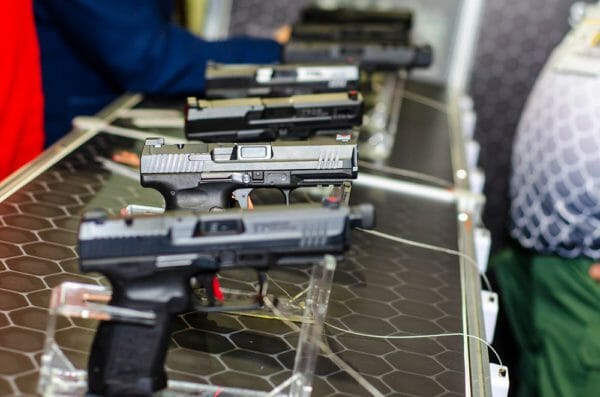
Canik iStock 1182677191
The National Shooting Sports Foundation is the newest bogeyman for the gun prohibition lobby. IMG iStock-1182677191

U.S.A. — ANALYSIS: With the National Rifle Association presumably “on the ropes” due to its ongoing legal battle, gun prohibition lobbying groups need a new bogeyman in their battle to erode the Second Amendment, and an article in The Guardian has revealed their new high-profile target: the National Shooting Sports Foundation.

The strategy isn’t even subtle, with Adzi Vokhiwa, director of federal affairs at the anti-gun Giffords group, declaring, “Make no mistake: the NSSF is even more insidious than the NRA with its ever-expanding lobbying operation and abnormally cozy relationship with its regulator.”

A close read of The Guardian article, authored by Washington-based journalist Peter Stone, reveals something important: Instead of once again portraying NRA as a lobbying group for the gun industry, an allegation mocked by many gun rights activists as absurd, NSSF is now rightly recognized for its activities as the firearms industry umbrella group, which it has been for decades. For years, anti-gunners portrayed NRA as being a lobbying group for gun makers rather than representing the interests of its millions of members.

Possibly NSSF’s greatest offense is its annual Shooting, Hunting and Outdoor Trade (SHOT) Show, held in Las Vegas. It is considered by many to be the biggest firearms industry trade show in the country, if not the world and the gun ban crowd cringes during its four-day run.

Among its other “faults” could be NSSF’s promotion of firearms safety, its involvement in suicide prevention efforts, support for hunting and competitive shooting, and its efforts to educate firearms retailers about prevention of theft and straw purchases.

Stone’s article quotes Kristen Rand, an attorney with the Violence Policy Center, who states, “The NSSF functions as the gun industry’s voice, with a singular focus on expanding the market for all types of firearms, including assault weapons and short-barreled rifles, and is eclipsing the NRA’s lobbying power on Capitol Hill.”

It’s something of a “Well, DUH!” observation, since any industry trade group—regardless of the industry—is expected to do exactly that; be the voice for the specific industry, even firearms.

Rand is quoted further, unintentionally describing what a competent trade umbrella group’s job is: “The NSSF burrows in on every nook and cranny of gun regulation as it works to ensure that the gun industry’s financial interests are consistently and zealously represented – on even the most arcane issues. For NSSF, gun violence prevention legislation is literally bad for business.”

Except that “gun violence prevention legislation” rarely, if ever, accomplishes its advertised mission. Washington State provides proof positive that such legislative efforts have failed miserably. As reported by Ammoland News back on June 16, Evergreen State gun control has been disastrous, with rising homicide numbers. Since 2015, the number of murders has doubled in Seattle, the state’s largest city and home to a billionaire-backed gun prohibition lobbying group.

Reacting to The Guardian article, Lawrence Keane, NSSF senior vice president and general counsel told Ammoland News via email, “NSSF makes no apology for effectively representing the interest of our members. NSSF lives rent free in the minds of the antigun left and their allies in the mainstream media who are desperately trying to paint NSSF as their new villain. NSSF is not so easily demonized. What NSSF is guilty of is working toward real solutions to make our communities safer.”

In a follow-up, he added, “I loved (Rand’s) nooks and cranny line. I’m the English muffin of lobbying.”

During the past couple of years, NSSF has, indeed, raised its profile as legislative attacks on the firearms industry have increased with efforts by Democrat-controlled legislatures considering, or adopting, legislation intentionally designed to collide with the federal Protection of Lawful Commerce in Arms Act (PLCAA), a law signed by then-president George W. Bush more than 15 years ago. It was passed by Congress to put a stop to harassment lawsuits filed essentially to cost the firearms industry millions of dollars, perhaps with hopes of bankrupting gun manufacturers.

Anti-gunners are also miffed that NSSF joined other pro-Second Amendment organizations in opposing the confirmation of David Chipman—President Joe Biden’s first pick to head the Bureau of Alcohol, Tobacco, Firearms and Explosives (ATF) because of his past history as a lobbyist for a gun control organization after he left the ATF, where he had previously been employed.

The article also notes how NSSF’s “legal muscle has expanded in the last year since the NSSF tapped the former solicitor general Paul Clement as an outside lawyer to fight laws in seven states that limit the protections from lawsuits that were granted by Congress.”

Absent from The Guardian’s piece are any references to other groups which have also risen in prominence over the past several years due to their increased legal activity. This would include the Second Amendment Foundation (SAF) and Firearms Policy Coalition. The Citizens Committee for the Right to Keep and Bear Arms is also picking up its pace, having announced this week that Andrew Gottlieb has been named “managing director” of the grassroots lobbying organization. CCRKBA is the sister organization of SAF, and has occasionally been involved in legal actions.

For example, CCRKBA was a co-plaintiff in the lawsuit successfully derailing a City of Seattle attempt several years ago to ban firearms in city park facilities, in direct violation of Washington’s firearms preemption statute. CCRKBA is also a plaintiff in the federal court challenge of Maryland’s ban on so-called “assault weapons.”

Perhaps in a future attack on the Second Amendment movement, those groups will also be demonized. In order to justify its increasingly extreme demands, the gun prohibition lobby will need to find as many foes as possible.


About Dave Workman

Dave Workman is a senior editor at TheGunMag.com and Liberty Park Press, author of multiple books on the Right to Keep & Bear Arms, and formerly an NRA-certified firearms instructor.Dave Workman


from https://ift.tt/Yu2KXVp
via IFTTT

Armed Citizen Defends his Family and Stops Violent Housemate

Homeowner Shoots Intruder Attempting Break-In in Louisiana
Armed Citizen Defends his Family and Stops Violent Housemate, iStock-1354938183

U.S.A. — A domestic dispute turned violent when a 35-year-old adult male forced his way into a bedroom occupied by another family. The father of that second family defended his child and shot the intruder when the family members were cornered in the bedroom. The police are often slow to close an investigation, and this case took 14 months before the defender was confident he wouldn’t be charged.

The report implies that the two families were living in the same home. The 35-year-old, identified as Travis Kenyon, was fighting with one of the women who lived in the home. After that fight, the homeowner told Kenyon that he would have to move out the next day. The confrontation became more heated from there.

It was about 9 in the evening when Kenyon forced his way past the homeowner and entered one of the bedrooms. A second adult male and a child were in that bedroom. They retreated until the angry 35-year-old cornered them. The second adult male shot Kenyon five times in the torso when cornered. There was an open call to 911 that recorded the gunshots. Police and Fire/Rescue responded to the scene.

The defender put his gun away before the police entered the home. Police swept the home twice to make sure the scene was safe. Reports indicate that the police were surprised by the large number of people in the home at the time of the shooting. Fire/Rescue responders declared the attacker dead at the scene.

The defender identified himself to the arriving police officers. He reported that he had a concealed carry permit and showed the police his identification. The defender also showed the officers where he stored his gun and then surrendered his firearm. The defender gave the investigating officers a brief statement and later invoked his right to remain silent. Police were at the home until the next morning, taking numerous statements and processing evidence.

The news reports implied that the defender was not charged with a crime because of Florida’s “stand your ground” statutes. Detectives told a different story. Detectives said the defender was in “imminent fear for his safety, and that of his family” and was cornered when he shot the attacker, who “forcefully entered an occupied bedroom.”

Even states without a stand-your-ground law still recognize that the duty to retreat only applies when we can retreat safely.

Note that someone called 911 before the attacker forced his way into the bedroom. The defender had a carry permit which told the arriving officers that he did not have a criminal record. There were also numerous witnesses that could describe the attacker’s state of mind. Those witnesses reported what the attacker said and did before he cornered the second male and child in the bedroom.


About Rob Morse

Rob Morse writes about gun rights at Ammoland, at Clash Daily, at OpsLens, and on his SlowFacts blog. He hosts the Self Defense Gun Stories Podcast and co-hosts the Polite Society Podcast. Rob was an NRA pistol instructor and combat handgun competitor.

Rob Morse


from https://ift.tt/f5wDZxm
via IFTTT

Arkansas Law Protects Medical Marijuana Users Gun Rights

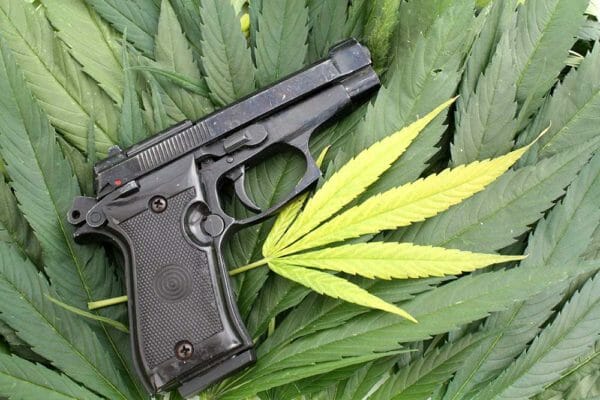
sangriana-iStock-823603532
Arkansas Law Protects Medical Marijuana Users Gun Rights , iStock-823603532

U.S.A. — The state of Arkansas has created a law to protect the ability of medical marijuana users in the state to obtain a concealed carry handgun license. HB1784 was introduced on March 29, 2023. On April 4th, 2023, the House voted for bill HB1784, 82 to 5, with 8 not voting and 5 not present. On April 7, 2023, the Senate voted for the bill HB1784, 26 to 3, with two not voting and two not present. HB1724 was signed by Governor Sarah Huckabee Sanders (R) into law on April 12, 2023. Here are relevant excerpts. From the Arkansas State Legislature:

(B) The director shall not consider a person’s status as a qualifying patient or designated caregiver under the Arkansas Medical Marijuana Amendment of 2016, Arkansas Constitution, Amendment 98, § 2, in determining whether an applicant is eligible to be issued a license to carry a concealed handgun under this subchapter….

(C) An applicant shall not be considered to chronically or 13habitually abuse a controlled substance based solely on the applicant’s 14status as a qualifying patient or designated caregiver under the Arkansas 15Medical Marijuana Amendment of 2016, Arkansas Constitution, Amendment 98.

This part of the statute prohibits the Arkansas Department of Health from disclosing the status of a person as a marijuana user in a criminal history check or other background checks which will be used in consideration of the issuance of a concealed carry handgun license.

20-56-308. Firearm rights protections.

(a) The General Assembly finds that under Arkansas Constitution, Amendment 98, § 5(f), a person’s status as a qualifying patient or designated caregiver is confidential.

(b) The Department of Health shall not disclose the identity of a person who has been issued a registry identification card to the Division of the Arkansas State Police for the purpose of facilitating a criminal history record check or any other background check related to the issuance of a license to carry a concealed handgun under § 5-73-301 et seq.

(c) The Director of the Division of Arkansas State Police shall not consider a person’s status as a qualifying patient or designated caregiver under the Arkansas Medical Marijuana Amendment of 2016, Arkansas Constitution, Amendment 98, § 2, in determining whether an applicant or licensee is eligible to be issued a license to carry a concealed handgun under § 5-73-301 et seq.

The Arkansas law takes effect on August 1, 2023.

Arkansas is a Constitutional Carry state. No permit is needed to carry a loaded handgun, openly or concealed. The permit is useful to carry in other states which recognize the Arkansas permit.

On the federal level, U.S. District Court Judge Patrick R. Wyrick found the prohibition on Marijuana users from purchasing and owning firearms in federal law to be unconstitutional. The case is in the Western District of Oklahoma in the Tenth Circuit Court of Appeals. The United States Attorney has filed an appeal to the Tenth Circuit Court of Appeals.

A bill, H.R.2772, the GRAM Act, has been filed in Congress to remove marijuana from the list of substances whose use disqualifies a person from being able to legally purchase a firearm or to possess one. The act does not appear to have much support at present.

Such disqualifiers are recent additions to federal law. They do not have historical precedents. In time, I expect they will be found to be unconstitutional by the Supreme Court.


About Dean Weingarten:

Dean Weingarten has been a peace officer, a military officer, was on the University of Wisconsin Pistol Team for four years, and was first certified to teach firearms safety in 1973. He taught the Arizona concealed carry course for fifteen years until the goal of Constitutional Carry was attained. He has degrees in meteorology and mining engineering, and retired from the Department of Defense after a 30 year career in Army Research, Development, Testing, and Evaluation.

Dean Weingarten


from https://ift.tt/jwGamu2
via IFTTT

FPC File Response to Government Attempt to Reinstate ATF’s “Frame or Receiver” Rule

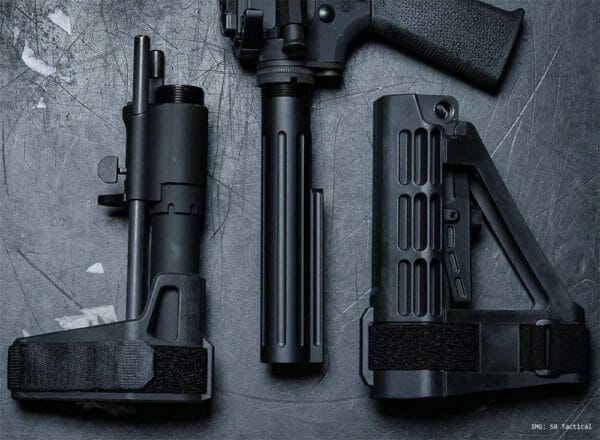
SB Tactical Stabilizing Braces

U.S.A. — Firearms Policy Coalition (FPC) and FPC Action Foundation (FPCAF) filed a response brief with the Supreme Court in VanDerStok v. Garland, their lawsuit where the Fifth Circuit refused to stay a federal district court’s decision to vacate significant portions of the ATF’s “frame or receiver” rule. Following the Fifth Circuit’s decision, the government asked the Supreme Court to fully stay the ruling and allow the rule to remain in effect while the lawsuit continues. The brief can be viewed at FPCLegal.org.

“The district court correctly held that the Bureau of Alcohol, Tobacco, Firearms, and Explosives (“ATF”) has exceeded its authority by seeking to depart from over fifty years of regulatory practice and extend the definitions of ‘firearm’ and ‘frame or receiver’ in federal law beyond any reasonable understanding of those terms,” argues the brief. “The district court also correctly held that vacatur is a proper remedy when a federal agency has been found to exceed its statutory authority, as courts have consistently held since the enactment of the Administrative Procedure Act in 1946.”

Key to the case surrounding ATF’s expansive redefinition of “frame or receiver,” the brief argues: “Here, Congress determined that “frame[s] or receiver[s]” should be regulated as firearms, and ATF has no authority to expand that phrase to include items that are neither frames nor receivers, but merely could be manufactured into them.”

“Our brief today demonstrates just how flawed the government’s arguments are in this case,” said Cody J. Wisniewski, FPCAF’s General Counsel and Vice President of Legal and counsel for FPC in this case. “We’re confident that the Supreme Court will see through ATF’s arguments, just as the Fifth Circuit and district court have, and will ensure that ATF is prevented from enforcing its unlawful rule while they seek to litigate their appeal of their loss at the district court.”

Plaintiffs in this case are two individuals, Tactical Machining, LLC, and FPC. FPCAF represents the Plaintiffs, alongside Mountain States Legal Foundation.

Individuals who would like to join the FPC Grassroots Army and support important pro-rights lawsuits and programs like these can sign up at JoinFPC.org. Individuals and organizations wanting to support charitable efforts in support of the restoration of Second Amendment and other natural rights can also make a tax-deductible donation to the FPC Action Foundation. For more on FPC’s lawsuits and other pro-Second Amendment initiatives, visit FPCLegal.org and follow FPC on Instagram, Twitter, Facebook, YouTube.


About Firearms Policy Coalition

Firearms Policy Coalition (firearmspolicy.org), a 501(c)4 nonprofit organization, exists to create a world of maximal human liberty, defend constitutional rights, advance individual liberty, and restore freedom. FPC’s efforts are focused on the Right to Keep and Bear Arms and adjacent issues including freedom of speech, due process, unlawful searches and seizures, separation of powers, asset forfeitures, privacy, encryption, and limited government. The FPC team are next-generation advocates working to achieve the Organization’s strategic objectives through litigation, research, scholarly publications, amicus briefing, legislative and regulatory action, grassroots activism, education, outreach, and other programs.Firearms Policy Coalition


from https://ift.tt/xVyNIu5
via IFTTT