Worst Anti-Knife City in America Caves to Knife Rights 2A Lawsuit
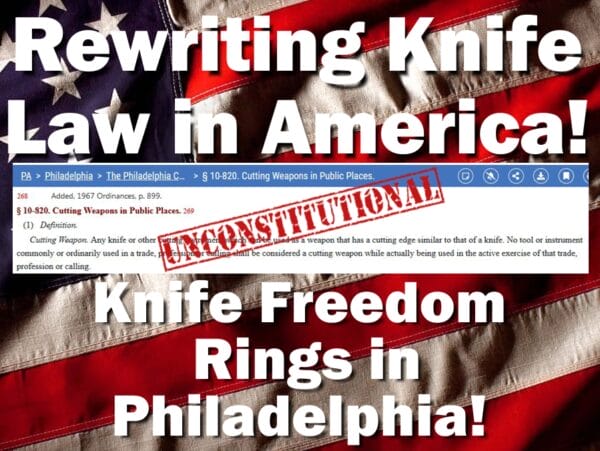
U.S.A. —In 2014, Knife Rights published a list of the Ten Worst Anti-Knife Cities in America. At that time, New York City was number one, but we fixed New York City’s “gravity knife arrests” problem in 2019, moving Philadelphia up to the number one Worst Anti-Knife City spot.
Now Knife Rights has accepted Philadelphia’s offer of judgment in Knife Rights, Inc. v. Outlaw, our federal Second Amendment lawsuit that sought to declare unconstitutional and enjoin Philadelphia’s laws that ban the possession and carry of any bladed arms (knives) in public. The City also agreed to pay $10,000 to cover Knife Rights’ legal expenses.
Knife Rights Chairman Doug Ritter said, “we are excited that after the Supreme Court precedent in Bruen, Philadelphia has recognized that its ban on carry and use of knives in public could not pass constitutional muster. As the premier advocacy organization for the right to possess and carry knives, Knife Rights looks forward to striking down all unconstitutional knife bans throughout the United States.”
The bottom line is that with the judge’s order issued Monday, it is no longer illegal to possess or carry a knife in public in Philadelphia. That includes an automatic knife that is carried openly and not concealed — also due to Knife Right’s efforts — became legal in Pennsylvania on January 2nd this year. Note that you still cannot carry any knife that is still illegal in the state, including daggers and similar knives.
Ritter noted, “We sincerely appreciate our individual plaintiffs in this case, Knife Rights members Keith Fetsurka and Scott Mele. It takes courage to step up and be plaintiffs in Second Amendment cases and without plaintiffs, there’s no case. We cannot thank them enough.”
Attorney John Dillon said, “It is refreshing when the government, even local government, acknowledges reality and admits they cannot prohibit arms in common use. We will continue our efforts to ensure that cities and states throughout the United States come to the same conclusion. Our rights are not up for debate.”
“We’re thrilled with today’s outcome,” said William Sack, local counsel on the matter. “The City did the right thing by promptly agreeing to a settlement instead of wasting the taxpayers’ money on needless litigation.”
In its 2022 NYSRPA v. Bruen decision, the Supreme Court emphasized that the Second Amendment right to keep and bear arms, applied against states and local governments through the Fourteenth Amendment, is not “a second-class right, subject to an entirely different body of rules than the other Bill of Rights guarantees.” In 2021, Knife Rights filed an important amicus (friend of the court) brief in the Supreme Court that was cited in the Bruen decision.
Knife Rights
Knife Rights is America’s grassroots knife owners’ organization, leading the fight to Rewrite Knife Law in America and forging a Sharper Future for all Americans. Knife Rights efforts have resulted in 40 bills enacted repealing knife bans in 26 states and over 150 cities and towns since 2010.
The Second Amendment Foundation’s Gun Rights Policy Conference is something unique in the gun world. There aren’t acres of booths or tables covered with guns and gear. The conference was not designed for manufacturers or distributors, although they’re certainly welcome. GRPC was designed for us.
What you will get is a master’s class in grassroots activism, delivered from the best people the gun world has to offer. More than 70 speakers have been chosen from the leadership of the gun-rights movement. Together, their presentations will help chart our course for years to come.
The 38th Annual Gun Rights Policy Conference (GRPC 2023) will be held September 22nd – September 24th, 2023 in Phoenix, AZ. This year’s theme is “Road to Liberty!”
GRPC will be streamed on multiple virtual platforms too, includingYouTubeandFacebook.
GRPC could not come at a better time. The Biden-Harris administration has been relentless in its war on our gun rights. Biden’s weaponized ATF and well-armed IRS have been on a tear. Armed with Biden’s zero-tolerance policy, these two agencies are targeting gun dealers every single day. What used to be considered minor paperwork errors now results in the revocation of the dealer’s Federal Firearm License since Biden falsely believes if he gets rid of gun dealers, he’ll get rid of all our guns.
The only antidote to the unconstitutional orders coming from the resident of 1600 Pennsylvania Avenue is information – shared information – and at GRPC, you’ll get that in droves. We will arm you with proven tactics you can use to push back against Biden’s imperial decrees and safeguard your rights.
There’s another big bonus to attending GRPC in person. You’ll be surrounded by like-minded, pro-gun folks. There’s no substitute for this level of camaraderie and networking. It will recharge your batteries, and you’ll leave even more committed to the cause than when you arrived. This is the real perk – the people. It’s why GRPC is in its 38th year.
I hope to see you next month. Please come up and say hello. My batteries are in dire need of recharging.
This story is presented by the Second Amendment Foundation’s Investigative Journalism Project and wouldn’t be possible without you. Please click here to make a tax-deductible donation to support more pro-gun stories like this.
About Lee Williams
Lee Williams, who is also known as “The Gun Writer,” is the chief editor of the Second Amendment Foundation’s Investigative Journalism Project. Until recently, he was also an editor for a daily newspaper in Florida. Before becoming an editor, Lee was an investigative reporter at newspapers in three states and a U.S. Territory. Before becoming a journalist, he worked as a police officer. Before becoming a cop, Lee served in the Army. He’s earned more than a dozen national journalism awards as a reporter, and three medals of valor as a cop. Lee is an avid tactical shooter.
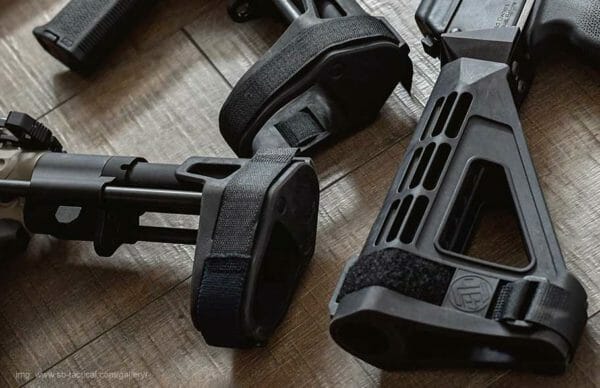
SB Tactical SBPDW and SBM4 Braces IMG SB Tactical gallery
U.S.A. — Firearms Policy Coalition (FPC) and FPC Action Foundation (FPCAF) announced that the Fifth Circuit Court of Appeals has ruled in Mock v. Garland, finding that FPC and FPCAF are likely to win on the merits of their lawsuit challenging ATF’s pistol brace rule. The Fifth Circuit also remanded the lawsuit back to the district court with instructions to reconsider the other preliminary injunction factors within 60 days. The opinion can be viewed at FPCLegal.org.
“The ATF incorrectly maintains that the Final Rule is merely interpretive, not legislative, and thus not subject to the logical-outgrowth test,” writes Judge Smith in the Court’s opinion. “The Final Rule affects individual rights, speaks with the force of law, and significantly implicates private interests. Thus, it is legislative in character. Then, because the Final Rule bears almost no resemblance in manner or kind to the Proposed Rule, the Final Rule fails the logical-outgrowth test and violates the APA.”
The Court goes on to state: “To ensure relative stability, we MAINTAIN the preliminary injunction pending appeal that the motions panel issued on May 23, 2023, as clarified by this merits panel on May 26, 2023. This court’s injunction will expire 60 days from the date of this decision, or once the district court rules on a preliminary injunction, whichever occurs first. We direct the district court to rule within 60 days.”
“Said in its simplest terms, the Fifth Circuit just indicated that the Plaintiffs–Firearms Policy Coalition, Maxim Defense, and FPC’s individual members–are likely to defeat ATF’s pistol brace rule when the merits of this case are finally heard,” said Cody J. Wisniewski, FPCAF’s General Counsel and FPC’s counsel in this case. “This is a huge win for peaceable gun owners across the nation, a huge win for FPC’s members, and yet another massive defeat for ATF and this administration’s gun control agenda.”
Individuals who would like to Join the FPC Grassroots Army and support important pro-rights lawsuits and programs can sign up at JoinFPC.org. Individuals and organizations wanting to support charitable efforts in support of the restoration of Second Amendment and other natural rights can also make a tax-deductible donation to the FPC Action Foundation. For more on FPC’s lawsuits and other pro-Second Amendment initiatives, visit FPCLegal.org and follow FPC on Instagram, Twitter, Facebook, YouTube.
About Firearms Policy Coalition
Firearms Policy Coalition (firearmspolicy.org), a 501(c)4 nonprofit organization, exists to create a world of maximal human liberty, defend constitutional rights, advance individual liberty, and restore freedom. FPC’s efforts are focused on the Right to Keep and Bear Arms and adjacent issues including freedom of speech, due process, unlawful searches and seizures, separation of powers, asset forfeitures, privacy, encryption, and limited government. The FPC team are next-generation advocates working to achieve the Organization’s strategic objectives through litigation, research, scholarly publications, amicus briefing, legislative and regulatory action, grassroots activism, education, outreach, and other programs.
James Bond author Ian Fleming wrote, “Once is happenstance. Twice is coincidence. Three times is enemy action.” It could be time for New Zealand gun owners to start getting suspicious.
On July 26, the New Zealand Herald reported that the country’s new Firearms Safety Authority had compromised the personal information of more than 100 gun owners. The paper explained,
In an email sent shortly after noon on Wednesday, seen by the Herald, Auckland Central Police District firearms staff emailed more than 100 gun owners to warn them their listed firearms licence address may not be up to date.
Their email addresses, in many cases including their first and last names, were visible in the cc field, rather than hidden in the bcc section.
The visible addresses included various prominent Auckland residents, including lawyers, company directors, police officers and government officials.
The Firearm Safety Authority described the data breach as an “error.”
The Herald quoted one gun owner as saying, “Gangs and criminals would no doubt love to get a copy of this shopping list, and now my information, the fact I’m a license holder, has been sent to 100 people whom I do not know.” The paper went on to explain that this gun owner “said the leak of the list of owners was exactly the reason he was worried about handing his details over to the new firearms register.”
This isn’t the first time New Zealand has had a problem securing gun owner data.
In June 2022, the Herald published an article titled, “Firearm owners’ details stolen in alleged burglary of old Auckland police station.” In August 2022, New Zealand outlet Newshub reported,
Police have revealed the details of around 400 gun owners – including names and possibly the types of firearms they had – were stolen from the old Auckland police station.
Sensitive documents were being stored inside the dilapidated and disused former Auckland City police station where staff no longer work.
The Newshub piece quoted Council of Licensed Firearms Owners Spokesperson Hugh Devereux-Mack, who said, “This makes firearms owners feel incredibly unsafe because the police have let us down in a way that puts a target on our backs for organised crime.”
At the time, the authorities told Newshub that “the chance of paperwork being stolen will be greatly reduced as the new gun register will be a digital system.” Ironic, given recent events.
In 2019, information connected to New Zealand’s mandatory gun “buyback” (gun confiscation) program was compromised. On December 2, 2019, The Guardian published a piece titled, “New Zealand’s gun buyback website ‘a shopping list for criminals.’” The outlet reported, “a gun lobby group said it had spoken to 15 people who were able to access information on a website where firearms owners registered weapons to be relinquished. It included their names, addresses, dates of birth, firearms licence numbers and bank account details, the group said.”
When confronted with the security breach, officials acknowledged the leak, but attempted to shift blame to a government contractor hired to create the website. The Guardian item explained,
New Zealand’s deputy police commissioner, Mike Clement, said an update on the buyback scheme’s website last week had caused personal information to be revealed more widely than it should have been. He blamed the software provider…
Of course, New Zealand isn’t the only jurisdiction incapable of safeguarding gun owner data. Stateside, California has proven itself a model of incompetence.
In June 2022, California Attorney General Rob Bonta announced the launch of the California Department of Justice (DOJ)’s Firearms Dashboard Portal. The data tool was designed to give granular firearm transaction and Concealed Carry Weapons (CCW) permit holder data to anyone visiting the DOJ’s website. However, astute users quickly realized that the dashboard could be used to access the personally identifying information of California CCW holders – including date of birth, full name, and address.
Explaining some of the extent of the breach, an article from firearms news outlet The Reload explained,
The Reload reviewed a copy of the Lost Angeles County database and found 244 judge permits listed in the database. The files included the home addresses, full names, and dates of birth for all of them. The same was true for seven custodial officers, 63 people with a place of employment permit, and 420 reserve officers.
2,891 people in Los Angeles County with standard licenses also had their information compromised by the leak, though the database appears to include some duplicate entries as well.
At the time, NRA was independently contacted by a concerned California resident who provided the organization with an image containing some of the leaked information, including gun owners’ full names and dates of birth.
Despite California’s proven inability to protect gun owner data, on July 26 the L.A. Times published what is ostensibly a news article whining, “The GOP and the NRA want to stop gun violence research. California is a target.” The implication of the piece was that gun rights supporters oppose California-style gun and gun owner registries because doing so denies such data to social “science” researchers.
This is incorrect. Gun rights supporters oppose gun and gun owner registries because of the potential for official and unofficial abuse.
Gun rights supporters correctly understand that such registries facilitate gun confiscation.
For example, New York City has twice used its gun registry to confiscate arms. Starting in 1967, the Big Apple required residents to register their rifles and shotguns. Then, in 1991, the city banned certain configurations of semi-automatic firearms. The city used its registry to inform those with offending firearms that their guns needed to be removed from the city, disabled or forfeited to law enforcement. The city employed this tactic again as recently as 2013, following the reclassification of another group of rifles.
Second, gun owners, just like other Americans, value their privacy. Whether that privacy is from malevolent government officials or criminals looking for a score, privacy has value – as evidenced by the existence of the Fourth Amendment. In the context of a person exercising a Constitutional right, privacy should be guaranteed. Inhibiting the collection of this data is the only way to adequately ensure this privacy.
The L.A. Times and the anti-gun “researchers” (advocates) it cites appear to take the position that it is their right to pry into the private behavior of law-abiding gun owners, as if this data were akin to the minutes of a city hall meeting. Rather, this data, in the unfortunate event it is collected, represents the private Constitutionally-protected conduct of private citizens and should be treated in the most confidential manner. One imagines these same actors would have a very different take on a government keeping and disseminating records on abortions, book purchases, or protest attendance.
Despite what some self-centered anti-gun advocates might think, the primary goal of restricting government record keeping of gun and gun owner data is to protect gun owners, not to deprive these activists of data. The fact that privacy measures make it harder for these gun control campaigners to concoct junk science aimed at advocating against Second Amendment rights is a side benefit.
As both New Zealand and California show, the only sure way to safeguard gun owner data is to not collect it at all.
About NRA-ILA:
Established in 1975, the Institute for Legislative Action (ILA) is the “lobbying” arm of the National Rifle Association of America. ILA is responsible for preserving the right of all law-abiding individuals in the legislative, political, and legal arenas, to purchase, possess, and use firearms for legitimate purposes as guaranteed by the Second Amendment to the U.S. Constitution. Visit: www.nra.org
Laying Bare the Fake Arguments in the Gun Control Propaganda War IMG iStock
Some Americans believe that a so-called “assault weapons” ban would help curb mass shootings in the United States. They say things such as “The Second Amendment didn’t guarantee the right to own cannons” and “assault weapons only belong in the hands of the military.” While these arguments make sense to the uneducated, they fail to hold water when put under scrutiny.
False Claim #1: An Assault Weapons Ban Would Reduce Casualties.
A complete assault weapons ban would rid the country of what lawmakers usually define as “a semiautomatic gun that can accept a detachable ammunition magazine that has one or more additional features considered useful in military and criminal applications but unnecessary for sports or self-defense, such as a folding, telescoping or thumbhole rifle stock.”
However, according to the Violence Project, (https://ift.tt/Hyxw0Is), which claims to be the “most comprehensive mass shooter database” in the United States, an astonishing 55% of weapons used in mass shootings from 1966 to 2022 were pistols, while only 21% of those weapons were these so-called “assault weapons.” In fact, during the third deadliest mass shooting in US history, Cho Seung-Hui managed to kill 32 people and injure 26 with only a Glock 19 and a Walther P22 chambered in .22lr, two firearms not classified as “assault weapons.”
False Claim #2: Data Shows A Drop In Gun Violence During The Federal Assault Weapons Ban Of 1994 To 2004.
The 1994 bill was never effective at reducing gun crime. It defined an assault weapon by the same general definition still used today – a semi-automatic rifle that accepts detachable magazines with two or more cosmetic features such as a folding stock or pistol grip.
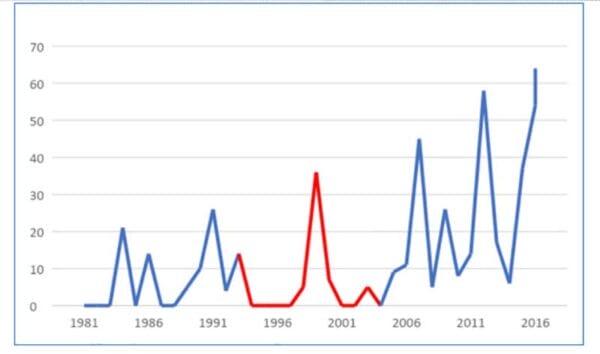
Gun violence during the federal assault weapons ban of 1994 to 2004. Violent crime continued to rise.
As it is, the concept of an “assault weapon” shouldn’t exist at all. The term is an invention of the anti-gun bloc used to scare ignorant voters into going against a mysterious “mass murdering machine” that is, in reality, just as dangerous as any semi-automatic firearm.
According to a survey of state prison inmates from 1991, only 1-8% of weapons used in gun crimes before the ban fell under the definition of an “assault weapon,” so the legislation failed to make a substantial impact, and violent trends continued to rise as normal.
False Claim #3: The Second Amendment Was Written For Muskets; It Didn’t Allow You To Buy A Cannon.
Oh yes, it did. Private merchants who did any sort of overseas trading were both allowed and encouraged to buy cannons for their vessels. Cannons were also present aboard privateer vessels – the ships owned by private citizens who were given letters of marque by Congress, which permitted them to raid British shipping lanes.
The argument here implies the Second Amendment never intended the colonists to have the same weapons as the federal government, yet the reality was the complete opposite. In fact, in 1801, Republican John Beckley of Pennsylvania lodged a complaint that “several hundred stand of arms and 18 pieces of cannon, heretofore in the hands of the Militia…” had been confiscated by federal troops. (Sharp, James Roger. American Politics in the Early Republic: The New Nation in Crisis. United Kingdom, Yale University Press, 1993. #ad) Republicans viewed this as a “usurpation” by Congress against the rights of the people, which justified a civil war.
Thankfully, the reports of weapons being confiscated turned out to be rumors, and a civil war was averted, but this account proves beyond a doubt that the intention of the Second Amendment had always been to safeguard the American people against government overreach, especially if it meant equipping the American people with the same weapons as the government.
False Claim #4: Assault Weapons Hold More Ammo.
A semi-automatic AR-15 which is not, in fact, an assault weapon, can accept a 30-round magazine, but so can a Glock pistol. Likewise, the Kel-Tec P50 comes standard with 50 rounds of 5.7x28mm straight out of the factory. The difference between the AR-15 and the two pistols is neither of the latter two firearms would be affected by a proposed assault weapons ban, and yet they could be just as effective as a semi-automatic rifle when throwing lead downrange.
False Claim #5: The AR-15 Is Deadlier Than Any Hunting Rifle.
Anti-gunners say an AR-15 has deadlier bullets than a hunting rifle, but a .308 shot out of an old-fashioned M1A or a bolt-action hunting rifle is much more damaging than the AR-15’s .223 round. Both rounds can put a hole in a creature at a hundred yards and render it dead, except the common .308 hits its target with much more energy and velocity, creating a greater impact wound, unlike the clean-hitting .223.
False Claim #6: Assault Weapons Have Faster Rates Of Fire
Semi-auto is semi-auto. An AR-15 is not a fully automatic weapon and only fires as fast as you can pull the trigger. Everyone who has ever fired one knows this. In fact, the process of getting a true automatic weapon involves a mountain of paperwork and months of waiting.
For the curious, any citizen who wants to own a fully automatic weapon must be a special occupational taxpayer with a federal firearms license which allows the purchaser to own a fully automatic weapon as well as a letter from law enforcement.
While this is law, it still has not prevented criminals from getting their hands on illegally modified automatic pistols.
False Claim #7: The AR-15 Is A Weapon Of War
This is simply not true. The AR-15, in its modern form, was designed as a civilian version of the M4 Carbine, a select-fire service rifle. No modern army anywhere in the world has ever been issued semi-automatic AR-15s en masse, and the rifle has never been used in any major conflicts.
This is mostly due to its limitations as a weapon. The AR-15’s lack of full-auto mode means it is terrible for laying down suppressing fire, a required component of any modern infantry doctrine.
False Claim #8: America Is Leading The World In Violent Gun Crimes
Brazil leads the world in total gun crime, with 49,436 people dying in 2019, as opposed to the 37,040 killed in the United States. Regarding gun deaths per 100k residents, El Salvador leads the rest of the world with 36.78 per 100k.
Narco states like Colombia and collapsed socialist states like Venezuela are far more dangerous than the United States, but lack of media coverage in these countries combined with a lack of public interest in violence in South America make it seem like the United States is the most dangerous place in the western hemisphere.
False Claim #9: These Weapons Should Only Belong In The Hands Of The Police And Military
This is exactly what the Chinese did. Look at them now.
False Claim #10: There Should Be More Background Checks.
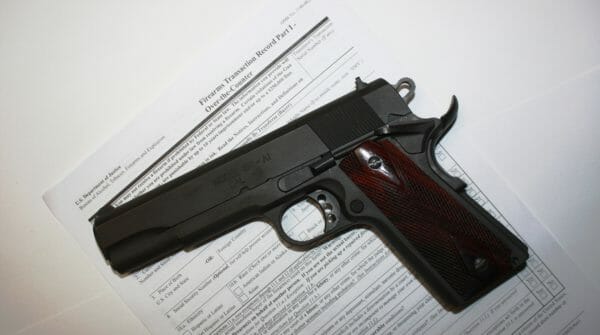
File Photo 4473
There are background checks—people who say this typically aren’t gun owners and have never bought a firearm. Federal background checks must be run for any purchase from a dealer. Mass shooters who slip through the cracks have typically never done anything wrong, and no background check in the world could determine what will happen to a shooter two or three weeks down the line since no crime has been committed yet.
The very people who want to take guns away don’t know what they’re talking about. There is, in fact, no true definition of an “assault weapon,” and the term is exclusively used in anti-gun circles for the sole purpose of villainizing a firearm because of its cosmetic appearance. There is no such thing as a common-sense gun law because anti-gun lawmakers themselves don’t have the common sense necessary to research what they’re trying to get rid of.
In the author’s opinion, the primary factor behind mass shootings is not rooted in history.
Prior to the Gun Control Act of 1968, when access to fully automatic machine guns was more lenient, such incidents were relatively rare, but a significant shift occurred after the 1999 Columbine Shooting. This event seemingly popularized the idea among disturbed individuals that committing a mass shooting could bring them fame and notoriety.
Many modern mass shooters have mental issues, write manifestos, usually plan out their shootings at “gun-free zones,” and intend to die in a blaze of glory to be “remembered forever.” The solution isn’t to ban a specific type of gun. A mass shooter can still kill as effectively with a shotgun or pistol as they could with an “evil, scary AR-15.” The solution is twofold: give people better, more affordable access to mental healthcare and make every school, office, and place of worship a hardened target.
A Silly Argument: The Second Amendment Insurrectionist Purpose
U.S.A. — One of the silliest arguments about the purposes of the Second Amendment is put forward this way. The newly formed Constitutional government would never have created an amendment with the purpose of destroying the government just created. Here is an example from the far-left eugeneweekly.com:
That newly created narrative included the supposed purpose of arming citizens in order to enable them to rebel against the very constitutional government which the Founders were establishing with its checks and balances. This despite the Founders having defined treason as taking up arms against that very government.
But this glaring contradiction persisted and found a home within the halls of the Supreme Court, whose collective wisdom may have suffered from the influx of unreported gifts by billionaires to a number of justices weighing in on the question.
The writer does not appear to have read the history of the Revolutionary War, the Federalist Papers, the arguments surrounding the Bill of Rights, the rudiments of the political theories the Constitution is based on, or the Constitution itself. Knowledge of any one of these fields provides ample refutation of the argument above.
One of the principle causes of the Revolutionary War was the attempt by the Government of England, specifically the King, to disarm the American colonists. The proximate start of the war resulted from an attempt by the Crown to confiscate privately and publicly owned weapons, resulting in the battles of Lexington and Concord. During the war, a British minister proposed disarming all the colonists in perpetuity. Having just defeated a government bent on their disarmament, the successful revolutionaries were not about to grant such power to the newly formed government of the Constitution.
During the argument about ratification of the Constitution in the Federalist Papers, those who were concerned about the centralization of power in the federal government demanded more checks and balances on the newly formed government. From gun quotations of the founding fathers:
“Before a standing army can rule, the people must be disarmed, as they are in almost every country in Europe. The supreme power in America cannot enforce unjust laws by the sword; because the whole body of the people are armed, and constitute a force superior to any band of regular troops.”
– Noah Webster, An Examination of the Leading Principles of the Federal Constitution, October 10, 1787
“Besides the advantage of being armed, which the Americans possess over the people of almost every other nation, the existence of subordinate governments, to which the people are attached, and by which the militia officers are appointed, forms a barrier against the enterprises of ambition, more insurmountable than any which a simple government of any form can admit of.”
– James Madison, Federalist No. 46, January 29, 1788
The Bill of Rights was ratified in December of 1791. It was demanded by the anti-federalists as a check on the powers of the new federal government. It enhanced the existing checks and balances of the Constitution. The people who demanded the Bill of Rights were not those who created the Constitution. They were those who warned of the centralization of power in the Federal government. The Bill of Rights was proposed by the anti-federalists and enthusiastically passed by the states with the overwhelming support of the people. It was not those who proposed and wrote the Constitution who demanded, passed, and ratified the Bill of Rights, including the Second Amendment. It was those who were leery of centralized power who demanded more restraints on the power of the new government. There is no contradiction in this action.
The political theories the Constitution is based on are those of Natural law and Natural rights, theories the founders avidly agreed with and supported.
The Second Amendment is a direct product of the theory of Natural Law, which holds no one, including the government, has the right to take a person’s life or property without due process. Because evil exists in the world, and many are willing to illegitimately take life or property, or to destroy communities, the means to defend your life, property, or community is protected. The right to life fundamentally includes the right to effective means to defend your life. The American revolutionaries understood the flaw in the English Bill of Rights, as put forward by Sir William Blackstone. When they created their distinctly American version of the right to arms, they made it far more powerful and restrictive than the English law which had failed them. St. George Tucker was a prominent revolutionary. As a legal scholar, he rose to the highest level of importance in the early United States. Tucker explained the difference of the treatment of the natural right to arms in England v. the new United States:
“The fifth and last auxiliary right of the subject, that I shall at present mention, is that of having arms for their defense suitable to their condition and degree, and such as are allowed by law. Which is also declared by the same statute 1 W. & M. st. 2 c. 2, and its indeed, a public allowance under due restrictions, of the natural rights of resistance and self-preservation, when the sanctions of society and laws are found insufficient to restrain the violence of oppression.”
Blackstone was explaining the 1689 English Bill of Rights, which provided: “That the Subjects which are Protestants may have Arms for their Defense suitable to their Conditions, and as allowed by Law.”
Tucker added his own analysis in two footnotes:
“The right of the people to keep and bear arms shall not be infringed. Amendments to the C.U.S. Art. 4 and this without any qualification as to their condition or degree, as is the case in the British government.”
The Constitution itself belies the idea the founders would not have included a means to defend against a government that might become tyrannical. The checks and balances in the Constitution are a basic defense against such tyranny. There is no contradiction in including the protection of another basic defense. The right of the people to keep and bear arms is not created by the Constitution, it is protected by it as an additional defense against a government which may become tyrannical. The founders were well aware of the history of governments accumulating power to themselves and turning against the people.
The idea the people who formed the new Constitution would reject their recent experience in the Revolutionary War, reject the commitments to create a Bill of Rights, and reject the historical importance of the individual right to keep and bear arms, because they feared arms in the hands of the people, is ridiculous. The idea the new government chose to limit itself is false. It was the people who opposed the centralization of power who forced the Bill of Rights to be added to the Constitution, as additional protections against a potential future tyranny.
Those who claim there should be no limitations on governmental power push such silliness to centralize more and more power in the hands of the government.
About Dean Weingarten:
Dean Weingarten has been a peace officer, a military officer, was on the University of Wisconsin Pistol Team for four years, and was first certified to teach firearms safety in 1973. He taught the Arizona concealed carry course for fifteen years until the goal of Constitutional Carry was attained. He has degrees in meteorology and mining engineering, and retired from the Department of Defense after a 30 year career in Army Research, Development, Testing, and Evaluation.
Back in March, NRA-ILA alerted members that under the 2022 omnibus federal gun control bill (dubbed the Bipartisan Safer Communities Act or BSCA) that the U.S. taxpayer is funding state Red Flag gun confiscation orders. On July 25, a group of federal lawmakers led by Sen. Roger Marshall (R-Kans.) and Rep. Alex Mooney (R-W.V.) sent a letter to the U.S. Department of Justice demanding answers on how federal resources are being used to advance state Red Flag schemes.
The BSCA, in part, provided grant funding through DOJ’s Byrne State Crisis Intervention Program (SCIP) for states to implement “extreme risk protection order” laws – better known as Red Flag gun confiscation orders. Currently, twenty-one states and Washington, D.C., have Red Flag laws on their books – while a host of pro-gun states, citing due process concerns, have outright rejected the concept.
During the BSCA negotiations, some supporters of the bill contended that to be eligible for the grant funding, state Red Flag programs would be required to meet “strict” due process requirements. BSCA proponent Sen. John Cornyn (R-Texas) published an item on his Senate website that claimed, “[t]his bill would force states with red flag laws to adopt strict and comprehensive due process protections before they qualify for the grant funding.”
The text of the legislation included the following language limiting Red Flag program eligibility:
(iv) extreme risk protection order programs, which must include, at a minimum–
(I) pre-deprivation and post-deprivation due process rights that prevent any violation or infringement of the Constitution of the United States, including but not limited to the Bill of Rights, and the substantive or procedural due process rights guaranteed under the Fifth and Fourteenth Amendments to the Constitution of the United States, as applied to the States, and as interpreted by State courts and United States courts (including the Supreme Court of the United States). Such programs must include, at the appropriate phase to prevent any violation of constitutional rights, at minimum, notice, the right to an in-person hearing, an unbiased adjudicator, the right to know opposing evidence, the right to present evidence, and the right to confront adverse witnesses;
As evidenced by the DOJ’s grant awards, the department appears to take the position that the existing state Red Flag laws meet the BSCA’s due process requirements, rendering this language effectively null. Despite the explicit language requiring pre-deprivation due process, grants are being given to states with ex parte Red Flag procedures. Under an ex parte Red Flag regime, the government can seize a person’s firearms and extinguish their Second Amendment rights without prior notice and a hearing for the person to rebut the allegations against them.
In their letter, the lawmakers pointed out that “[t]he Department of Justice appears to have weaponized the Bipartisan Safer Communities Act to illegally fund ineligible ‘red flag’ laws.” The letter explained that “every ‘red flag’ gun confiscation law in this nation lacks sufficient and constitutional due process protections for gun owners,” and that the minimum due process protections demanded by the BSCA “are not in effect in a single state’s existing ‘red flag’ law statutes.” Further, the lawmakers noted that, contrary to Sen. Cornyn’s professed intention, “[s]ince the passage of the Bipartisan Safer Communities Act, no states have revised their statutes to comply with the ‘due process’ requirements imposed by the 117th Congress.”
The lawmakers also addressed the threat of BSCA SCIP funding being used to bribe states into enacting Red Flag legislation. This is a legitimate concern, and something that gun owners and elected representatives must remain vigilant to prevent.
However, the BSCA’s language does make clear that states may access these funds for programs that have nothing to do with gun control. The relevant statue (34 U.S.C. § 10152), makes clear that the SCIP funds can be used for the,
(I) Implementation of State crisis intervention court proceedings and related programs or initiatives, including but not limited to– (i) mental health courts; (ii) drug courts; (iii) veterans courts
As noted, misuse of these funds is a serious concern. However, to the extent pro-gun jurisdictions apply and receive SCIP funding for legitimate non-gun control purposes, they can ensure that the available funds are not used for carrying out unconstitutional Red Flag gun confiscation schemes.
For instance, Montana’s grant award makes clear that the state will not use its nearly $1.4 million SCIP funding to pursue gun control. The award states, “Montana has no Extreme Risk Protection Order (ERPO) laws in place therefore, it is not anticipated the CIAB will pursue any types of ERPO programs.” The Treasure State award makes clear that the focus of its SCIP funding will be on “[s]pecialized court-based programs such as drug, mental health, and veterans’ treatment courts.”
Sen. Marshall and Rep. Mooney requested that the DOJ respond to their concerns no later than August 18. NRA-ILA eagerly awaits the department’s response.
About NRA-ILA:
Established in 1975, the Institute for Legislative Action (ILA) is the “lobbying” arm of the National Rifle Association of America. ILA is responsible for preserving the right of all law-abiding individuals in the legislative, political, and legal arenas, to purchase, possess, and use firearms for legitimate purposes as guaranteed by the Second Amendment to the U.S. Constitution. Visit: www.nra.org