Wednesday, October 5, 2022

Second Amendment Activists ~ Now Is NOT the Time To Retreat, Hold the Line!

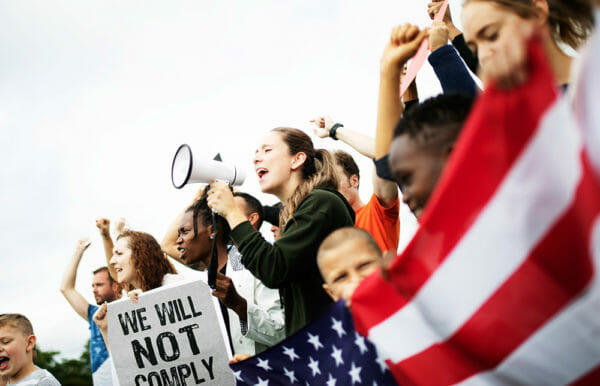
Will Not Comply Protesting Protestors iStock-Rawpixel-1125544034
iStock-Rawpixel

USA – -(AmmoLand.com)- I love AmmoLand News for many different reasons. One of them is that it is chock full of talented writers whose insight and commentary provide “research triage” as I prepare each day’s Armed American Radio broadcasts. Another is that the editors, from time to time, will print columns guaranteed to be controversial to its staunchly pro-gun readership. Just such a column appeared a couple of days ago penned by Mr. Harold Hutchinson, titled, Postal Service Spying Warrants Serious Response.  In it, he brought attention to the unwarranted and politically motivated surveillance of gun rights activists with a focus on January 18, 2021, Lobby Day in Virginia, and offered ideas to combat such dangerous nonsense in the future.

“Should pro-Second Amendment leadership control Congress, there needs to be some serious oversight hearings and some serious consequences for this surveillance, most likely through the power of the purse that Congress has. Second Amendment supporters should write their Senators and Representative to demand this happen.”

He is spot on in that regard; however, Mr. Hutchinson, painfully, didn’t stop there. Rather, and for whatever reason, he took a hard-left turn and smoothly merged directly into the left lane of the gun-grabbers.

“That being said, it may also be time for Second Amendment supporters to re-think “open carry” protests. While there are some media outlets that give us a fair shake at a minimum, the vast majority of them don’t, and will paint such protests in a bad light.”

Some will say, “there goes Harold the Fudd again,” but there are some objective conditions here. The media climate, while it’s not as bad as it was, is still generally hostile. If Jonathan Turley is right, then the media landscape will grow even more hostile in the coming years as calls for discarding balance in favor of propaganda increase.

They may not be explicitly going after Second Amendment activists now, but what do they do when screaming about Trump no longer works? It will probably get worse.

Second Amendment supporters must factor media coverage – potentially hostile coverage – into their plans,,, keep in mind that they have NO control over who shows up to cover a protest you announce.

Media outlets will “paint such protests in a bad light?” There you have it. The media won’t like us, so maybe we should rethink peacefully gatherings to support our rights. We certainly wouldn’t want the biased liars and charlatans running corporate media to write bad things about us, would we? Except when the corporate media and gun-grabbing politicians such as former VA. Gov. Northam is forced to report the fact that an organized armed gun rally was completely peaceful and “went off without a hitch,” with Governor Northam himself declaring publicly;

“Today showed that when people disagree, they can do so peacefully.” In fact, “only one arrest occurred, with a 21-year-old woman charged with one felony count of wearing a mask in public.”

Oh, the irony of that one, huh?

However, Mr Hutchinson continued:

“There is also the fact that Merrick Garland’s Justice Department has already gone after parents who protested certain things taught in their local schools. We also know that the Biden administration is very hostile to our Second Amendment rights.”

He failed to point out that those Virginia parents who stood up to the tactics of the leftist goons won school board seats, ousted the Democrats, retook the Governor’s mansion, and shut down the loudmouth, woke, boneheads. We saw the same thing happen in five Florida counties, including Duval, Miami-Dade, Sarasota, Clay, and Martin Counties, when according to National Review, “multiple school boards across the state of Florida flipped conservative on Tuesday thanks to a groundswell of parental rights activism and GOP turnout.” (emphasis added)

They didn’t do it by “rethinking” their protests and shying away. Rather, they got louder and declared victory.

But wait, there’s more from the author:

“This is not to say we don’t advocate for our rights, but it is saying that there needs to be a lot of thought put into HOW we advocate for our rights in the present climate. Otherwise, it will be harder to defeat anti-Second Amendment extremists via the ballot box at the federal, state, and local levels.”

This reminds me of “I support the Second Amendment, but…” and we all know what that means.

Bottom line? We don’t win our rights back by standing down and trying to appease the biased media, gun-grabber groups, & anti-rights politicians.

We win when we stand up, get louder and stronger, and never back down. We win when our peaceful rallies get bigger and ever more powerful. We win when we tell them we will never give in to their un-American demands, and we win by fighting harder than they do and doing it in their faces.


About Mark Walters

Mark Walters is the host of two nationally syndicated radio broadcasts, Armed American Radio and Armed American Radio’s Daily Defense, with Mark Walters. He is the Second Amendment Foundations 2015 Gun Rights Defender of the Year award recipient and co-author of two books, Lessons from Armed America with Kathy Jackson (Whitefeather Press).


from https://ift.tt/JQUfvTB
via IFTTT

Supreme Court Refuses to Hear Bump Stock Cases

Slidefire Solutions Bump Fire Stock Assembled
Supreme Court Refuses to Hear Bump Stock Cases

U.S.A.-(AmmoLand.com)-– On October 3, 2022, it was revealed the Supreme Court refused to review two cases challenging the rule implementing a bump stock ban put in place by the ATF at the request of President Donald Trump.

The two cases which had been appealed to the Supreme Court were distributed for conference where decisions are made to hear the case (grant a writ of certiorari) or not on September 12. Both had been rescheduled earlier in the year. Both cases were denied as of October 3, 2022.

The appeals process for the bump stock ban has ended.

The two cases were: Aposhian v. Garland and Gun Owners of America v. Garland.

The Aposhian case was in the Tenth Circuit.  The GOA case was in the Sixth Circuit.

Both cases had gone through three-judge panels at the appeals courts. The Aposhian case had lost at both. The GOA case won at the three-judge panel but was tied at the en banc panel. The GOA case then reverted to the District court decision, where the ATF had prevailed.

Both cases challenged the power of the ATF to unilaterally change federal law regarding the definition of what a machine gun is. Another part of the challenge was whether an agency could refuse to rely on the Chevron decision. The Chevron decision involved a case about whether the courts should defer to the administrative “expertise” of an agency to make decisions independent of Congressional votes.

The ATF claimed they were simply interpreting the law, as the statute allowed them to do.  That interpretation means an agency can reverse long-standing precedent of law simply because an executive asks them to do so or they decide to do so.

This destroys the idea of the rule of law. How can a citizen, or anyone who is subject to American law, know whether their property will be safe when an agency can reverse a previously longstanding rule and declare their property contraband without any congressional vote?

How can this be considered a representative republic?

The Supreme Court refusing to hear a case does not mean the court endorses the existing law. It means they refused to hear the case, or perhaps more specifically, it means less than four Supreme Court justices voted to hear the case.

Opinion:

As someone following these cases, it appeared there was a good chance the Supreme Court would hear them.

A good chance is not a certainty. The Supreme Court has now, officially, refused to hear them. There is no more appeal.

It is a bit hard to take, after a tie at the en banc hearing for the Sixth circuit. If GOA had won that vote, it would be a clear and obvious circuit split, and the court would have been much more likely to take the case.

There are many more Second Amendment related cases are coming up in the near future.  Some of those will involve the “final rule” of the ATF. Most of them will be citing the Bruen decision. The bump stock cases did not cite Bruen, as I recall. They were about regulatory overreach on the part of the ATF and the Trump administration.


About Dean Weingarten:

Dean Weingarten has been a peace officer, a military officer, was on the University of Wisconsin Pistol Team for four years, and was first certified to teach firearms safety in 1973. He taught the Arizona concealed carry course for fifteen years until the goal of Constitutional Carry was attained. He has degrees in meteorology and mining engineering, and retired from the Department of Defense after a 30 year career in Army Research, Development, Testing, and Evaluation.

Dean Weingarten


from https://ift.tt/R6tUjl0
via IFTTT

Tuesday, October 4, 2022

When Security Video Can Keep Us Out of Jail

SIG P365XL Streamlight TLR-6
You probably didn’t see these stories covered by the mainstream news media, but again last week, responsible gun owners defended themselves and the people they love IMG Jim Grant

U.S.A. -(AmmoLand.com)- You probably didn’t see these stories covered by the mainstream news media, but again last week, responsible gun owners defended themselves and the people they love. Self-defense instructor David Cole joins the Self Defense Gun Stories Podcast to look at four new examples. Were these gun owners lucky, or did they have a plan?

First story- Are you armed at home?

It is after 10 pm when you hear someone banging on your front door. You are not expecting company, particularly at this hour. The stranger continues to bang on your door. Your husband moves toward the door in case they break in. Eventually, the intruder kicks down your door. Your husband fights with him to push him back outside. You run to the bedroom to grab your gun. You run back and shoot your attacker. He stops fighting your husband, so you stop shooting. Your attacker goes back outside.

You stay inside. Your husband is hurt, but not badly. You speak Mandarin, but your English is poor. You call a neighbor who speaks Mandarin, but her English is better. She calls the police for you. You put your gun away when the police arrive. They ask you to come outside. You and your husband leave your home and give a statement to the police. Emergency medical services declare your attacker dead at the scene.

Police look at security videos taken outside your home and inside your home. You are not charged with a crime.

Neighbors said the attacker had a habit of becoming drunk and then banging on doors in the area, looking for his friends who used to live nearby.

Second Story- Do you have a gun nearby at night?

You are at home on a weekday night. Two strangers knock on your door. You don’t open it. You look at your security cameras. The two men are armed with handguns, so you get your gun. The strangers start beating on your door.

The story isn’t clear if you opened the door or if the intruders broke through the door or through an adjacent window. Maybe you shot through the window. We simply don’t know.

We know you shoot at your attackers. They stop beating on your door and run. You stay inside and call the police. The police find one of your attackers on your front porch. You put your gun away and go outside to talk to the police. You tell them what happened. They call Emergency Medical Services. EMS declares your attacker dead at the scene. You show the police your security video. They put out a call for a man driving a dark-colored sedan.

You are not charged with a crime.

Third story- Are you armed at work?

You’re working behind the counter at a convenience store. It is pretty slow. You notice the security video when a customer drives up. He grabs a shotgun from the back seat of his car. You run to the back room and grab your gun. You stay in the back room of the store. The customer enters your store and looks around. He shouts if anyone is there. You answer. You slowly come out of the back room with your gun up and on target. The stranger has his shotgun on the far side of his body and the barrel is down. He starts saying stupid stuff and walks out of the store. You call 911.

You put your gun away and show the police the security video. It isn’t clear if the outside security video got the robber’s license plate number. Your attacker is arrested a few days later and the Benelli shotgun he carried with him is confiscated by the police.

You are not charged with a crime.

Tag- No Shots Fired

Fourth story- Do you have a firearm at home?

You hear someone outside. It is about 4 in the morning and you hear the sounds of an ATV or a motorcycle coming from your backyard. That is unusual since your family is inside your home at that hour. You get up to investigate. You also grab your rifle. Another member of your family joins you. Both of you walk towards two ATVs that are parked near your storage buildings. You see two men come out of the buildings towards the ATVs. You shout for them to stop. One man runs into the brush behind your house. The other man rushes toward you with his hand out. You shoot him. Now he stops.

You call 911 and ask for help. You give a statement to the police when they arrive. Police arrest your wounded attacker. EMS takes him to a nearby hospital to treat his wounded arm. The police also arrest the second intruder.

The extended discussion of each story is at the Self Defense Gun Stories podcast webpage.


from https://ift.tt/kfL1Bg3
via IFTTT

Monday, October 3, 2022

The Unconstitutional Irony Of Handgun Training In New York’s Amended Gun Law

Opinion

Executive Orders Rule Regulation Red Tape
Istock

New York – -(AmmoLand.com)- Anyone who possesses a handgun, or any functional firearm, should be familiar with its operation and, ideally, proficient in its use.

Few gun owners would object to that, and few would argue the responsibility to obtain understanding and proficiency of use rests with the individual, not the “nanny state” to require it.

Yet, a burning question, asked rarely, if ever, but one that needs to be asked and answered is this:

Should the State mandate handgun training when the individual undertakes that responsibility upon himself, where that responsibility belongs anyway, and where State handgun training is time-consuming, unduly expensive, and redundant?

In that normative question rests a pressing legal one:

“Does the State have the legal right to require han dgun training and, if so, from where does that purported legal right to mandate handgun training derive?”

There is nothing in the natural law right of armed self-defense as codified in the Second Amendment of the Bill of Rights of the U.S. Constitution that expressly says or alludes to a training requirement as a condition precedent to one exercising the right to bear arms, as a natural law right accruing to the individual. But is this assertion true? Granted, it requires explication and qualification:

The phrase “well-regulated” in the Second Amendment does mean “well-trained,” but only in the context of the prefatory “militia” clause, where it appears, not in the salient, independent clause: “the right of the people to keep and bear arms shall not be infringed,” where no mention is made of it.

Justice Scalia, writing for the majority in Heller, pointed this out. And Justice Alito, writing for the majority in McDonald, reiterated and expanded upon it.

DISTRICT OF COLUMBIA v. HELLER - Training
DISTRICT OF COLUMBIA v. HELLER – Training

An important distinction rests between the right of the people to keep and bear arms in matters of a life-threatening personal confrontation and the right of the people to keep and bear arms as “a failsafe” to thwart tyranny.

And as for the matter of tyranny, the Heller majority discusses it, but in passing.

The late Justice Antonin Scalia, who penned the Heller opinion, was undoubtedly acutely aware of making too much of the fundamental right of the common people to take up arms against a tyrannical government in the seminal U.S. Supreme Court Second Amendment case of the 21st Century that, he knew, would draw incredulity and ire from many quarters, not least of all among some of his brethren, given the magnitude of the rulings.

That Scalia mentioned tyranny at all, especially given its trajectory in our Nation in the 21st Century, he may have felt it enough to allude to tyranny as an imminent threat to the continuation of our free Constitutional Republic and prudently left the matter of discussion at that, going no further.

But, one legal scholar, discussing Heller, who, as an academician, not a U.S. Supreme Court Justice, who need not be mindful of the potential backlash, elaborated on the singular import of tyranny as separate from the natural law right of self-defense, He writes:

“The natural right of self-defense applies not only to defense of the individual, but also to the defense of society against tyranny. There was little disagreement on this understanding at the time of the founding. As Hamilton put it, ‘if the representatives of the people betray their constituents, there is then no recourse left but in the exertion of that original right of self-defense which is paramount to all positive forms of government.’ It was universally agreed that the well-regulated militia consisted of the entire general populace, which was to be armed and trained in the use of arms. Indeed, that the people be well trained in the use of arms was central to the founders’ understanding of the Second Amendment and was considered the basic source of their liberty. As Madison put it, ‘if the people [of Europe] were armed and organized into militia, ‘the throne of every tyranny in Europe would be speedily overturned in spite of the legions which surround it.’” “The Responsible Gun Ownership Ordinance And Novel Textual Questions About The Second Amendment, 102 J. Crim. L. & Criminology 471 (Spring 2012) by Owen McGovern.

One can extrapolate from Heller and McDonald that when the Tyrant mandates arms training as a precursor to bearing arms, it isn’t done with the aim to create, in the commonalty, a force capable of deposing the Tyrant. That would be nonsensical.

The Tyrant seeks to disarm the populace, not embolden it. Otherwise, the common man might displace the Tyrant.

Mandating handgun training in jurisdictions such as New York is to inhibit the exercise of the natural law right of armed self-defense.

Training, along with other mandates, takes time and money. The Government’s goal here is to dissuade the would-be gun owner, not ease his burden of acquiring a concealed handgun carry license.

Unfortunately, the U.S. Supreme Court majority in Heller, McDonald, and Bruen allows the despots and despoilers in Government to betray the intent of the Court’s rulings.

But the Court, knowledgeable of the irascibility and intransigence of forces hostile to the American citizenry’s fundamental, immutable, and unalienable rights, still provides these forces with loopholes, albeit reluctantly, to get around its rulings.

Consider: immediately after the Heller rulings, the City of Chicago sought to ignore those rulings, claiming Heller applies to the Federal Government only, not to the States.

Justice Alito, writing for the majority, refuted that idea, and then gave the City of Chicago the means to defy the Court, notwithstanding. How and why is that?

Alito recognized the inherent dilemma the Court was in and, perhaps, anticipating that Chicago would try to negate the impact of McDonald, was, nonetheless, compelled to acknowledge that,

“This history of intrusive regulation is not surprising given that the very text of the Second Amendment calls out for regulation, and the ability to respond to the social ills associated with dangerous weapons goes to the very core of the States’ police powers. Our precedent is crystal-clear on this latter point.”

This was all the City of Chicago needed to hear.

The City mandated handgun training, arguing that doing so is within its power to regulate firearms, as Alito acknowledged. The City thereupon promptly banned the means to obtain that training in Chicago.

This impossible situation, not surprisingly, led to a Court challenge.

In Ezel “II,” the Seventh Circuit opined,

“In Ezell I, we held that Chicago’s ban on firing ranges could not be reconciled with the Second Amendment and ordered the district court to preliminarily enjoin its enforcement. 651 F.3d at 710-11. . . . Chicago responded to our decision by promulgating a host of new regulations governing firing ranges, including zoning restrictions, licensing and operating rules, construction standards, and environmental requirements. (Firing ranges operated by law enforcement and private-security firms are exempt from the regulatory scheme; there are currently 11 of these located throughout the city.) The plaintiffs returned to court arguing that many of the new regulations violate the Second Amendment.

In the face of this second round of litigation, the City amended the regulatory scheme four times. . . repealing or revising some of the new rules.”

Since the Seventh Circuit precluded the City of Chicago from banning gun ranges outright, the City came up with another ploy. It cunningly established zoning restrictions, i.e., “sensitive places,” where gun ranges cannot lawfully operate.

Does this sound familiar? Does this bring New York’s new “Sensitive Location” restriction to mind? It should.

Likely taking its cue from Chicago, New York created a new Penal law section, NY CLS Penal § 265.01-e, that prohibits the carrying of a firearm, rifle, or shotgun in any “sensitive location”—applicable to a multitude of areas where a person holding a valid concealed handgun carry license could, once upon a time, not so long ago, lawfully carry a handgun, but now can no longer do so.

And, like Chicago, New York now institutes mandatory handgun training as a condition precedent to obtaining a license to carry a handgun in public even though it had never mandated such training for holders of concealed handgun carry licensees before. And that raises a question as to the State’s rationale for it.

Curiously, the Bruen majority opinion never dealt with the training issue. Reference to training appears only once: in Justice Kavanaugh’s concurring opinion. But that is dicta. It isn’t a Court ruling. And Kavanaugh simply notes this.

So, then, is State mandated handgun training lawful in the eyes of the court? Probably so, as evidenced in Heller and, more specifically, in McDonald.

Be that as it may, applying a State’s police powers to over-regulate civilian citizen use of firearms ostensibly to promote public safety is a hard sell when the public faces the ravages of violent crime.

The New York public now finds itself betwixt the proverbial rock and a hard place: at once bereft of a tenable means to protect itself, given a new spate of ponderous gun laws it must contend with, and a government ever apathetic to its needs for “public safety,” even as it incessantly, deceitfully proclaims its desire to promote it.

Thus, Americans who cherish their Second Amendment right are compelled to file yet again, ever again, another round of lawsuits: a tedious, expensive, eternal process. And this will continue if unthinking sorts among the polity continue to vote the same unprincipled rogues and prevaricators into public office.

Read Related: Seneca Sporting Range NY, 1st to Offer Hochul’s Conceal Carry Training Course


About The Arbalest Quarrel:

Arbalest Group created `The Arbalest Quarrel’ website for a special purpose. That purpose is to educate the American public about recent Federal and State firearms control legislation. No other website, to our knowledge, provides as deep an analysis or as thorough an analysis. Arbalest Group offers this information free.

For more information, visit: www.arbalestquarrel.com.

Arbalest Quarrel


from https://ift.tt/tCQg35l
via IFTTT

Federal Court says ATF Overstepped Authority with “Final Rule”

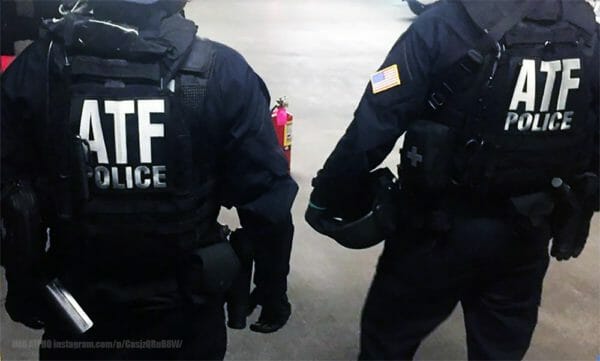
ATF Agents IMG ATFHQ-IG Public Domain

U.S.A.-(AmmoLand.com)-– On September 2, 2022, the United States District Court, Northern District of Texas, Fort Worth Division, issued an Opinion and Order granting a preliminary injunction, in part, on the ATF “Final Rule” which radically changed the decades-long definition of what is a firearm in federal law.  The opinion explains that ATF created the longstanding definition of what a firearm is in 1978. Now, over forty years later, they are updating and expanding the definition into new areas.  From the opinion/order, p. 2-4:

In April 2022, ATF published a Final Rule changing, among other things,the 1978 definition of “frame or receiver.”See Definition of “Frame or Receiver” and Identification of Firearms, 87 Fed. Reg. 24,652 (Apr. 26, 2022)(codified at 27 C.F.R. pts.447, 478, and 479(2022)).1ATF split the phrase intotwo parts, assigning the term “frame” to handguns and the term “receiver” to any firearm other than a handgun, such as rifles and shotguns. See 27 C.F.R. §478.12(a)(1), (a)(2). ATF then defined the terms “frame” and “receiver” along the same lines as the 1978 rule, though with updated, more precise technical terminology.2 But ATF did not stop there. 

Rather than merely updating the terminology,ATF decided to regulate partial frames and receivers. Under the new Final Rule, “[t]he terms ‘frame’and ‘receiver’shall include a partially complete, disassembled, or nonfunctional frame or receiver, including a frame or receiver parts kit, that is designed to or may readily be completed, assembled, restored, or otherwise converted to function as a frame or receiver. ”Id.§478.12(c). But “[t]he terms shall not include a forging, casting, printing, extrusion, unmachined body, or similar article that has not yet reached a stage of manufacture where it is clearly identifiable as an unfinished component part of a weapon (e.g., unformed block of metal, liquid polymer, or other raw material).” Id. When determining whether an object is a frame or receiver, the ATF Director is not limited to looking only at the object. “When issuing a classification, the Director may consider any associated templates, jigs, molds, equipment, tools, instructions, guides, or marketing materials that are sold, distributed, or possessed with the item or kit ….” Id. 

The Final Rule also amends ATF’s definition of “firearm”to include weapon parts kits.The ATF’s new definition of “firearm,”“shall include a weapon parts kit that is designed to or may readily be completed, assembled, restored, or otherwise converted to expel a projectile by the action of an explosive.”Id.§478.11(definition of “firearm”).

The Court found ATF exceeded its authority. From the opinion/order, p. 6:

1. The Final Rule exceeds ATF’s statutory authority under the plain language of the Gun Control Act. 

The Administrative Procedure Act requires courts to “hold unlawful and set aside agency action, findings, and conclusions found to be … in excess of statutory jurisdiction, authority, or limitations.”5 U.S.C. §706(2)(C). Plaintiffs argue the Final Rule exceeds ATF’s statutory authority under the Gun Control Act in two ways. First, Plaintiffs argue that the Final Rule expands ATF’s authority over parts that may be “readily converted” into frames or receivers, when Congress limited ATF’s authority to “frames or receivers” as such.Second, Plaintiffs argue that the Final Rule unlawfully treats weapon parts kits as firearms.Plaintiffs are likely to succeed on both claims.

On September 23, 2022, Blackhawk Manufacturing Group, doing business as 80 Percent Arms, filed a motion to intervene (to be included in the lawsuit). The motion is under consideration. The court has ordered the ATF to reply by October 7, 2022.

On September 26, 2022, the court denied the government’s motion for clarification, where the ATF wanted to complete a classification of one of the plaintiff’s products. The Court ruled to do so would be in contravention of the injunction it placed in effect on September 2, 2022.

Texas is in the Fifth Circuit Court of Appeals. Another Court in Texas refused to issue a preliminary injunction.

In North Dakota, in the  8th Circuit Court of Appeals, Judge Peter D. Welte refused to grant a preliminary injunction in another case challenging the ATF “Final Rule”.

A major contention is the wording of the 1968 Gun Control Act, which clearly differentiates weapons that “may be readily converted” and receivers, which does not include the “may be readily converted” language.

In addition, the inclusion of information, tooling, and jigs as part of what is defined as a firearm is new and a considerable expansion of governmental power.

In Delaware, Judge Maryellen Noreika has ruled the ability to make and possess homemade guns is protected by the Second Amendment.

The Supreme Court may eventually take a case on what power, if any, the ATF may legitimately have to regulate the private, non-commercial making of or sale of firearms, and what may be defined as a “firearm”.  The court action may take years.


About Dean Weingarten:

Dean Weingarten has been a peace officer, a military officer, was on the University of Wisconsin Pistol Team for four years, and was first certified to teach firearms safety in 1973. He taught the Arizona concealed carry course for fifteen years until the goal of Constitutional Carry was attained. He has degrees in meteorology and mining engineering, and retired from the Department of Defense after a 30 year career in Army Research, Development, Testing, and Evaluation.

Dean Weingarten


from https://ift.tt/eBgM9kD
via IFTTT

Postal Service Spying Warrants Serious Response

Postal Service Spying Warrants Serious Response, iStock-1345137870

United States – -(AmmoLand.com)- Reports that the United States Postal Service engaged in the surveillance of pro-Second Amendment activists are very serious, and they also warrant some serious thinking by Second Amendment supporters.

First of all, the surveillance of participants in peaceful protests is beyond the pale. There is no justification for it. That being said, one of the incidents referenced was the “peaceful armed protest” at the January 18, 2021 “Lobby Day” in Virginia.

Should pro-Second Amendment leadership control Congress, there needs to be some serious oversight hearings and some serious consequences for this surveillance, most likely through the power of the purse that Congress has. Second Amendment supporters should write their Senators and Representative to demand this happen.

This is crucial. The Postal Service will be hiking rates to try to address potential losses of $60 to $70 billion over the next ten years. It’s time for them to focus on the core mission as opposed to following political whims.

That being said, it may also be time for Second Amendment supporters to re-think “open carry” protests. While there are some media outlets that give us a fair shake at a minimum, the vast majority of them don’t, and will paint such protests in a bad light.

Some will say “there goes Harold the Fudd again,” but there are some objective conditions here. The media climate, while it’s not as bad as it was, is still generally hostile. If Jonathan Turley is right, then the media landscape will grow even more hostile in the coming years as calls for discarding balance in favor of propaganda increase.

They may not be explicitly going after Second Amendment activists now, but what do they do when screaming about Trump doesn’t work. And it will probably get worse. The fact is Second Amendment supporters must factor media coverage – potentially hostile coverage – into their plans and keep in mind that they have NO control over who shows up to cover a protest you announce.

There is also the fact that Merrick Garland’s Justice Department has already gone after parents who protested certain things taught in their local schools. We also know that the Biden administration is very hostile to our Second Amendment rights. Then there is the fact that banks could decide to financially deplatform Second Amendment supporters.

This is not to say we don’t advocate for our rights, but it is saying that there needs to be a lot of thought put into HOW we advocate for our rights in the present climate. Otherwise, it will be harder to defeat anti-Second Amendment extremists via the ballot box at the federal, state, and local levels.


About Harold Hutchison

Writer Harold Hutchison has more than a dozen years of experience covering military affairs, international events, U.S. politics and Second Amendment issues. Harold was consulting senior editor at Soldier of Fortune magazine and is the author of the novel Strike Group Reagan. He has also written for the Daily Caller, National Review, Patriot Post, Strategypage.com, and other national websites.Harold Hutchison


from https://ift.tt/RnIQfAj
via IFTTT

Sunday, October 2, 2022

FBI’s Las Vegas Shooter Report Raises Serious Unanswered Questions. What NFA Weapons?

U.S.A. – -(Ammoland.com)- “@FBI why include that Paddock had NFA firearms at Mandalay Bay when you previously said they were bumpstocks (and thus weren’t machine guns until after the bumpstock rule?)” attorney Stephen Stamboulieh tweeted Saturday.

“What NFA [weapon] did he have?”

“@ATFHQ any comment?” he asked.

Included with Stamboulieh’s tweet was an embedded copy of “Stephen Paddock: Part 0I” from FBI Records: The Vault.

“The Vault is our new FOIA Library, containing 6,700 documents and other media that have been scanned from paper into digital copies so you can read them in the comfort of your home or office,” the Federal Bureau of Investigation explains.

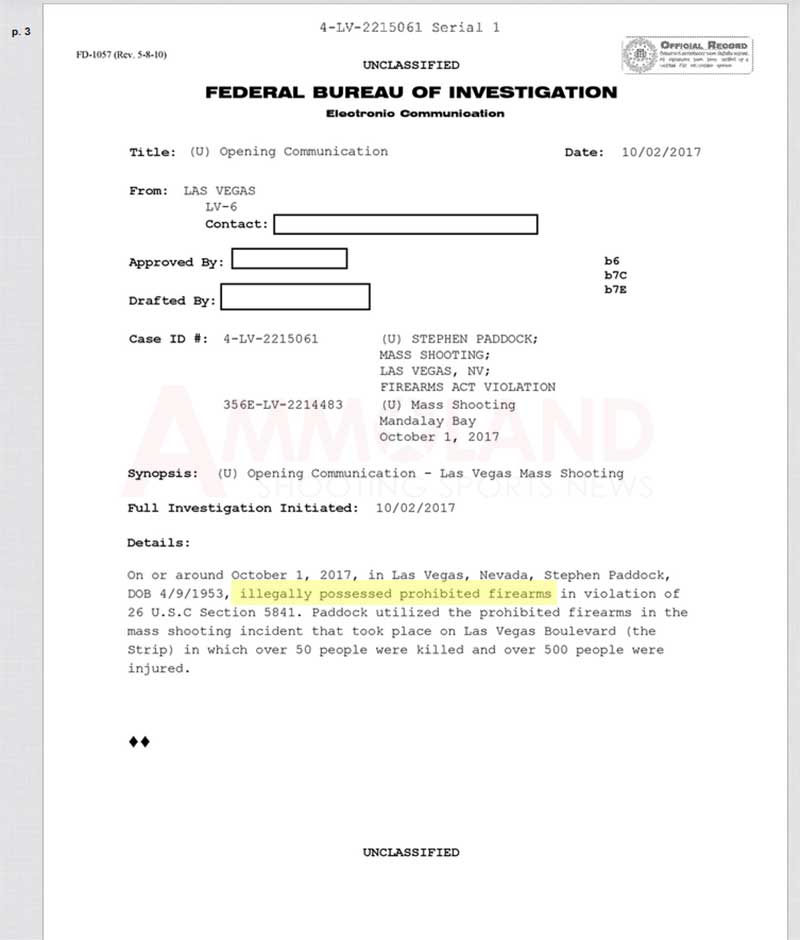
What’s not explained is a curious claim made on page 3 of the “Paddock” report dated 10/02/2017:

“On or around October 1, 2017, in Las Vegas, Nevada, Stephen Paddock, DOB 4/9/1953, illegally possessed prohibited firearms [emphasis added] in violation of 26 U.S.C. Section 5841. Paddock utilized prohibited firearms in the mass shooting incident that took place on Las Vegas Boulevard (the Strip) in which 50 people were killed and over 500 people were injured.”

26 U.S.C. Section 5841 is the code section for the “central registry of all firearms in the United States which are not in the possession or under the control of the United States. This registry shall be known as the National Firearms Registration and Transfer Record.”

That puts the exclamation point to Stamboulieh’s question because the shootings have been widely blamed on “bump stocks,” which were not reclassified as machineguns or banned at the time the FBI made its observations.

FBI Stephen Paddock Part 01 Page 3 FOIA

The bottom line is “bump stocks,” which were “legal” at the time, could not have been the “illegally possessed prohibited firearms” referred to in the “Paddock” report. So what weapon/s are they referring to?

Confusion is further compounded by a PowerPoint presentation by the Bureau of Alcohol, Tobacco, Firearms, and Explosives that it was “not allowed to physically examine the interior of the weapons for machinegun fire-control components or known machinegun conversion devices such as Drop-In Auto Sears, Lightning Links, etc.” recovered from the Las Vegas shooter’s hotel room.

A Freedom of Information Act Request filed by Stamboulieh representing firearms designer Len Savage yielded even more confusing and conflicting admissions:

An ATF Firearms Enforcement Officer … has not yet been provided access to conduct a full examination.

“…the ATF FEO has not been able to conduct a full examination of them at this time.”

“I CANNOT FURTHER COMMENT ON THE BUMP-TYPE DEVICES RECOVERED IN THIS CASE AT THIS TIME AS THE PROCESSING AND ASSESSMENT OF EVIDENCE ONGOING, INCLUDING WHETHER OR HOW THE FIREARMS WITH BUMP STOCKS WERE USED// [capitalization and bold text emphasis in original.]

More from Len Savage;

“ATF did not disclose that they had not examined the firearms prior to promulgating the rule,” Savage noted in response. “And now that the comment period is closed … that information can not be used in a court challenge because it was not submitted prior to the closing of comments.

“From what we got from ATF in our FOIA years back the photos show NO third pinhole,” Savage recalled. “Bump stocks at the time were not NFA, so that leaves either a drop in auto sear or ‘DIAS’ or possibly a what is known as a ‘Swift link’ a very simplistic but effective conversion device.”

So, why highlight this, and what is this writer claiming…that bump stocks attached to some of the recovered guns weren’t used?

For the record, I’m not claiming anything. It is and was, every other MSM media outlet claiming that bump stocks were responsible for the death toll and that fact somehow “justified” banning them and ordering lawfully-obtained property to be confiscated or destroyed.

All I’m doing here is repeating what ATF has said and comparing it to what the FBI has said, and noting that with all the inconsistencies, unanswered questions, and suspicions of official cover-up still hanging over the Las Vegas shootings, here is a thread that major media investigative journalists and congressional inquirers, people with influence and reach, could pull to see what unravels.

If they wanted to.

vault.fbi.gov/stephen-paddock/stephen-paddock-part-01.pdf/view

Read Related: Review Route 91: Uncovering the Cover Up, 2017 Las Vegas Shooting


About David Codrea:

David Codrea is the winner of multiple journalist awards for investigating/defending the RKBA and a long-time gun owner rights advocate who defiantly challenges the folly of citizen disarmament. He blogs at “The War on Guns: Notes from the Resistance,” is a regularly featured contributor to Firearms News, and posts on Twitter: @dcodrea and Facebook.


from https://ift.tt/EjWoxF8
via IFTTT