At this point, it might be easier to list what isn’t a so-called, “Assault Weapon”. IMG NRA-ILA
U.S.A. -(AmmoLand.com)- In 2020, the California legislature passed Senate Bill 118 expanding the definition of “assault weapon” to include a category of “other assault weapons.” Recently, the California Department of Justice announced the opening of a registration period to run from October 1, 2021, through December 31, 2021, for those individuals who wish to remain in lawful possession of those covered firearms without making any modifications to remove them from the covered category. For those who intend to comply with this registration requirement, please see the below information provided on the California Department of Justice Website https://oag.ca.gov/firearms:
“Other” Assault Weapon Registration
Penal Code section 30900, as amended, requires any person who, prior to September 1, 2020, lawfully possessed an assault weapon as defined by Penal Code Section 30515 subdivision (a) paragraphs (9), (10), and (11), and is eligible to register an assault weapon as set forth in Penal Code Section 30900, subdivision (c), to submit an application to the DOJ to register the firearm before January 1, 2022. The regulations for Other Assault Weapon Registration that contain additional information regarding registration requirements are now available on the Firearms Regulations/Rulemaking Activities webpage.
Please Note: The “Other” assault weapons registration is NOT affiliated with or an extension to previous registrations, including the “SB 23” and “Bullet Button” assault weapons registrations. Therefore, registrations submitted for assault weapons that do not meet the definition under Penal Code section 30515, subdivision (a), of paragraphs (9), (10), or (11) will be rejected.
Beginning October 1, 2021 at 9:00 AM PST, registration applications may be submitted electronically at https://oawr.doj.ca.gov or by submitting the Other Assault Weapon Registration Form (BOF 1039), available for download from the Forms and Publications webpage. All registration applications, whether submitted electronically or through the mail, must be submitted during the registration period beginning October 1, 2021 at 9:00 AM PST through December 31, 2021 at 11:59 PM PST. The registration fee is $37.19 for one firearm and an additional $5 for each additional firearm registered in a single transaction.
Please Note:Registration applications received or postmarked after December 31, 2021, will not be accepted.
What is considered an “Other” assault weapon?
Pursuant to Penal Code section 30900, subdivision (c), paragraph (1), effective September 1, 2020, an “Other” assault weapon is defined in Penal Code section 30515, subdivision (a), paragraphs (9), (10), or (11), as:
9. A semiautomatic centerfire firearm that is not a rifle, pistol, or shotgun, that does not have a fixed magazine, but that has any one of the following:
A. A pistol grip that protrudes conspicuously beneath the action of the weapon. B. A thumbhole stock. C. A folding or telescoping stock. D. A grenade launcher or flare launcher. E. A flash suppressor. F. A forward pistol grip. G. A threaded barrel, capable of accepting a flash suppressor, forward handgrip, or silencer. H. A second handgrip. I. A shroud that is attached to, or partially or completely encircles, the barrel that allows the bearer to fire the weapon without burning the bearer’s hand, except a slide that encloses the barrel. J. The capacity to accept a detachable magazine at some location outside of the pistol grip.
10. A semiautomatic centerfire firearm that is not a rifle, pistol, or shotgun, that has a fixed magazine with the capacity to accept more than 10 rounds.
11. A semiautomatic centerfire firearm that is not a rifle, pistol, or shotgun, that has an overall length of less than 30 inches.
For purposes of this section, “fixed magazine” means an ammunition feeding device contained in, or permanently attached to, a firearm in such a manner that the device cannot be removed without disassembly of the firearm action.
About NRA-ILA:
Established in 1975, the Institute for Legislative Action (ILA) is the “lobbying” arm of the National Rifle Association of America. ILA is responsible for preserving the right of all law-abiding individuals in the legislative, political, and legal arenas, to purchase, possess, and use firearms for legitimate purposes as guaranteed by the Second Amendment to the U.S. Constitution. Visit: www.nra.org
New FBI crime data shows more criminals killed by armed citizens than police in 2020.
U.S.A. –-(AmmoLand.com)- One stunning revelation in the FBI Uniform Crime Report for 2020 is that armed private citizens fatally shot more criminals during the commission of felonies than police, a fact that seems to be avoided by the establishment media.
According to the FBI’s expanded homicide data for 2020, law enforcement used firearms 298 times in fatal line-of-duty shootings, while private citizens killed 343 suspected felons “during the commission of a felony.”
The data, which updates figures posted for 2019 last year, shows that in 2019, police and private citizens killed the same number of felons (334) during the commission of crimes.
“If the FBI data published in their crime report for 2020 is accurate,” he said, “it is ample evidence that the individual right to keep and bear arms for personal defense is as important today as it was when the Second Amendment was adopted as a cornerstone of the Bill of Rights.
“Gun prohibitionists who enjoy their own private security while promoting restrictive laws that take guns out of the hands of law-abiding citizens are world-class hypocrites,” Gottlieb added. “The same people who want to disarm honest citizens are typically those who support policies that are soft on criminals. They haven’t simply lost perspective; they’ve abandoned common sense.”
This happened against a backdrop of social unrest through most of 2020, beginning with the riots occurring in many big cities following the death of George Floyd while being restrained by police in Minneapolis. One major fallout from that incident is that in several jurisdictions efforts were mounted to defund police departments and cut their manpower.
Fewer police on the streets are being at least partly blamed for the rise in violent crime (5.6%) and specifically homicides and non-negligent manslaughter (29.4%) over the figures for 2019, according to Reuters.
Last year, according to the FBI’s Expanded Homicide Data Table 11, the murder total was 17,754 and guns accounted for roughly 76 percent of all victims. According to this chart, 13,620 people were murdered with firearms, the most prevalent weapon being a handgun (8,017). As is typical, rifles of any kind (the type isn’t specified in FBI reports) were used in a fraction of homicides (454) and shotguns even less (203).
However, there were 4,946 gun-related murders in which the type of firearm is not identified, so it is conceivable more rifles and shotguns were used by killers, though it would be logical to expect the ratios between handguns, rifles, and shotguns would remain roughly the same if the numbers were sorted out.
Once again, knives and other “cutting instruments” were used to kill more people (1,732) than rifles and shotguns combined. Additionally, 655 murder victims were beaten to death, according to the FBI.
“The use of deadly force is not something anybody wants,” CCRKBA’s Gottlieb observed, “but neither is being injured or killed by some thug during a violent criminal attack. Self-defense may be the oldest natural right, and every time we hear some politician, public official or gun control extremist call for citizen disarmament, we have to wonder which side they’re on. It certainly can’t be on the side of public safety.”
The New York Times reported last year’s “significant rise” in homicides “roughly coincided with the 18 months of the COVID-19 pandemic.” Of course, that pandemic has continued into 2021, and the violence has continued with it.
One other continuing phenomenon is the sale of firearms and ammunition. By some estimates, at least 8 million Americans bought guns for the first time last year.
“This data should send a message to criminals that their chances of recidivism are gradually shrinking,” said Gottlieb. “The tide has clearly turned.”
Concerns about personal safety led to many if not most of those purchases, and more than 800,000 more people obtained licenses or permits to carry guns despite the fact that in many states, the process was shut down because of the coronavirus outbreak. At least, that was the observation from the Crime Prevention Research Center, which put the number of active concealed carry licenses at more than 19.4 million. An update on that number is expected shortly.
About Dave Workman
Dave Workman is a senior editor at TheGunMag.com and Liberty Park Press, author of multiple books on the Right to Keep & Bear Arms, and formerly an NRA-certified firearms instructor.
New Leak Shows The ATF Doubling In Size Within Five Years
MARTINSBURG, WV –-(Ammoland.com)-AmmoLand News has learned from a leaked Bureau of Alcohol, Tobacco, Firearms and Explosives (ATF) video conference meeting that the agency is looking to double its size over the next five years.
Acting ATF Director Marvin Richardson started the conference call by discussing the number of comments received from the two previous comment periods. According to Richardson, almost 300,000 comments were submitted to the Federal Registry for unfinished frames and receivers during the comment period. Also, Americans submitted just over 250,000 comments on pistol stabilizing devices during that comment period.
President Joe Biden and his administration have targeted pistol stabilizing braces and unfinished frames since he came into office. Earlier this year, Biden took executive action on the firearms market. He ordered the ATF to change the rules surrounding braces and frames by using Chevron deference. The ATF submitted proposed regulations for public comment on frames and receivers four weeks later. Shortly after, the ATF published propose rules for public comment on pistol stabilizing devices.
Anti-gun states and groups have long been trying to outlaw unfinished frames. The Biden administration has pushed the narrative that unfinished frames and receivers are a tool only used by criminals. Biden calls these kits “ghost guns” and wants the ATF to regulate them as firearms. The ATF has also carried out several high-profile visits to makers of unfinished frames, including Polymer80. Stamps.com and Authorize.net also turned over Polymer80’s customer information to the ATF.
The ATF has also been targeting pistol-stabilizing braces. Shortly after the presidential election, AmmoLand News uncovered a meeting between the ATF and the Biden transition team. During these meetings, the Biden transition team asked then ATF Acting Director Regina Lombardo and Acting Assistant Director Richardson what their top priorities were for the new administration. Other than unfinished frames, the other item on its list have pistol stabilizing braces. The ATF, specifically Richardson, saw these items as a workaround to the National Firearms Act of 1934 (NFA) and believed that pistols equipped with most stabilizing braces should be considered short-barrel rifles (SBR).
The ATF is creating two teams to deal with the massive number of public comments. Enforcement Programs and Services (EPS) Division Director Alphonso Hughes and Deputy Assistant Director Andy Graham will run these two teams. Each man will run a team to sort through the submitted comments. Richardson did not give a timeline for the teams to review all the submitted comments.
Richardson also talked about the ATF’s plan to double in size over the next five years under President Biden’s administration. The ATF plans to expand to around 2500 special agents, up from 1700 gun-carrying agents. This amount would put the number of agents at a higher level than the IRS, with 2000 special agents.
An expansion of the ATF concerns those in the gun world.
Gun rights advocates see the ATF as an out-of-control agency. Richardson didn’t expand on how the agency plans to pay for all the proposed new ATF employees, but it is known that Biden wants to see the ATF’s power greatly expanded.
No specific plans for the agency expansion were given to the agency’s employees in attendance. Besides the five-year time frame, Richardson didn’t give a rate of growth that the agency is expecting.
About John Crump
John is a NRA instructor and a constitutional activist. John has written about firearms, interviewed people of all walks of life, and on the Constitution. John lives in Northern Virginia with his wife and sons and can be followed on Twitter at @crumpyss, or at www.crumpy.com.
Attacked in Your Home Before Sunrise- Armed Citizen Stories
U.S.A. –-(AmmoLand.com)- We start with this local news storyfrom Mesa, Arizona and reported by radio station KTAR FM in Phoenix.
It is before sunrise on a weekday. You have some yard work you want to finish before you leave for work. You’re in your backyard and look up when you hear a crash from inside your house. Your security system says there was movement outside your carport door. You go investigate.
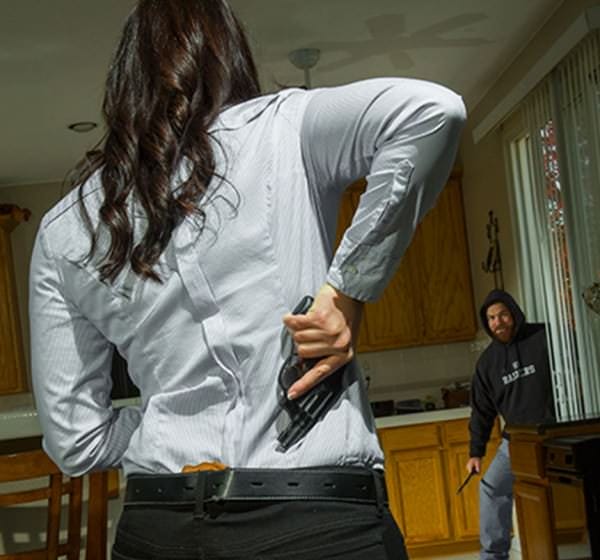
You see a man standing in your kitchen. You shout for him to leave and you run to your bedroom. You grab your handgun and go back into the home. The man runs toward you from the carport door. This time he has a knife in his hands. You shoot him when he reaches the living room. Now he turns around. You go outside and call 911. You’re standing in your driveway when the police arrive.
Police find your attacker in your living room of your home. They disarm him. Emergency medical services take him to the hospital. Your attacker said he was high on methamphetamine and didn’t remember attacking you. He is arrested forfirst degree burglary and aggravated assault along with his outstanding warrants including violating his parole.
Comments
Our defender did a number of things to ensure her safety. There are also some actions we’d like to take if we were in her place. Many of us are in a situation like this every day.
Our defender had an alarm system and she turned it on. That action makes her extraordinary, and good for her. She also had a loaded gun for her defense. She kept the intruder at a distance rather than go hand-to-hand against a man with a knife who was out of his mind on drugs. Our defender escaped from her home and called for help. She stayed at the address to meet the police when they arrived, and she gave the officers a brief statement.
We have more in common with this defender than you might first imagine. Almost half of new gun owners are women. We had about 1.3 million violent crimes each year, though crime is on the rise and the total for 2021 is expected to be higher. About 70 percent of assaults are committed by people who are intoxicated with drugs or alcohol. About half of our defensive gun uses are outside our home but on our property. Also, about half of our defensive gun uses are at night. That means this is a typical crime rather than an unusual event.
As a side note, many criminals break into our homes to take the drugs from the medicine cabinet. With that in mind, it is no surprise that one news article used this attacker’s old mugshot in their story.
One thing that sets this story apart from the typical defensive gun use is that the homeowner fired her gun. Most of the time the attacker runs away when they learn the defender is armed. This attacker didn’t remember his crime and he may have been so high that he did not recognize that the defender was armed. Deterrence doesn’t work as well on people who are out of their minds.
This attacker stopped his attack after he was shot in the chest. As debilitating as that sounds, the wound was described as not life-threatening. The attacker stopped because he didn’t want to get shot again rather than because he was physically incapable of continuing the fight.
Our defender was disarmed in her backyard. That is the rule rather than the exception since most of us are disarmed most of the time. The best practice is for us to put our firearm on our body when we dress in the morning and to carry concealed all day. That means our gun is secure so that other people can’t take it. It also means our firearm is immediately accessible when we need it. If this defender were unlucky, then the attacker could have grabbed the unsecured gun kept in the home before the homeowner got to it.
The best practice is to avoid confronting an intruder. We don’t know how many of them there are and we don’t know how they are armed. We also don’t know how intoxicated or crazy they are. In this story, it sounds like there were no other family members in the home so our defender could have stayed outside and called the police.
This attack took place before sunup. Many of us are still at home at that hour. Your defensive options are limited if you have to protect your family. In that case, you either have to get your family outside to safety or to defend them from a safe location inside your home. It helps to have a plan.
A family safety plan is a series of actions you’ve thought through ahead of time. We have added at least five million new gun owners who bought their first gun in the last year. Many of them are still building their safety plan.
“I’ll only get my gun when I’m going somewhere dangerous,” is a safety plan of sorts, but not a very good one. Few of us think our backyard in the early morning is going to be a dangerous place. We carry concealed as often as possible because we seldom get a warning that we’ve walked into a dangerous situation. Plan to carry, and put good choices into your safety plan.
Let’s talk about making good choices. If we carry concealed, then we don’t have to run back inside our home where there is an intruder in order to get our gun. If we ran to get our gun from our bedroom, then we don’t have to run back out into the home where the intruder is waiting. We should lock the bedroom door and call 911. Use a flashlight or turn on the lights in your bedroom. Get behind the bed with the gun in front of you.
It is best practice to avoid clearing your house because we want to avoid a gunfight with strangers. Let the police go hand-to-hand with the intruders. They will show up with lots of men and lots of gear. Defend yourself with your firearm if an intruder breaks through your bedroom door.
We practice a fire drill so we remember not to run back into a burning building. We want to walk through our family safety plan so we won’t walk back into our home and meet an armed intruder.
Arizona is a constitutional carry state. The homeowner didn’t need a permit to carry in public. In contrast, there are some states where you need a permit to carry if you’re standing in your own driveway. You might not need the state permission slip of a carry permit, but you do want to carry the knowledge from a good class on armed defense. For millions of new gun owners, buying the gun was the easy part. Now they need to learn when and how to use their firearm.
Even if you’re owned a gun for a long time and have a carry permit, when was the last time you reviewed that class material and walked through your safety plan?
My concealed carry class talked about meeting the police after an incident. For obvious reasons, we don’t want to meet the officers with a gun in our hands. Reholster your gun if you can. Open your hands and drop your gun if you can’t holster it. Hold your hands out with your fingers spread and your palms toward the officers. Do what the police tell you to do. They talk about this, and more, in a concealed carry class.
There is more you want to know. You want to know what to say when you’re a mess after calling the police. If you have not studied it before, then say nothing. I’ve you’ve studied the law of self-defense, then say little. In this case, tell the officers something like this-
I called you. I’m the homeowner. A stranger attacked me with a knife. I defended myself and then ran out here. I’ll press charges and be a witness against him. I’ll answer all your questions once I’ve spoken to my lawyer.
Your concealed carry class should have talked about self-defense insurance or pre-paid legal plans. Your legal defense can be expensive even if you did everything correctly during the incident. Given a moment’s thought, your self-defense plan should include a way to pay for your legal defense.
Rob Morse highlights the latest self-defense and other shootings of the week. See what went wrong, what went right, and what we can learn from real-life self-defense with a gun. Even the most justified self-defense shooting can go wrong, especially after the shot. Get the education, the training, and the liability coverage you and your family deserve, join USCCA.
A Painful History Lesson on the NRA & Gun Control ~ LISTEN Now! iStock
New Jersey – -(AmmoLand.com)- I have been watching the news and started thinking about one of the stories getting attention, the removal of the Robert E. Lee statue in Virginia.
The big monument is Robert E. Lee, sitting on Traveler, his horse. A crowd was there cheering the removal of that statue, and it got me thinking about the real ramifications there and how we are currently viewing history. We could debate all day long about the Civil War and the effects of it; why the men who fought for the South were motivated or not, but that’s not what I was thinking about.
Robert E. Lee is part of our American history. To some, it might be a very painful history, and to others, it is someone that they admire. It has nothing to do with slavery. They admire his generalship, his wisdom on the battlefield, and the rest of his career prior to the Civil War. He faithfully served his country as well. So, there is a lot to it. But the bottom line is that it is our history. This is an attempt at removing our history and that is really a dangerous thing. It is a dangerous thing because, as the old saying goes, if we do not know history, you are doomed to repeat it.
Listen Here:
Plus, painful history is important to help shape our country. It also helps shape you as an individual. I was thinking about an old Star Trek episode where a fellow gets on board the Enterprise and is able to remove people’s pain and make them all happy. Even Spock gets happy. This guy may be a hustler or maybe he is a religious figure. It does not really matter. He can remove pain.
So, they go to Captain Kirk and say, this guy can get rid of your pain. Let him do it. Kirk says I want my pain. I need my pain. That’s what made me what I am. There is something really important there.
The pain made us as a country who we are. We cannot just remove it, and have it not have the effect that it had in shaping us and making us who we are and letting us learn from it. So, I looked at the removal of the Robert E. Lee statue and the other attacks that are taking place on our history. I started thinking about the painful history when it comes even to firearms. There is painful history about our political situation, and how we got here.
Now, let me just preface this by saying that I am a proud NRA member, a benefactor member, and have helped do many things for NRA. I am not anti-NRA at all. But what I’m going to tell you is, in effect, a painful history of things that occurred early on in the NRA. As the removal of the Robert E. Lee statue, removing this painful history is not a good idea. We need to know and understand it. It is generally not known out there, but by recognizing it, we can look at the mistakes that were made, and mistakes were made. I am not talking about the modern situation now with the attack by the New York State Attorney General and all the politics going on here. Questions about whether Wayne LaPierre should stay in leadership or not. None of that. I am not going to get into that, and it is not about that. I want to look at the actual history of the NRA when it comes to gun control and gun laws.
History Of The Nra As Comes To Gun Control & Gun Laws
You may be surprised to know that back in the 1920s and into the 30s, NRA was a proponent of gun control, and actually aggressively pursued the enactment of gun control laws. Laws that to this day, we are fighting. Laws to this day that the NRA is now fighting and has been fighting for many years to repeal and get rid of. But we need to know and understand what mistakes NRA made, and it was really done out of those folks being naive. If you want to read more about this, there is a really interesting article, believe it or not, in The Atlantic, which is a magazine that is generally considered, you know, left-wing, liberal without a doubt. But they had an article called The Secret History of Guns by Adam Winkler in the September 2011 issue.
It is a very interesting article to read. As much as I do not care for the politics of The Atlantic, and there, of course, is an agenda behind everything they do, this article does have many things in it that are factually true and surprising about guns and the history of guns. The fact that is put out by a liberal, left-wing magazine, and there is an agenda to it, does not mean that the history there is necessarily untrue or that we should reject it, want to close our eyes to it, and remove the statue. No, no, not a good idea. Instead, we should embrace it, understand it, and learn from it.
So, let me tell you that in the 1920s, NRA was actually a champion of enacting gun control. Because at that time, it had come over from England where there was gun control being pushed, and it came across the pond. It was after World War One, and there was this kind of a naive concept that gun laws could maybe work and go at crime and other concerns. The President of the NRA at the time was Karl T. Frederick. Karl Frederick was a Princeton and Harvard-educated lawyer. He was known as the best shot in America because he won three gold medals in handgun shooting at the 1920 Summer Olympics. So, he was a good shooter, obviously, a skilled shooter, and he was President of the NRA at the time. He was made a special consultant to the National Conference of Commissioners on uniform state laws.
In this role and during his NRA presidency, Frederick drafted what was called the Uniform Firearm Act. The Uniform Firearm Act was model legislation that was pushed in the States at the time throughout America with the NRA and Frederick pushing these uniform firearm laws because they wanted to see gun laws in all the states. It is shocking even say it, but what did these gun laws, these model firearm laws, what did they promote? Back in the 20s? I will tell you what they did. Number one, they required anyone that wanted to carry a concealed handgun in public must have a permit from the local police. Advocating permits. When what we had prior to that was constitutional carry. We had constitutional carry, and the NRA under Frederick pushed to not have constitutional carry and in fact have permits.
The standard in the Uniform Firearm Act was you had to be a suitable person and have a proper reason for carrying a firearm. Gee, have we seen any of this before? Of course, we have. New Hampshire’s pistol permit law required a suitable person, and do you know who backed a suitable person in the 20s? The Ku Klux Klan, that’s who, because that is how you could discriminate and not have those “unsuitable persons” get gun licenses and carry. This is historically true and painful. But here they were pushing suitable person and proper reason. Of course, in New Jersey, the proper reason became a “justifiable need”; the bar and the trick to denying citizens their gun rights completely.
What else did the model uniform firearm laws supported by NRA say?
Well, they required gun dealers to report to law enforcement, the sale of handguns. In essence, what was it? A firearm registration scheme. Handgun registration. Reporting the sale. Think about reporting the sale. Oh, my, what is the New Jersey pistol purchase permit say? Oh, it’s a purchase permit, and guess what it does? It reports the sale. Gee, I wonder where the roots for that came from? You guessed it, the Uniform Firearm Act. Finally, guess what else NRA supported in this Act? A two-day waiting period. That’s right, a waiting period. So, here we are – waiting periods, permits required to carry, handgun registration, and reporting the sale. It was naively pushed and promoted throughout America during the 20s and 30s. So much so, it was cited in the Article that the Virginia Law Review article from 1932 reporting about the Uniform Firearm Act and its success, basically that the license to carry concealed weapon were in effect in practically every jurisdiction.
Since then, what have we had to do? Fight to turn back the clock. Fight to get our rights back. Mistakes were made.
Again, I love the NRA. This is not NRA bashing. It is not about that. But it is a painful history that you need to know.
It is why we are here, what we are doing, what mistakes are made, and what we are trying to fight to correct. And that is exactly what it was. It did not end there, by the way. Because also in the 30s came the infamous 1934 machine gun act. The 1934 National Firearms Act (NFA), and NRA supported that, too. They supported it because they looked at it from a national scope. They did not have to worry too much about pushing states to pass gun laws if they could get a national gun law in effect. This was a radical idea, actually, because where would the federal government have even the powers to enact a federal gun law. The only way they could come up with is taxation. That is why if you ever wondered why ATF was part of the Treasury, and why you have to pay a $200 tax, because this law was enacted, utilizing at the time the federal government’s power of taxation.
I have read the original 1934 committee hearings, and you may be surprised to know what the original 1934 Firearms Act proposed to ban. It proposed to ban all handguns. It banned fully automatic firearms and all semi-automatic firearms. It had a magazine ban in it of 12 rounds. That’s right. That is the original NFA. Then what happened was there was through the committee hearings and NRA did fight to remove portions of this, we ended up with what we have today. They got rid of the handgun ban, and they kept semi-autos, etc. In the end, the National Firearms Act was supported by the NRA, and in it were not only machine guns and sawed-off shotguns, but also short barrel rifles, and silencers. What are our battles today? Oh my God, we are still dealing with trying to get suppressors off the list for hearing protection, and we are battling that. We are trying now to stop the pistol brace ban from taking effect. What is that pistol brace ban? How is it going to work? Oh my gosh, they are going to put it into the 1934 Short Barrel Rifle category, originally supported by NRA. Now, of course, it is vigorously opposed.
Again, it is history that is painful, but you need to know it. That is its origins. That is where it came from.
I read in the old American Rifleman magazine from 1934 after this passed. In the original riflemen, NRA proclaimed that they have solved the gun control problem for America. They have solved the gun problem for America by this wonderful new gun law. Of course, it laid the framework and the foundation for more and more gun laws federally. Including the 1968 Gun Control Act, which by the way, was also supported by the NRA and gun manufacturers that wanted to stop the import of cheap firearms and surplus stuff. Oh, yeah, that is right. Painful history, but true.
So, here we are now, and we are focused on not just getting our firearm freedom but regaining our firearm freedom based on mistakes that were made by, we’ll even say, well-intentioned individuals. That is the battle. Not knowing it is foolish, and not recognizing painful history is stupid. I want you to know these things and keep them in mind as we fight our fight for freedom, liberty, and our Second Amendment rights. I am going to talk more about history, and I love the history of guns specifically.
About Evan Nappen
Known as “America’s Gun Lawyer,” Evan Nappen is above all a tireless defender of justice. Host of the praised “Gun Lawyer” Podcast, author of eight bestselling books and countless articles on firearms, knives, weapons history, and the law, a certified Firearms Instructor, and avid weapons collector and historian with a vast collection that spans almost five decades, it’s no wonder he’s become the trusted, go-to expert for local, industry, and national media outlets. Called on regularly by radio, television, and online news media for his commentary and expertise on breaking news, Evan has appeared on countless shows including Fox, CNN, Court TV, WOR-New York. As a creative arts consultant, he also lends his weapons law and historical expertise to an elite, discerning cadre of movie and television producers and directors, and novelists. He also provides expert testimony and consultations for defense attorneys across America.
Gun control is still a waste of money and time. IMG NRA-ILA
United States – -(AmmoLand.com)- Second Amendment supporters often have raised a stink about times major legislation that attacks our rights is enacted. The 1968 Gun Control Act and the 1993 Brady Act are two major bones some pick with the National Rifle Association at the time. But then there are times when the NRA scored wins – like halting any federal gun control after Columbine and Sandy Hook.
One thing to keep in mind with these differing outcomes is this: The situations were very different. In 1968 and 1993, the Congress and White House were in the hands of foes of the Second Amendment, and the margins in Congress were significantly in their favor. For the 1968 Gun Control Act and the Brady Act, the best option was to limit the damage.
In 1968, LBJ wanted a federal licensing and registration scheme. That didn’t happen. In 1993, Clinton wanted a permanent waiting period on handguns bought from FFLs. That didn’t happen. Not that those laws don’t need massive changes (and the bulk of the provisions affecting those laws would ideally be gone) but compared to what those who try to take our rights wanted, they fell short of what anti-Second Amendment extremists wanted. In 1994, of course, the NRA didn’t give an inch on the crime bill with the semi-auto ban. That was because gun bans don’t leave any room for falling back, even with a sunset provision.
In the case of Columbine, the NRA’s tactics were very successful in defending gun shows from being destroyed by federal legislation. The way it was done was to present a version that covered pro-Second Amendment lawmakers, while still being unacceptable to anti-Second Amendment extremists.
In addition, the NRA pushed Project Exile, and that also helped defeat Al Gore in 2000. While some raise objections to that program, it very well may have been the difference in that razor-close election. George W. Bush’s appointments of John Roberts and Samuel Alito were the difference in the landmark Heller and McDonald rulings.
Similarly, in the wake of Sandy Hook, federal legislation was stopped by a filibuster in the Senate. But a big part of it was an alternative to the sweeping semi-auto ban Obama was pushing in the form of the Protecting Communities and Preserving the Second Amendment Act. That led to big gains in the 2014 mid-terms.
Second Amendment supporters should keep in mind the importance of the right strategy and tactics as they seek to defeat anti-Second Amendment extremists at the federal, state, and local levels via the ballot box in the upcoming elections.
About Harold Hutchison
Writer Harold Hutchison has more than a dozen years of experience covering military affairs, international events, U.S. politics and Second Amendment issues. Harold was consulting senior editor at Soldier of Fortune magazine and is the author of the novel Strike Group Reagan. He has also written for the Daily Caller, National Review, Patriot Post, Strategypage.com, and other national websites.
By “Something must be done,” gun-grabbers generally mean this (USDA media archives).
U.S.A. – -(Ammoland.com)- “The rising and spreading murder statistics should raise the alarm that it’s time to stop despairing over the damage done by guns and do something about it,” The Washington Post Editorial Board opines in a Wednesday exercise in hand-wringing.
To prove their case, they cited last week’s rampage by a maniac loser at a Tennessee Kroger store, lamenting “it’s not even a major headline.” Some of us wonder if it would be if it only supported the two essential narrative points, with the shooter being a “white supremacist” and the gun being a dreaded “AR-15.” Since it takes a bit of searching to find that killer Uk Thang’s parents don’t speak English and investigators are being coy about the gun used, it’s fair to wonder if those two inconvenient truths might help explain why the story’s been placed on the back burner.
We also are told that “The FBI’s annual tabulation of crime data, released on Monday, showed that killings in the United States increased nearly 30 percent last year, the largest annual increase on record,” and that “Many factors are at play — including an unprecedented pandemic that caused economic and mental stress — but what is most striking is the undeniable role played by guns.”
It’s safe to say everyone reading this has been subjected to those same stresses. Somehow, despite the universal impact of these forces, the five million or so members of the NRA and other national and state groups, arguably the most heavily armed “civilian” population on the planet, have nonetheless remained peaceable.
Perhaps it’s not the guns?
But “Rising and spreading murder rates means it’s time to act on guns,” The Editorial Board insists. “Instead of putting in place sensible gun control — such as bans on assault weapons, universal background checks, safe secure laws with stiff consequences — Congress has remained gridlocked.”
What we aren’t told, at least by them, is that “FBI data released Monday in the Uniform Crime Report (UCR) show over three and a half times as many people were stabbed to death in 2020 than were killed with all kinds of rifles combined.” We also aren’t told, at least by them, that “more people were killed in 2020 with fists and feet than were killed with rifles of all kinds.”
What, no bans and background checks for those?
Instead, we’re told it’s all the fault of the Republicans who “have enacted laws — such as the one that went into effect in July in Tennessee that allows most adults to carry, openly or concealed, a handgun without a permit.”
What does that have to do with victimizing others? The goal here is to trick readers who don’t know any better into believing that uninfringed carry for lawful purposes sanctions predatory criminal abuse, which, of course, is a calculated deception.
Instead, it raises the question that if it’s so easy to carry a gun in Tennessee, what the heck were Kroger shoppers and clerks doing hiding in a freezer?
And how would the editorialists, who presume to instruct the rest of us on what we should be allowed to have and to do, fare if the maniac had chosen their workplace? Their version of “doing something” means the competent and prepared must be rendered just as contemptible as they are – under the force of government arms.
About David Codrea:
David Codrea is the winner of multiple journalist awards for investigating/defending the RKBA and a long-time gun owner rights advocate who defiantly challenges the folly of citizen disarmament. He blogs at “The War on Guns: Notes from the Resistance,” is a regularly featured contributor to Firearms News, and posts on Twitter: @dcodrea and Facebook.