Wednesday, March 4, 2026

Eighth Circuit Overturns Machine Gun Possession Conviction for Iowa Police Chief

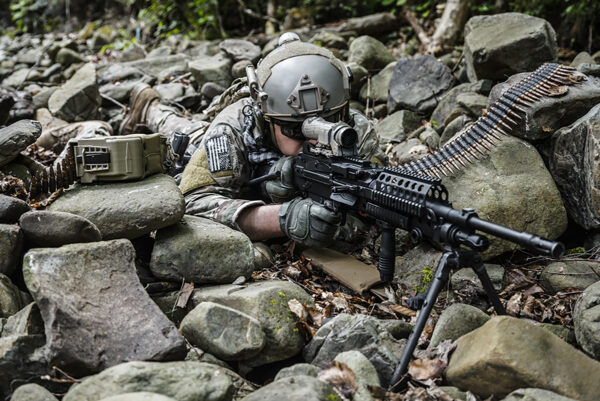
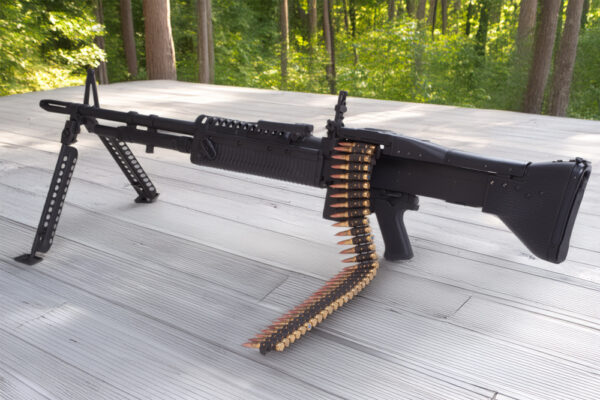
A belt-fed M60-style machine gun similar to the firearm referenced in the Eighth Circuit’s decision in United States v. Brad Wendt. The court overturned Wendt’s conviction for illegal machine gun possession while leaving fraud convictions intact. iStock-1019603648

In a closely watched decision released on March 3, 2026, the U.S. Court of Appeals for the Eighth Circuit issued a split ruling in United States v. Brad Wendt. The court unanimously affirmed Brad Wendt’s convictions for making false statements to the ATF and conspiracy to defraud the agency, but reversed his conviction for illegal possession of a machine gun. The 2-1 decision spotlights deep divisions over the scope of federal machine-gun prohibitions when applied to law-enforcement officers and provokes significant questions about vagueness, statutory interpretation, and Second Amendment protections.

Judge David Stras, in a concurrence, went further, arguing that Wendt’s possession of the department-owned weapon was never criminal at all. Judge Jane Kelly dissented only on the possession count, warning that the majority’s vagueness analysis strayed into hypotheticals not before the court.

Brad Wendt’s story reads like a cautionary narrative at the intersection of small-town policing and the firearms industry. Since 2013, Wendt owned and operated two federal firearms licensees (FFLs) in Anita and Denison, Iowa, under the name BW Outfitters. In 2016, he obtained Special Occupational Tax (SOT) status, allowing legal dealing in machine guns, highly restricted weapons whose civilian possession has been effectively frozen since 1986 under 18 U.S.C. § 922(o).

On July 2, 2018, Wendt was sworn in as Chief of Police for Adair, Iowa, a town of fewer than 800 residents with only two full-time officers. As chief, Wendt gained authority to issue “law letters” on official Adair Police Department letterhead. These letters authorized transfers of machine guns either for “official use” by the department or for “demonstration” to help the agency decide on future purchases.

Between July 2018 and July 2022, Wendt authored approximately 90 such letters. Prosecutors alleged, and the jury found, that many were fraudulent. Wendt purchased machine guns with his personal funds, registered them to the tiny police department, and then resold them at massive markups. One example: Heckler & Koch MP7A2s bought for $2,080 each and sold for $25,000 apiece. Over time, he profited roughly $79,660 from guns registered to Adair.

He also wrote demonstration letters for other FFL-SOTs, including Robert Williams and Jonathan Marcum, knowing the Adair department had zero interest in the weapons. Marcum later pleaded guilty to related charges.

The scheme culminated on April 16, 2022, when BW Outfitters hosted a commercial “machine gun shoot” in Woodbine, Iowa, 57 miles from Adair. Wendt attended off-duty, out of uniform. His business supplied ammunition, and at least eleven machine guns, including a U.S. Ordnance M60 registered to the Adair Police Department. Civilians paid to shoot; law-enforcement attendees shot for free. Undercover ATF agents were present.

A federal jury convicted Wendt on nine counts of false statements (18 U.S.C. § 1001(a)(2)), one count of conspiracy (18 U.S.C. § 371), and one count of illegal machine-gun possession (18 U.S.C. § 922(o)). He received a below-Guidelines 60-month sentence, a $50,000 fine, and forfeiture of fifteen firearms.

On appeal, Wendt challenged jury instructions on the false-statement counts and the sufficiency of evidence for possession. The panel unanimously rejected his arguments on the § 1001 convictions.

Judge L. Steven Erickson, writing for the majority, held that the district court’s instructions accurately tracked the statutory elements and the specific false representations Wendt made in his law letters. Wendt had certified that the guns were for “official use” and “not for resale” or that demonstrations were sought for potential future purchase by Adair; statements the jury found knowingly false.

Erickson dismissed Wendt’s request for a “Harra-style” ambiguity instruction, noting that, unlike the complex banking guidance in United States v. Harra, the ATF regulations here were unambiguous: transfers must be for genuine official use or legitimate demonstration.

The court also upheld the Guidelines calculation, confirming the district court properly associated the false-statement counts with the firearms guideline under USSG § 2B1.1(c)(3).

The real fireworks came on Count 20, the standalone § 922(o) possession charge involving the M60 at the Woodbine shoot.

Section 922(o) bans machine-gun possession except for transfers or possession “by or under the authority of” a government agency (§ 922(o)(2)(A)). Erickson concluded that this “public authority” exception is unconstitutionally vague as applied to Wendt.

A person of ordinary intelligence, Erickson wrote, would not have fair notice that a police chief lacks authority to transport a department-registered machine gun to a law-enforcement-friendly shooting event even if off-duty and sponsored by his private business. The statute and ATF regulations provide no guidance on off-duty status, geographic limits, uniform requirements, or commercial context.

Citing United States v. Vest, Erickson noted that the exception invites arbitrary enforcement: the government could, in theory, charge an officer with leaving a gun in a patrol car during a meal break but not during official duties. The rule of lenity resolved the remaining ambiguity in Wendt’s favor.

Accordingly, the court vacated the possession conviction, remanded for vacatur of the special assessment, and left Wendt’s 60-month sentence intact (the counts ran concurrently).

Judge Stras concurred in the judgment but on wider grounds. He argued Wendt’s conduct was lawful under both § 922(o)(2)(A) and the separate exemption in § 925(a)(1), which protects firearms “imported for, sold or shipped to, or issued for the use of” any state or local government from most federal prohibitions.

As police chief, Wendt possessed actual and implied authority under Iowa law to manage and transport department weapons even off-duty and outside city limits. Iowa Code § 724.6(1)(c) expressly allows certified peace officers to “go armed anywhere in the state at all times.”

Stras further invoked the doctrine of constitutional avoidance and New York State Rifle & Pistol Ass’n v. Bruen. Historical analogues show sheriffs and peace officers have long carried “dangerous” weapons without restriction. There is no tradition of prosecuting officers for possessing government-issued arms.

“Federal law recognizes a broad exception to the machine-gun ban for any held by state or local governments,” Stras wrote. “The point is that, even though Wendt criminally misled the ATF… he did not illegally ‘possess [the city’s] machinegun.’”

Judge Kelly concurred in the false-statement holdings but dissented on possession. She argued that Wendt’s specific conduct off-duty, 57 miles away, at a for-profit event where civilians paid to shoot a police-registered gun, fell plainly outside any reasonable reading of “under the authority of” the Adair Police Department.

The jury had already rejected Wendt’s “government authority” defense after proper instructions. Kelly warned against hypothetical vagueness analysis: “We do not speculate about possible vagueness in hypothetical situations not before the Court.”

The decision is a clear win for Wendt on the most serious count but leaves his fraud convictions and 60-month sentence intact. More broadly, it spotlights persistent ambiguity in federal machine-gun law when law-enforcement officers wear multiple hats.

For FFL-SOTs and police departments, the ruling illustrates the perils of “law letters.” False certifications about official use or demonstration intent remain prosecutable even if the underlying possession might be protected.

Gun-rights advocates will celebrate Stras’s concurrence for its textualist and historical analysis, potentially allowing passage to further challenges against § 922(o) as applied to government actors. Some critics may worry that the vagueness holding creates uncertainty for prosecutors nationwide.

Legal observers note the Eighth Circuit’s inclination to engage Bruen analysis even in a non-Second Amendment facial challenge. With machine-gun cases increasingly reaching appellate courts post-Bruen, today’s opinion adds a significant data point.

Wendt’s case now returns to the Southern District of Iowa for ministerial cleanup. Whether the government seeks en banc review or Supreme Court review remains to be seen, particularly given the circuit split potential created by Stras’s broader reasoning.

For now, Brad Wendt is no longer a convicted illegal machine-gun possessor. But the federal government’s successful prosecution of his fraudulent scheme acts as a stark reminder that even small-town police chiefs cannot treat public authority as a blank check for private profit.


About John Crump

Mr. Crump is an NRA instructor and a constitutional activist. John has written about firearms, interviewed people from all walks of life, and on the Constitution. John lives in Northern Virginia with his wife and sons, follow him on X at @crumpyss, or at www.crumpy.com.

John Crump


from https://ift.tt/I7xpL4F
via IFTTT

Gun Rights Activist Brandon Herrera Forces Rep. Gonzales Into Texas GOP Runoff

GunVote Mini-14 223 Nikon P223
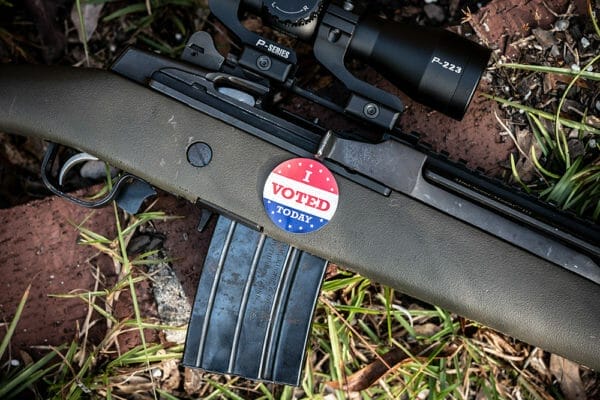
I Voted sticker on a Ruger Mini-14 223 carbine with Nikon P223 scope. IMG Jim Grant

One of the most closely watched Republican primaries in the country has turned into a political earthquake in South Texas. Gun-rights activist and firearms manufacturer Brandon Herrera has forced incumbent Rep. Tony Gonzales (R-TX) into a runoff election in Texas’ 23rd Congressional District, signaling deep dissatisfaction among grassroots conservatives and Second Amendment voters.

With nearly all votes counted in the March 3 Republican primary, Gonzales and Herrera each captured enough of the vote, leaving neither candidate above the 50-percent threshold required to win outright under Texas election law.

The result sends the race to a May 26 runoff, where Republican voters will decide whether to renominate the incumbent or replace him with one of the most recognizable gun-rights voices in the country.

For many gun owners, the race has become a referendum on the direction of the Republican Party—and whether Congress will have members willing to unapologetically defend the Second Amendment.

A Challenge From the Gun Rights Grassroots

Herrera is not a traditional political candidate. Known to millions online as “The AK Guy,” Herrera built his national reputation producing firearms content on YouTube while running a firearms manufacturing business in Texas.

In recent years, he has become a prominent voice in the gun-rights community, frequently testifying against gun-control legislation and speaking at pro-Second Amendment rallies.

Herrera first challenged Gonzales in 2024 and nearly pulled off a political upset. In that race, the incumbent narrowly survived the runoff with just 50.6 percent of the vote, defeating Herrera by only a few hundred ballots.

That razor-thin margin convinced many grassroots activists that the district, long considered safe for establishment Republicans, was ready for a more aggressive defender of the right to keep and bear arms.

Herrera returned in 2026 with a larger campaign infrastructure and a growing coalition of gun owners, younger voters, and anti-establishment conservatives.

Why Gonzales Is Under Fire

Rep. Tony Gonzales, first elected to Congress in 2020, represents one of the largest congressional districts in the country, stretching across hundreds of miles of southern Texas along the U.S.–Mexico border. But his relationship with the conservative base in the district has been strained for years.

The Texas Republican Party formally censured Gonzales after he supported the bipartisan gun-control package passed following the 2022 Uvalde school shooting.

For gun owners, that vote crossed a line.

Herrera and his supporters have repeatedly argued that Gonzales sided with Washington moderates rather than defending the constitutional rights of Texans.

That vote, along with his track record on other issues, has made Gonzales a frequent target of grassroots criticism and a prime target for a primary challenge.

A Primary Dominated by Controversy

The race became even more volatile in the final days of the primary.

Reports surfaced alleging that Gonzales had an affair with a former congressional aide who later died by suicide, a controversy that prompted calls from some Republicans for the congressman to step aside. Gonzales has denied wrongdoing and characterized the allegations as politically motivated attacks.

Despite the scandal dominating headlines, Gonzales still managed to remain competitive in the primary, setting up the high-stakes runoff against Herrera.

What the Runoff Means for Gun Owners

For Second Amendment advocates, the Texas 23rd District race represents something bigger than a typical primary.

It reflects a growing divide inside the Republican Party between the political establishment and grassroots activists who want stronger resistance to gun-control legislation.

Herrera’s candidacy also represents a new type of political figure emerging from the firearms community: individuals who built their reputations through online platforms and industry involvement rather than traditional political careers.

That dynamic has energized younger gun owners who see Herrera as a candidate willing to challenge Washington rather than compromise with it.

The Road to May

The May 26 runoff will determine who becomes the Republican nominee in a district that historically leans GOP but remains politically competitive due to its geography and demographics.

Texas’ 23rd District stretches from the suburbs of San Antonio west across the Big Bend region toward El Paso, covering vast rural areas and several border communities.

Because neither candidate cleared 50 percent in the primary, the two top finishers now face a head-to-head showdown.

For Gonzales, the runoff is a fight for political survival.

For Herrera, it represents another opportunity to finish what he nearly accomplished in 2024—unseating an incumbent and sending a new voice for gun owners to Washington.

One thing is certain: the battle for Texas’ 23rd District is no longer just a local race. It has become one of the most closely watched tests of grassroots gun-rights activism in American politics.

Texas’ District 23 Pits RINO Against Popular Gun Rights Champion

Idaho Introduces Bill to Legalize Machine Guns If Federal Ban Falls


from https://ift.tt/bisdHWT
via IFTTT

Anti-Gun States Rush to Save Federal Handgun Mailing Ban

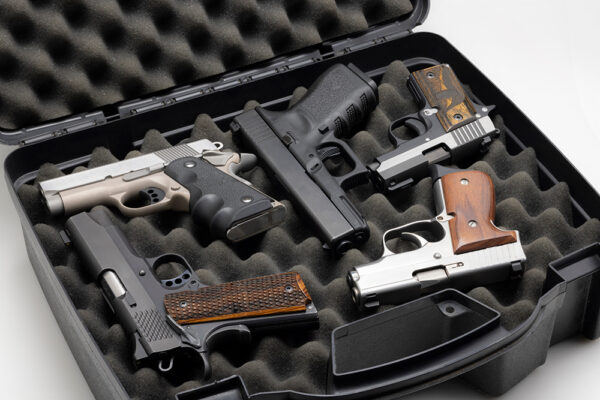
Handgun collection in a plastic hard case on white background. iStock-1357038188
Anti-Gun States Rush to Save Federal Handgun Mailing Ban, iStock-1357038188

In a dramatic new chapter of Shreve v. United States Postal Service, a trio of anti-gun states has stepped into the legal fight over the federal ban on mailing handguns. This fight was reignited earlier this year, when the U.S. Department of Justice formally concluded that the nearly 100-year-old prohibition in 18 U.S.C. § 1715 is unconstitutional as applied to constitutionally protected arms.

In January 2026, the Department of Justice’s Office of Legal Counsel (OLC), led by Assistant Attorney General T. Elliot Gaiser, issued a memorandum concluding that the federal statute barring the mailing of pistols, revolvers, and other concealable firearms through the U.S. Postal Service violates the Second Amendment under the Supreme Court’s modern jurisprudence.

Section 1715, originally enacted in 1927 and later amended, generally prohibits mailing “pistols, revolvers, and other firearms capable of being concealed on the person,” with exceptions for military, law enforcement, and certain licensed entities. For decades, it has functioned as a categorical federal ban on ordinary citizens mailing handguns through USPS.

Applying the Supreme Court’s framework in New York State Rifle & Pistol Association v. Bruen, which requires firearm regulations to be consistent with the Nation’s historical tradition of firearm regulation, the OLC concluded that the statute substantially burdens conduct covered by the plain text of the Second Amendment and lacks sufficient historical analogues from the Founding era.

Importantly, the OLC opinion does not repeal the statute. Congress has not amended Section 1715. However, the executive branch has taken the position that it cannot constitutionally defend or enforce the ban against constitutionally protected arms. That marks a significant shift after nearly a century of federal enforcement.

Delaware, New Jersey, and New York Move to Intervene

Following DOJ’s decision not to defend the constitutionality of Section 1715 in the pending litigation, the states of Delaware, New Jersey, and New York have filed a motion to intervene as defendants in the case.

In their brief, the states argue that they have substantial sovereign and financial interests tied to the continued enforcement of the federal mailing restriction. They contend that if the statute is struck down, it could undermine aspects of their firearm regulatory systems and impose additional enforcement burdens on state authorities.

The states assert that because the federal government is no longer defending the statute’s constitutionality on the merits, their interests may not be adequately represented unless they are permitted to participate directly in the case.

In their motion, Delaware, New Jersey, and New York argue that invalidating Section 1715 would impose new burdens on their law enforcement agencies. They claim that if USPS begins accepting shipments of concealable firearms, states may face increased costs associated with enforcing their own firearm laws, particularly in jurisdictions with extensive licensing and transfer requirements.

According to the states, allowing individuals to use the mail to ship handguns could complicate enforcement of regulatory frameworks that rely heavily on controlled transfer points, typically involving federally licensed firearms dealers (FFLs).

At the same time, federal law governing interstate firearm transfers through FFLs would remain in effect unless separately challenged. The core issue in Shreve is whether the federal government may categorically prohibit the mailing of constitutionally protected arms, not whether states may enforce otherwise valid and constitutional firearm regulations within their borders.

The states also argue that they have independent sovereign interests in maintaining regulatory systems built around background checks, licensing schemes, and purchase restrictions. They contend that without intervention, a federal statute affecting those systems could be invalidated without a full adversarial defense.

The unusual posture of the case underscores the stakes. The Department of Justice, the entity ordinarily responsible for defending federal statutes, has concluded that Section 1715 cannot survive Second Amendment scrutiny under Bruen. Delaware, New Jersey, and New York are now seeking to step into that role to defend the law themselves.

Section 1715 remains federal law. It has not been repealed by Congress, and USPS regulations implementing it have not yet been formally amended.

The DOJ’s position means the executive branch has declined to defend the statute’s constitutionality in court, but until a federal court issues a ruling or Congress acts, the statute remains on the books.

If the district court grants the states’ motion to intervene, they will become full participants in defending the statute. If intervention is denied, the case could proceed without a traditional defense of the ban’s constitutionality — an extraordinary scenario in federal litigation.

Should the court permit intervention, Delaware, New Jersey, and New York will be able to file briefs, participate in hearings, and shape appellate strategy if the case advances to the U.S. Court of Appeals and potentially the Supreme Court.

A ruling striking down Section 1715 on constitutional grounds would represent one of the most significant post-Bruen developments in Second Amendment jurisprudence. It would address not merely possession or public carry, but the federal government’s authority to restrict lawful methods of acquiring and transporting protected arms.

Despite the DOJ’s constitutional assessment, practical changes are not immediate. USPS has not yet revised its domestic mail policies, and Section 1715 remains enforceable until a court says otherwise.

However, the combination of the DOJ’s opinion and the states’ intervention effort sets up a high-stakes constitutional showdown. For gun owners, the case could determine whether the federal government may continue imposing a categorical mailing ban on handguns, or whether that nearly century-old restriction will fall under modern Second Amendment scrutiny.

AmmoLand will continue to monitor Shreve v. USPS and provide updates as this significant case moves forward.

Supreme Court Signals Trouble for Federal Law Disarming Regular Marijuana Users

Preparing for the Terrorist Threat Here at Home


from https://ift.tt/B6zy873
via IFTTT

Minnesota Bill Would Require Gun Registration and Police Inspections, Deadlocked in Committee

Minnesotans Its A Fight For Your Rights

The Minnesota legislature is considering HF 3433. HF3433 contains several significant infringements on the rights protected by the Second Amendment of the United States Constitution. The bill was introduced in the Minnesota House of Representatives on February 17, 2026. HF 3433 has been referred to the Minnesota House of Representatives Committee on Public Safety Finance and Policy. 35 members of the House have signed up as authors of the bill.

HF3433 bans a long list of firearms by name, bans firearms by specific features, requires people who desire to keep any of the firearms specified to register them, store them in accordance with requirements to be adopted, and agree to allow police to inspect the storage system. Registration will be required to be renewed every three years, and the firearms will only be allowed to be kept on the property of the individual. In addition, those firearms would only be allowed to be fired on licensed firing ranges.

Included in the list of specific features are items that sweep into the definition millions of common firearms owned by large numbers of Minnesota citizens at this time. Included in the definition of “Semiautomatic military-style assault weapon” are:

 (2) semiautomatic pistol or any semiautomatic, centerfire, or rimfire rifle with a fixed  magazine that has the capacity to accept more than ten rounds of ammunition;

The above definition includes enormous numbers of .22 rimfire semi-automatic rifles such as the Marlin model 60, Remington models Nylon 66, 550, 552, Winchester models 190, 290, and 77, and many other models of the popular tube-fed, semi-automatic .22 design.

In addition, the ban includes semi-automatic pistols with common features such as a threaded barrel:

(3) semiautomatic pistol that has the capacity to accept a detachable magazine and has one or more of the following: 

 (v) a threaded barrel capable of accepting a barrel extension, flash suppressor, forward  hand grip, or silencer;

The above includes many common and highly regarded pistols owned by millions of people across the United States, including models from Ruger, KelTec, Sig Sauer, Taurus, Smith & Wesson, FN, Walther, and many more.

If you swap out a threaded barrel for a non-threaded barrel, you could be in compliance, as long as you do not keep the threaded barrel. This provision in the bill makes it illegal to possess parts that could convert a firearm into what the legislation broadly defines as a “semiautomatic military-style assault weapon.” As included in the bill:

 (6) conversion kit, part, or combination of parts from which a semiautomatic military-style assault weapon can be assembled if those parts are in the possession or under the control of the same person.

The 35 authors of the bill are almost half of the Democratic-Farmer-Labor (DFL) Party representatives in the Minnesota House. The DFL is the Minnesota version of the Democratic Party in the rest of the United States. The Minnesota Legislature is almost evenly split at this time, with a one-vote majority belonging to the DFL Party. In the Senate, 34 DFL to 33 Republicans. In the House, the parties are tied with 67 representatives each.

HF 3433 was introduced on February 17, 2026, and referred to the House Public Safety Finance and Policy Committee. The bill received a committee hearing on February 24, 2026, where members took recorded votes on motions related to the bill’s referral, resulting in a 10–10 tie. No floor votes have been taken on the bill. The Minnesota Gun Owners Caucus has notified its members about the bill. A hearing was held in the committee.  As of this writing, there have not been any recorded floor votes on HF3433.

It is unlikely this draconian and almost certainly unconstitutional bill will pass the Minnesota Legislature this session. The parties are so evenly split that a highly controversial bill such as HF 3433 will attract enough attention from Second Amendment supporters to peel off a few DFL votes.

Second Amendment supporters in Minnesota are well organized and active.

ATF Exposed: Bureaucrats Blocked Americans from Owning Post-1986 Machine Guns

Supreme Court Signals Trouble for Federal Law Disarming Regular Marijuana Users


About Dean Weingarten:

Dean Weingarten has been a peace officer, a military officer, was on the University of Wisconsin Pistol Team for four years, and was first certified to teach firearms safety in 1973. He taught the Arizona concealed carry course for fifteen years until the goal of Constitutional Carry was attained. He has degrees in meteorology and mining engineering, and retired from the Department of Defense after a 30 year career in Army Research, Development, Testing, and Evaluation.

Dean Weingarten


from https://ift.tt/uf4XPHd
via IFTTT

Tuesday, March 3, 2026

Idaho Introduces Bill to Legalize Machine Guns If Federal Ban Falls

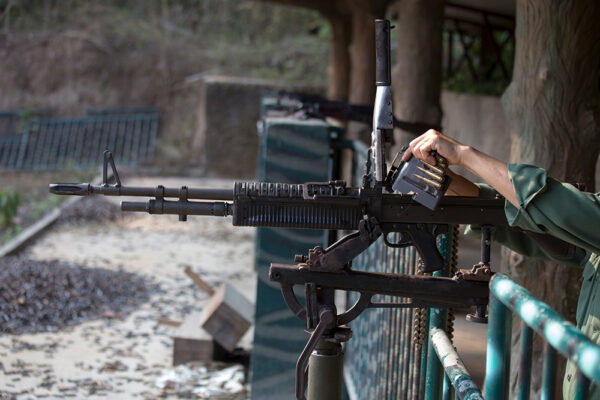
A man is preparing an M60 rifle down a shooting range. iStock-611295580
A man is preparing an M60 rifle at a shooting range. iStock-611295580

In the opening days of the 2026 Idaho legislative session, a quiet but strong challenge to federal firearms restrictions emerged from the State Affairs Committee. Senate Bill 1349 (S1349), introduced on March 2, 2026, and immediately referred to the printing committee, proposes a prospective framework that might transform Idaho into a shelter for civilian machine gun ownership, provided that federal law changes. Titled “An Act Relating to Machine Guns,” the bill does not immediately legalize new machine guns. Instead, it establishes a “trigger” mechanism that activates only if the longstanding federal ban under 18 U.S.C. § 922(o) is repealed, struck down by courts, or ceases to be enforced.

This is no ordinary gun bill. It reflects Idaho’s deep devotion to Second Amendment principles, states’ rights, and vigorous defense against what many in the state view as unconstitutional federal overreach. With an emergency clause and an effective date of July 1, 2026, S1349 signals that Idaho is prepared to lead if the national landscape moves.

To understand S1349, one must revisit the 1986 Firearms Owners’ Protection Act (FOPA) and its controversial Hughes Amendment. Sponsored by Rep. William J. Hughes (D-NJ), the amendment, which passed in a frenzied voice vote amid disputed parliamentary procedure, closed the National Firearms Act (NFA) registry to new civilian machine guns. Enacted as 18 U.S.C. § 922(o), it prohibits the possession or transfer of machine guns manufactured after May 19, 1986, except for government entities or those lawfully possessed before that date.

The result: Today, only approximately 250,000–300,000 transferable “pre-86” machine guns exist nationwide, commanding premium prices (often $20,000–$50,000+ depending on model). Post-1986 “post-ban” machine guns remain illegal for civilians despite the NFA’s original 1934 taxing-and-registration scheme remaining intact for other items like suppressors and short-barreled rifles. Idaho, like most states, imposes no additional restrictions; pre-86 machine guns are legal with federal compliance. Yet the Hughes Amendment has long been a flashpoint for gun-rights advocates, who argue it infringes the Second Amendment’s protection of arms “in common use” or suitable for militia purposes, as affirmed in District of Columbia v. Heller and New York State Rifle & Pistol Association v. Bruen.

Recent events have reignited debate. In February 2026, West Virginia introduced Senate Bill 1071, a GOA-drafted measure exploiting a narrow exception in the Hughes Amendment allowing states to transfer machine guns. Wyoming lawmakers have signaled interest in similar legislation. Kentucky has also introduced a similar bill. These efforts, combined with ongoing federal litigation and shifting attitudes in a post-Bruen world, create the backdrop for Idaho’s approach.

S1349 begins with explicit findings and a goal. It affirms that the right to keep and bear arms is “fundamental” under both the U.S. and Idaho Constitutions (Article I, Section 11). It recognizes the federal machine gun restriction but declares Idaho’s readiness to safeguard lawful civilian ownership, manufacture, transfer, and sale “by law-abiding citizens and the firearms industry” once federal barriers fall. The bill’s stated goals: protect constitutional rights, position Idaho acting as a leader in “firearms freedom,” and bar state resources from enforcing invalid federal rules.

The heart of the legislation is new Idaho Code § 18-3328, which defines a “machine gun” verbatim from federal law: any firearm that shoots, is designed to shoot, or can be readily restored to shoot more than one shot without manual reloading automatically by a single function of the trigger.

Crucially, it outlines four “trigger events” that activate authorization:

  1. Congressional repeal of § 922(o) or any successor.
  2. A U.S. Supreme Court decision holding it unconstitutional (in whole or relevant part).
  3. A federal court ruling is binding in Idaho that permanently enjoins enforcement (and is not stayed).
  4. Formal written notice from Idaho’s Attorney General that the ATF (or successor) has ceased enforcing the restriction against law-abiding civilians.

Upon any trigger event, it becomes lawful for non-prohibited persons (those not disqualified under federal or state law) to possess, purchase, receive, sell, transfer, or manufacture machine guns. State agencies are barred from prohibiting or “unduly burdening” these activities. The Attorney General must notify officials and publish notice within 30 days; provisions take effect 30 days after that.

The bill does not authorize possession by prohibited persons, override general criminal laws (e.g., using a machine gun in a crime remains illegal), or compel private parties to manufacture or sell. A companion section (§ 18-3329) prohibits state entities from expending resources to enforce the federal restriction post-trigger or assisting federal prosecutions of conduct now lawful under Idaho law. Severability and an emergency declaration round out the measure.

In short, S1349 is a sophisticated “nullification-plus” statute. It does not defy current federal law but stands ready to fill the void and shield Idahoans if that law collapses. Idaho has earned its reputation as one of America’s most gun-friendly states. Constitutional carry has been the law since 2016. No permit is required to purchase, no “assault weapon” or magazine bans exist, and NFA items (suppressors, SBRs, etc.) face only federal hurdles. The state constitution’s strong language prohibits special taxation, registration, or licensure on firearms.

S1349 fits this pattern. The bill echoes earlier Idaho efforts to resist federal gun control, such as nullification-style bills on background checks or land management. Supporters, likely including the Idaho Second Amendment Alliance (which has publicly tracked machine-gun expansion proposals), see it as insurance against a future when Bruen’s history-and-tradition test or congressional action dismantles the Hughes Amendment.

Economically, the bill could boost Idaho’s small but growing firearms industry. Manufacturers and ranges specializing in full-auto experiences shall expand. Rural counties, where machine guns could serve recreational, competitive, or even defensive roles (as the Founders’ militia concept historically contemplated), stand to benefit. Opponents might worry about public safety, but the bill’s focus on law-abiding citizens and preservation of criminal penalties addresses that directly.

Idaho is not alone. West Virginia’s SB 1071 takes a bolder, immediate step by creating a state agency to facilitate transfers, using the “by or to a State” exemption. If successful, it could test federal tolerance. Wyoming discussions suggest a domino effect. S1349’s contingent model is more cautious waiting for a federal trigger but equally assertive in refusing to cooperate afterward.

Judicial challenges are inevitable. Federal preemption doctrine could be invoked, though Printz v. United States bars federal commandeering of state officials. Post-trigger enforcement bans rest on solid anti-commandeering ground. If the Supreme Court ultimately validates civilian machine gun rights, S1349 would smoothly integrate. Until then, it remains dormant.

Pragmatic obstacles include ATF cooperation (or lack thereof) during any transition, as well as ensuring manufacturing complies with changing federal rules. Public reaction remains muted given the bill’s fresh introduction, but Second Amendment groups are expected to rally support while gun-control advocates decry it as reckless.

S1349 is more than policy; it is philosophy in legislative form. It asserts that states are not simply subordinates but sovereign laboratories of liberty, especially on rights the Founders viewed as core. Whether the triggers fire soon (via court, Congress, or executive action) or years hence, Idaho has declared its intent: when federal restrictions on machine guns fall, the Gem State will not hesitate to adopt the full scope of the Second Amendment.

As the 2026 session unfolds, lawmakers, gun owners, and legal scholars will watch closely. For a state that already trusts its citizens with constitutional carry and open ranges, S1349 represents the next logical frontier. In a time of rapid judicial and cultural change on firearms, Idaho is not just to react, but to lead.

WV Machine Gun Bill Clears Committee – Then Faces Pushback

ATF Exposed: Bureaucrats Blocked Americans from Owning Post-1986 Machine Guns


About John Crump

Mr. Crump is an NRA instructor and a constitutional activist. John has written about firearms, interviewed people from all walks of life, and on the Constitution. John lives in Northern Virginia with his wife and sons, follow him on X at @crumpyss, or at www.crumpy.com.

John Crump


from https://ift.tt/RDBP8W1
via IFTTT

Florida AG Says Jacksonville Firearm Registry Violated State Law

Personal Data Gun Registration Paperwork Privacy iStock-solarseven 1048264146.jpg
Personal Data Gun Registration Paperwork Privacy iStock-solarseven 1048264146

In a significant development for Florida gun owners, Attorney General James Uthmeier has formally challenged the decision of the Fourth Judicial Circuit State Attorney’s Office not to pursue action against the City of Jacksonville over its maintenance of firearm logbooks at city buildings.

On March 2, 2026, Uthmeier sent a detailed letter to State Attorney Melissa Nelson disputing her office’s conclusion that no criminal violation occurred when Jacksonville security personnel recorded firearm and personal information of citizens entering City Hall and another municipal building between July 2023 and April 2025.

According to the Attorney General’s letter, the logbooks contained more than 140 entries documenting the names, birthdates, identification numbers, and firearm types of over 100 individuals. Uthmeier argues that this practice constituted a prohibited registry under Section 790.335(2)(a), Florida Statutes — a law that expressly forbids local governments or government employees from “knowingly and willfully” keeping any list, record, or registry of privately owned firearms or their owners.

The Core Dispute Over Florida Law

In her earlier letter dated January 2, 2026, State Attorney Nelson explained that her office declined prosecution in part because the logbooks did not explicitly record firearm ownership, and because the public works manager who authorized the practice reportedly believed it was lawful. She characterized the issue as a failure of process rather than criminal intent.

Uthmeier rejected that interpretation.

In his March 2 response, the Attorney General states that the statute does not require the registry to explicitly label individuals as “owners” in order to violate the law. If the firearms recorded were privately owned — and not government property — then maintaining a list of those firearms and the individuals bringing them into city buildings qualifies as a prohibited registry under the statute.

He further explained that Section 790.335(2)(a) does not impose strict liability but instead requires proof that a person “knowingly and willfully” kept or caused to be kept such a list. Uthmeier argues that the statutory definitions of “knowingly” and “willfully” do not require proof of malicious intent or awareness that the conduct was unlawful. Rather, the terms require that the act be done intentionally and with awareness of the facts. In other words, if officials intentionally maintained a logbook documenting privately owned firearms, that satisfies the statutory standard regardless of whether they believed it was legal at the time.

The Attorney General also emphasized that ignorance of the law is not a defense under Florida precedent, directly addressing the argument that the public works manager mistakenly believed the practice was lawful and that the directive had not been reviewed by the city’s Office of General Counsel.

Responsibility at the City Level

Uthmeier’s letter does not limit responsibility to a single employee. He states that the firearm logbook practice continued for approximately two years and was maintained at City Hall using city resources and personnel acting within the scope of their official duties. According to the Attorney General, either city leadership was aware of the practice and failed to intervene, or it failed to properly supervise and train its employees — both of which, he argues, expose the city to potential liability.

He also notes that Florida’s prohibition on firearm registries exists specifically to prevent the government from compiling lists that could later be used to profile, harass, or target law-abiding citizens exercising their Second Amendment rights.

Possible Civil Enforcement Ahead

Although the Attorney General’s Office does not have direct authority to bring criminal charges in this instance, Uthmeier is directing Deputy Attorney General (Enforcement) Jason Hilborn to retrieve all evidence related to the matter for potential civil proceedings under Section 790.335(4)(c).

Under Florida law, a local government found to have compiled or maintained a prohibited firearm registry may be subject to civil penalties of up to $5 million.

A Test Case for Florida’s Registry Ban

Florida’s firearm registry prohibition is one of the strongest in the country. Uthmeier’s letter signals that his office interprets the statute broadly and is willing to pursue enforcement when local governments appear to cross the line.

The City of Jacksonville has not yet publicly responded to the Attorney General’s March 2 letter. Whether the matter proceeds to civil enforcement remains to be seen, but the dispute highlights ongoing tensions between local administrative practices and Florida’s statewide protections for gun owners.

AmmoLand will continue to monitor developments as the situation unfolds.

Supreme Court Signals Trouble for Federal Law Disarming Regular Marijuana Users

ATF Exposed: Bureaucrats Blocked Americans from Owning Post-1986 Machine Guns


from https://ift.tt/Y3SegxW
via IFTTT

SAF Challenges Third Circuit After Court Dismisses 3D-Printed Gun Files Case

Petition for Rehearing After Third Circuit Tosses 3D-Printed Gun Files Case, iStock-2191244801
SAF Challenges Third Circuit After Court Dismisses 3D-Printed Gun Files Case, iStock-2191244801

In the latest development in a long-running battle over firearms freedom and digital expression, the Second Amendment Foundation (SAF) has filed a petition for rehearing in Defense Distributed v. Attorney General of New Jersey, urging the full Third Circuit to reconsider a controversial panel decision that effectively dismissed gun owners’ constitutional challenge to New Jersey’s crackdown on 3D-printed firearm files.

The case, originally filed in 2018, challenges the constitutionality of a New Jersey statute that bars the publication of computer code and digital firearms information used to program 3D printers to make guns or gun parts without a federal firearms license. In its petition, SAF argued that the panel opinion contained “analytical errors that run contrary to well-established legal precedent” and severely truncated the opportunity for merits review on the First and Second Amendment claims.

“This appeal challenges the New Jersey Attorney General’s long-running censorship of Second Amendment speech,” SAF said in its filing, characterizing the Third Circuit’s handling of the case as procedural gamesmanship that denied a proper constitutional examination.

A Setback for Digital Firearm Rights

The petition comes in the wake of an earlier ruling by a three-judge panel of the U.S. Court of Appeals for the Third Circuit — a ruling that represented a serious setback for advocates of unrestricted firearms innovation and free speech online. In that February decision, the court affirmed the dismissal of the lawsuit, holding that the plaintiffs had failed to allege facts sufficient to allow courts to decide whether 3D-printed gun files qualify as protected speech under the First Amendment, or whether the restriction directly burdens the right to keep and bear arms.

AmmoLand previously reported how the court rejected the notion that computer-aided design (CAD) and computer-aided manufacturing (CAM) files are inherently expressive speech, declining to apply heightened constitutional scrutiny based on the plaintiffs’ pleadings. The panel also concluded there was no concrete Second Amendment injury because the complaint did not allege that any plaintiff was prevented from personally manufacturing a firearm.

That decision marked a troubling new test for digital firearm rights: judges now may treat code used to make guns as purely functional conduct that falls outside core First Amendment protections unless litigants specifically and articulately plead expressive elements.

Why the Rehearing Matters

SAF’s petition for rehearing is more than procedural formality — it’s a direct challenge to a framework many gun owners and digital rights supporters view as hostile to both free speech and the independent manufacture of arms. The petition argues that the panel’s decision dodged the substantive constitutional issues at its core and instead relied on technicalities and factual deficiencies that could have been cured with a more thorough judicial review.

Alan M. Gottlieb, SAF founder and executive vice president, underscored that the case “has languished in the system since 2018” and criticized the Third Circuit for sidestepping the heart of the constitutional questions presented. If the court is unwilling to correct its analytical errors, SAF’s filing suggests, further appeals may be inevitable.

Looking Ahead

For Second Amendment advocates, the stakes in Defense Distributed’s fight are clear: the ability to share and access digital firearm information has become a flashpoint in broader debates over modern gun rights and online free speech. New Jersey’s statute and similar laws in other states effectively criminalize the distribution of digital files based on where someone lives, raising sharp questions about the limits of state power in an era when 3D printers and digital blueprints are widely available.

If the Third Circuit agrees to rehear the case en banc, it could reset the legal landscape for how courts treat digital firearm information. If not, SAF’s next move may be a petition for Supreme Court review — a path that could redefine how the Constitution applies to code, printers, and the quintessential right to keep and bear arms.

Stay tuned; this case is far from over.


from https://ift.tt/DlvNXzF
via IFTTT

WV Machine Gun Bill Clears Committee – Then Faces Pushback

WV Machine Gun Sales Bill Advances, Then Stalls as Crossover Deadline Threatens Its Survival, iStock-619761640
WV Machine Gun Bill Clears Committee – Then Faces Pushback, iStock-619761640

In the final frantic days of the 2026 West Virginia legislative session, a bill unlike any other in modern American history appeared to clear its first major hurdle. On March 2, the Senate Judiciary Committee advanced Senate Bill 1071, the Public Defense and Provisioning Act, by voice vote, sending the measure to the Finance Committee with barely 24 hours to spare before the crossover deadline.

Sponsored by Senators Chris Rose (R-Monongalia) and Zack Maynard (R-Lincoln) and drafted with assistance from Gun Owners of America (GOA), SB 1071 would create a state-run Office of Public Defense inside the West Virginia State Police. That office would purchase modern, fully automatic machine guns, AR-15/M16-platform rifles, M249 squad automatic weapons, MP5 submachine guns, and any other arms “in common use by the military or law enforcement,” and sell them directly to qualified West Virginia residents at every State Police troop headquarters across the state.

The bill is not a modest tweak to existing firearms law. It is a deliberate, carefully constructed attempt to circumvent the 1986 Hughes Amendment, which effectively froze civilian ownership of newly manufactured machine guns after May 19 of that year.

By positioning the State of West Virginia itself as the transferor, SB 1071 invokes the explicit federal exemption in 18 U.S.C. § 922(o)(2)(A) that allows transfers “to or by, or possession by or under the authority of… a State.” The bill’s legislative findings run for pages, quoting District of Columbia v. Heller, Tench Coxe, Henry Campbell Black, and Article III, Section 22 of the West Virginia Constitution to argue that the right to bear “arms of modern warfare” is both a constitutional imperative and a practical necessity for state defense and resistance to tyranny.

If enacted, the practical mechanics are straightforward yet unprecedented. The Office, headed ex officio by the State Police Superintendent, would acquire weapons, prioritizing West Virginia manufacturers where possible, store them in existing barracks and troop headquarters, conduct NICS-style background checks, and complete the transfer. Buyers pay the dealer price plus a mandatory $250 surcharge (plus up to $50 in administrative fees) that flows into a new “Public Defense Fund.” The state issues a sealed certificate proving the transfer was made “by” West Virginia, which the bill declares satisfies federal law. Critically, the legislation shields the state, its officers, and employees from any civil or criminal liability arising from subsequent misuse of the firearms. Records are exempt from the state’s Freedom of Information Act.

The immediate legislative impact is already measurable in the political theater it has generated. Even in one of the nation’s most gun-friendly states, where constitutional carry for those 21 and older has been law since 2021, SB 1071 has exposed fissures.

Sen. Ryan Weld (R-Brooke) voiced open skepticism during the Judiciary hearing, questioning whether the state can unilaterally declare itself immune from decades of federal court precedent interpreting the Hughes Amendment as a near-total ban on new machine guns for private citizens. The president of the West Virginia Troopers Association, Lonnie Faircloth, testified that rank-and-file troopers are personally uneasy about becoming the intermediaries in transfers that he claims could expose both sellers and buyers to federal felony charges. Committee counsel acknowledged that no court has ever blessed a state-to-citizen machine-gun sale of this nature and warned that the Supremacy Clause would likely control any conflict.

Yet supporters, led by GOA’s volunteer state director Alex Shay, insist the bill is not a loophole but a plain-text reading of federal statute. “This actually is federal law,” Shay told the committee. “West Virginia is not flying in the face of federal law.” Chairman Tom Willis (R-Berkeley) called the proposal a “novel legal concept” that finally delivers full Second Amendment parity in the Mountain State.

Though Willis has talked like he has always supported the bill, it took an outpouring of calls from gun owners who live in the Mountain State to force his hand to bring the bill for a vote. Last Friday, the bill was due to be heard, but Willis pulled it at the last minute. Only after an outpouring of outrage was the bill finally given a hearing yesterday, where it passed by a voice vote.

This stage is where the bill should have been reported out of committee, but Willis failed to do his duty and report it as of early Tuesday Morning. Of all the bills voted out of committee, only SB 1071 was not reported. A West Virginia lawmaker told AmmoLand News that he believed that Willis did not want the bill and only brought it to the committee to quell unrest.

Although most believe that pro-gun organizations would support the bill, one organization whose endorsement was conspicuously absent was the West Virginia Citizens Defense League (WVCDL). A West Virginia lobbyist working for WVCDL threatened to kill the bill over the weekend in a verbal exchange in front of multiple lawmakers. The lobbyist threatened to kill the bill in other states as well, including Kentucky.

AmmoLand News also discovered in closed-door meetings that at the Capitol, the same lobbyist openly worried to lawmakers that if the bill passed, it could lead to police getting arrested for transferring machine guns. Since the transferee would have to go through the National Firearms Act (NFA) process, the police would be in the clear. The ATF could approve or deny the transfer. If the ATF approved, the police officer would transfer the gun with the federal government’s blessing. If they denied the transfer, the firearm would not be transferred, triggering legal battles. The lobbyist also said he was worried about West Virginians “getting hurt.”

AmmoLand News reached out to WVCDL President Kevin Patrick. He confirmed that the lobbyist was working for WVCDL, but WVCDL doesn’t have an official position on the bill. In the organization bill tracker, SB1071 is not listed, and in an email sent out Monday by WVCDL about current gun legislation, the bill was conspicuously absent. On Saturday, Patrick claims he just hadn’t had the time to update the tracker.

AmmoLand News asked Mr. Patrick whether the lobbyist was acting in good faith for WVCDL or acting on his own, using the WVCDL name. Mr. Patrick refused to answer the question and ended the conversation. It is unclear the motivation for trying to kill the bill, or why WVCDL has not even acknowledged its existence.

All bills must clear their respective chambers by Wednesday in what is known as “Crossover Day.” The bill’s non-reporting could kill it for a year, even though West Virginia Governor Patrick Morrisey has indicated he would sign it into law. The West Virginia Senate could change the rules and forgo some of the mandatory readings, but that would require a two-thirds vote, and it’s unclear whether there is enough support for such an action.

SB 1071 tests the outer limits of state authority versus federal gun control. Success would represent the first time since 1986 that civilians in any state could legally acquire brand-new, select-fire weapons without the artificial scarcity premium that has driven pre-1986 transferable machine guns to $20,000–$50,000 apiece. Should the ATF approve even a handful of Form 4 transfers under this framework, the precedent could ripple outward. Wyoming lawmakers have already signaled interest in similar legislation.

The passage would cement West Virginia’s reputation as the most aggressive pro-Second Amendment state in the Union. For Republican lawmakers facing primary challenges from the right, a vote for SB 1071 becomes a litmus test. Mr. Willis is facing a tough primary, and gun owners might see his actions as a betrayal if the bill isn’t reported.

As of March 3, 2026, the bill’s future remains uncertain. Yet the mere fact that such a bill has advanced this far in 2026 speaks volumes about the evolution of Second Amendment jurisprudence post-Bruen (2022) and the growing assertiveness of state legislatures against perceived federal overreach. Whether SB 1071 ultimately arms thousands of West Virginians with modern machine guns or becomes a symbolic footnote in the culture wars, its legislative journey has already reframed the national conversation.

In a nation where gun policy remains bitterly divided, West Virginia is once again proving willing to push the envelope toward what its lawmakers see as constitutional parity between citizen and soldier.


About John Crump

Mr. Crump is an NRA instructor and a constitutional activist. John has written about firearms, interviewed people from all walks of life, and on the Constitution. John lives in Northern Virginia with his wife and sons, follow him on X at @crumpyss, or at www.crumpy.com.

John Crump


from https://ift.tt/nlVTem4
via IFTTT

Monday, March 2, 2026

ATF Exposed: Bureaucrats Blocked Americans from Owning Post-1986 Machine Guns

For nearly four decades, American gun owners have been told a simple story: if a machine gun was made after 1986, civilian ownership is flatly illegal. End of discussion. That narrative has been repeated so often it’s treated as an unquestionable fact — in gun shops, in courtrooms, and even in conservative circles.

But what if that story isn’t actually what Congress wrote?

ATF Regulation (27 CFR § 479.105) governs the transfer and possession of machine guns under the National Firearms Act (NFA). It primarily implements the restrictions established by the Firearm Owners’ Protection Act of 1986 (specifically 18 U.S.C. § 922(o), which effectively banned the possession and transfer of machine guns manufactured after May 19, 1986, for most civilians.

For almost forty years, gun owners have been told the same line: if a machine gun was made after 1986, you can’t have it. Period. That claim traces back to the so-called Hughes Amendment, passed as part of the Firearms Owners Protection Act and codified at 18 U.S.C. § 922(o).

But here’s the part most people never hear. The law’s text does not say what the ATF later claimed. The ban we’ve lived under since the 1980s didn’t come straight from Congress. It came from the ATF “interpreting” the statute during the political climate of the 1980s, when the agency was still under the Treasury Department, and anti-gun bureaucrats were flexing hard.

The key language in 18 U.S.C. § 922(o)(2)(A) states that the machine gun prohibition “shall not apply with respect to a transfer to or by, or possession by or under the authority of, the United States or a State.” For nearly four decades, that clause has been read narrowly by regulators and most courts. But the phrase “under the authority of” is not self-defining. It is the pressure point.

One plausible reading — and the one embedded in federal regulation — is that “under the authority of” means possession that is directed, controlled, or specifically requested by a governmental entity. That interpretation appears in 27 C.F.R. § 479.105 (E), which limits post-1986 machine gun registration to firearms manufactured “for the benefit of” a government agency and at its request. Those phrases do not appear in § 922(o) itself. They represent the agency’s understanding of what “under the authority of” must mean.

A competing litigation theory would argue that the statute’s text can bear a broader interpretation. “Authority” ordinarily refers to legally granted power. States routinely exercise authority through licensing regimes, permits, or statutory authorization. Under this view, if a state affirmatively authorizes possession of a specific class of arms, that possession is, by definition, “under the authority of” the state. The statute does not explicitly require the firearm to be manufactured at the government’s request or solely for government use. That limitation comes from ATF regulation, not from the legislative text.

Historically, courts have sided with the narrower interpretation. In Farmer v. Higgins, the Eleventh Circuit upheld ATF’s refusal to register a newly manufactured machine gun for civilian possession. The court treated § 922(o) as at least ambiguous. They relied on legislative history suggesting Congress intended to close the civilian machine gun registry after 1986. The court also deferred to ATF’s interpretation as reasonable. Whether labeled explicitly as Chevron deference or as traditional agency deference. The practical effect was the same: the agency’s narrow reading prevailed.

The legal landscape shifted in 2024 with Loper Bright Enterprises v. Raimondo, where the Supreme Court rejected mandatory Chevron deference. Courts are no longer required to accept an agency’s interpretation merely because a statute is ambiguous. Judges must now exercise independent judgment in determining the best reading of the law.

That change does not automatically invalidate § 479.105. But it does reopen the interpretive question. A future challenge could argue that courts should reevaluate § 922(o) from the ground up. Focusing on ordinary meaning, statutory structure, and constitutional context — rather than starting from decades of regulatory practice.

Such a case would likely arise if a state enacted legislation expressly authorizing possession of post-1986 machine guns under defined conditions and a qualified applicant sought NFA registration. If ATF denied the application under § 479.105, the dispute would present a clean legal question: does “under the authority of a State” permit state-authorized civilian possession, or is it limited to firearms possessed for direct governmental use?

That litigation would force a court to decide, without Chevron’s thumb on the scale, whether the regulatory language requiring manufacture “for the benefit of” a government entity is the best reading of § 922(o) — or whether it reflects a policy judgment layered onto the statute.

Framed this way, the issue is not whether Congress banned machine guns in 1986. It did enact § 922(o). The narrower and more contestable question is how far the exception extends — and whether the regulatory interpretation that has controlled for nearly forty years is textually compelled or historically assumed.

As gun owners, we’ve been living under an agency rewrite of the law for almost forty years. The video breaks down the legal mechanics. The bigger point is simpler. When bureaucrats stretch statutes beyond their plain meaning, rights disappear. When courts stop deferring and start reading the text, freedom has a chance.

1986 wasn’t just a bad year for machine guns. It was the beginning of a regulatory power grab that we’re only now in a position to challenge.

GOA Backs West Virginia Bill to Allow State-Facilitated Machine Gun Transfers for Civilians

Kentucky HB 749 Follows West Virginia in Expanding Citizens’ Access to Modern Machine Guns


from https://ift.tt/cHzO1x0
via IFTTT

Supreme Court Signals Trouble for Federal Law Disarming Regular Marijuana Users

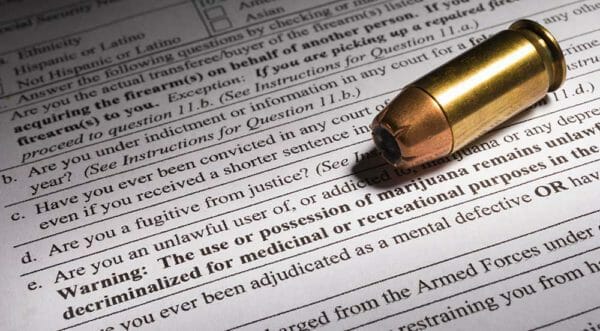
NICS Background Check Marijuana Exclusion ATF Form 4473 Firearms Transaction Record Question. iStock-919659526
ATF/NICS firearm purchase form showing the marijuana-user exclusion question. iStock-919659526

The U.S. Supreme Court today heard vigorous oral arguments in United States v. Hemani, a high-profile Second Amendment case testing whether a decades-old federal law can permanently disarm Americans who regularly use marijuana or other controlled substances. The justices appeared deeply divided on the scope of historical analogues but broadly skeptical of applying the ban to non-impaired, occasional-to-moderate users, denoting a likely victory for respondent Ali Danial Hemani and potentially millions of cannabis consumers in states where the drug is legal.

The case revolves on 18 U.S.C. § 922(g)(3), part of the 1968 Gun Control Act, which makes it a felony for any “unlawful user of or addicted to any controlled substance” to possess a firearm or ammunition. Marijuana is still a Schedule I substance under federal law, despite legalization or decriminalization in most states and continuing efforts (including under the current Trump administration) to reschedule it to Schedule III.

United States v. Hemani

In 2022, FBI agents raided the Denton County, Texas, home shared by Hemani (a 25-year-old dual U.S.-Pakistani citizen) and his parents as part of a wider investigation. They found a 9mm pistol, a small amount of marijuana, and trace cocaine. Hemani admitted to smoking marijuana “every other day.” He was indicted only on the § 922(g)(3) charge, with no allegation that he was intoxicated at the moment he possessed the gun, and no other charges were filed.

Hemani moved to dismiss, arguing the statute violated the Second Amendment as applied to him. Both the federal district court and the conservative 5th U.S. Circuit Court of Appeals agreed, relying on the Supreme Court’s 2022 decision in New York State Rifle & Pistol Association v. Bruen. That ruling requires modern gun restrictions to be “consistent with this Nation’s historical tradition of firearm regulation.” The 5th Circuit held that § 922(g)(3) can constitutionally apply only when the government proves the defendant was presently intoxicated while possessing the firearm. Habitual or past use alone is insufficient.

The Government’s Defense of the Ban

The United States, represented by Sarah M. Harris, Principal Deputy Solicitor General, defended the law as a “modest, temporary” restriction on a category of people who present special risks when mixing firearms and mind-altering substances. She pointed to founding-era laws disarming “habitual drunkards,” vagrants, and those subject to civil commitment or surety bonds measures that targeted individuals whose frequent intoxicant use created public-safety dangers without requiring proof of intoxication at every moment.

Harris emphasized that the restriction is reversible (rights can be restored upon cessation of use) and that illegal drugs differ from alcohol because of their federal illegality, association with black-market violence, and explicit congressional scheduling judgments about abuse potential and lack of accepted medical use.

Hemani’s Rebuttal: A Historical Mismatch

Hemani’s lawyers, Erin E. Murphy (of Clement & Murphy PLLC, arguing alongside ACLU and other counsel), countered that the government’s analogy fails Bruen’s “relevantly similar” test.

Historical “habitual drunkard” laws focused on severe, life-disrupting intoxication, people who were “falling-down drunk,” neglecting families, or unable to function, not moderate or occasional users. Founding-era Americans, she noted, consumed far more alcohol than modern marijuana users without losing gun rights. Applying the ban to someone who consumes marijuana “a few times a week” is a category error and renders the statute unconstitutionally vague and overbroad.

Murphy urged the Court to limit the “unlawful user” prong to cases of proven functional impairment or to strike it entirely, while conceding that the “addict” prong (loss of self-control) may have firmer historical grounding.

Gorsuch, Barrett Signal Skepticism

Justice Neil Gorsuch repeatedly pointed out the mismatch. He asked whether daily hard cider drinkers like John Adams or nightly whiskey drinkers like James Madison would have been disarmed. When Harris suggested the law targets “habitual” illegal-drug use, Gorsuch quipped about “one gummy bear every other night” and pressed whether that qualifies. He appeared inclined to rule narrowly for Hemani: “Isn’t it just enough to say that is not a habitual drunkard?”

Justice Amy Coney Barrett zeroed in on practical absurdity. She asked whether lawful users of Ambien, Xanax, or even Robitussin who exceed dosage become “unlawful users” subject to lifetime disarmament. She questioned whether Congressional scheduling decisions automatically translate into Second Amendment disqualifications. Barrett seemed open to some restrictions, but unconvinced of a blanket rule untethered to actual dangerousness.

Liberal Judges Focus on Dangerousness

Justices Sonia Sotomayor and Ketanji Brown Jackson (who dissented or concurred skeptically in Bruen and Rahimi) expressed concern that the government offered no specific congressional finding that marijuana users as a class are dangerously impaired with guns. Sotomayor stressed that historical drunkard laws required evidence of lost self-control affecting daily life. Both appeared ready to side with Hemani.

Justice Elena Kagan explored hypotheticals involving hallucinogens like ayahuasca, probing whether frequency alone or functional impairment should determine whether gun rights are lost.

Chief Justice John Roberts and Justice Samuel Alito voiced practical worries about the government’s position. Roberts questioned whether case-by-case dangerousness hearings would flood courts. Alito noted modern synthetic drugs post-date the founding and suggested stricter rules might be justified for substances unlike culturally entrenched alcohol. They appeared more receptive to upholding the ban in its entirety.

The overall tone was technical and respectful, with occasional flashes of humor (Gorsuch’s Founding Fathers drinking references drew chuckles). There was broad agreement that the “addict” prong has historical support if properly tied to loss-of-control cases. The fight centered on the far broader “unlawful user” prong, which is likely a good thing for the Second Amendment.

Likely a Narrow Ruling — With Major National Impact

While no final votes were cast today, a majority appeared prepared to rule for Hemani at a minimum, striking the law as applied to him and likely narrowing § 922(g)(3) to require proof of present impairment, addiction, or clear dangerousness. A divided decision is possible, with different justices writing separately on how Bruen’s history-and-tradition test applies to modern substances.

The ruling, expected by late June, would have enormous practical consequences. It could open gun ownership to tens of millions of state-sanctioned marijuana users, force ATF form revisions, and intersect with federal rescheduling efforts. It would also test the durability of the Bruen framework just four years after it upended Second Amendment jurisprudence.

For now, the justices’ questions today suggest the federal government’s categorical ban on gun ownership by marijuana users is on shaky constitutional ground.

Roberts v. ATF Challenges Post-Tax NFA Registration Scheme in Federal Court

Mayor LaGrand’s Epic Fail: Defensive Gun Use Data Destroys the Narrative


About John Crump

Mr. Crump is an NRA instructor and a constitutional activist. John has written about firearms, interviewed people from all walks of life, and on the Constitution. John lives in Northern Virginia with his wife and sons, follow him on X at @crumpyss, or at www.crumpy.com.

John Crump


from https://ift.tt/ox7R9PC
via IFTTT