
Opinion
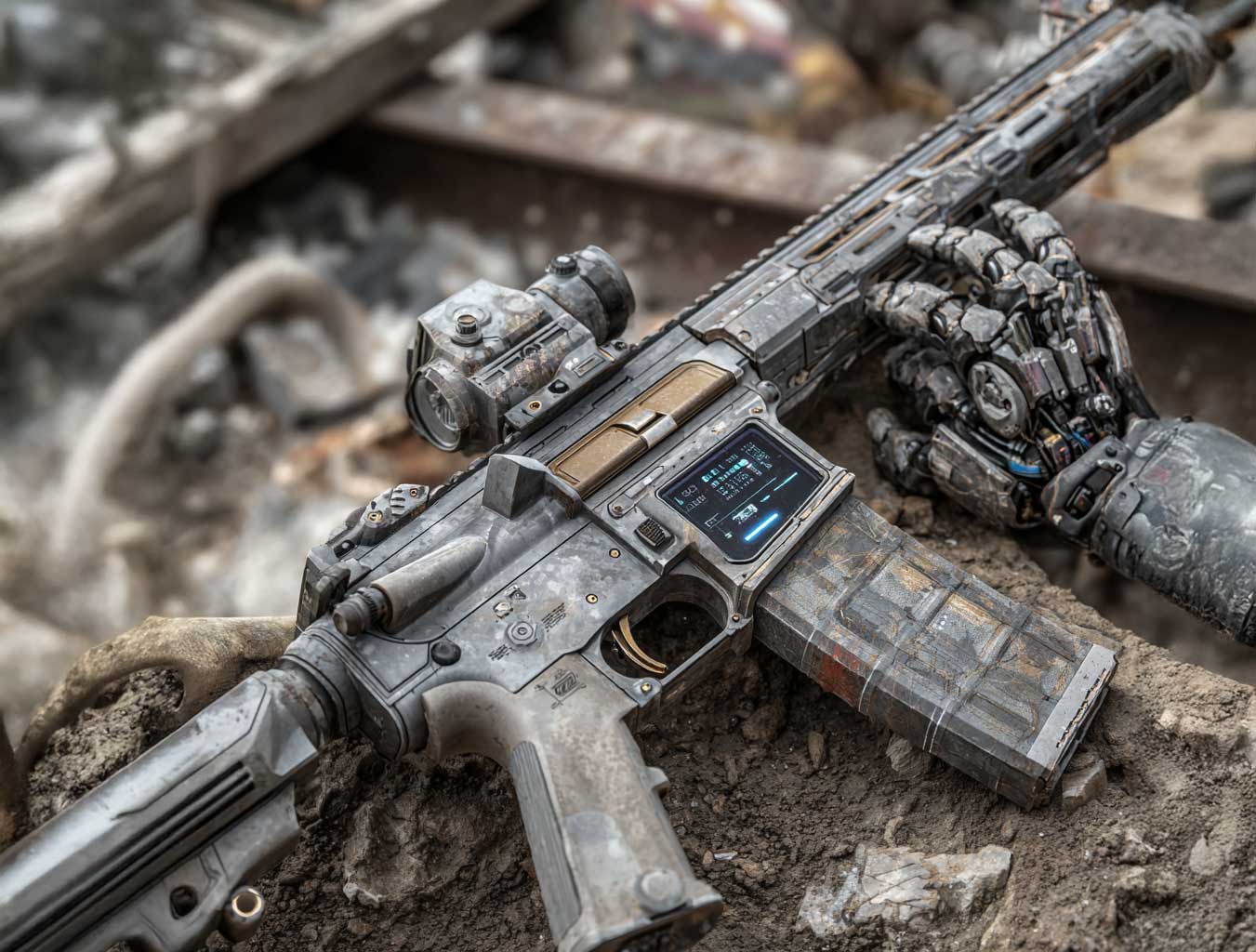
If Elon Musk gets his way, Tesla’s Optimus robots and full-self-driving cars aren’t just sci-fi—they’re the next multi-trillion-dollar industry.
Musk is openly talking about humanoid robots doing factory work, replacing human labor, and rolling out in the thousands in the next few years. (The Times of India)
Put that together with weaponized drones, autonomous systems, and AI everywhere, and you can see where this goes: at some point, the threat to you and your family may not be a human attacker at all, but a machine—whether it’s criminal misuse of robots, hostile code, or a rogue state’s toys.
So here’s the obvious question almost nobody in the gun-control world wants to touch:
If the Supreme Court says the Second Amendment covers “all instruments that constitute bearable arms, even those that were not in existence at the time of the founding,” why wouldn’t a future EMP rifle or anti-robot weapon be protected? (Justia Law)
If the right to keep and bear arms is tech-neutral, then the logic of Heller, McDonald, Caetano, and Bruen doesn’t stop with muskets, Glocks, and AR-15s. It runs straight into the age of Tesla robots and directed-energy weapons.
Lets makes that case—and swat down the usual anti-gun talking points on the way.
The Supreme Court Already Answered The “But It Didn’t Exist In 1791!” Argument
The anti-gun side’s favorite dodge is simple: “If it didn’t exist when the Founders wrote the Second Amendment, it’s not protected.”
The Supreme Court has already burned that argument to the ground—twice.
In District of Columbia v. Heller (2008), the Court went back to founding-era dictionaries to define “arms” and found they meant “weapons of offence, or armour of defence” and “any thing that a man wears for his defence, or takes into his hands, or useth in wrath to cast at or strike another.” (Teaching American History)
That definition isn’t about flintlocks or bayonets. It’s about function: offensive or defensive weapons you can carry.
Then in Caetano v. Massachusetts (2016), the Court took the next step and hammered it home:
“The Court has held that ‘the Second Amendment extends, prima facie, to all instruments that constitute bearable arms, even those that were not in existence at the time of the founding.’” (Justia Law)
That’s not vague. That’s not soft. That’s a straight-up rule:
- If it’s a bearable arm—a carried weapon for offense or defense—
- It’s presumptively protected by the Second Amendment.
Stun guns weren’t around in 1791. The Court said: Doesn’t matter. They’re arms.
So, if tomorrow there’s a shoulder-fired EMP rifle or some compact anti-robot beam weapon you sling like a carbine, it fits the same box:
- Bearable? Yes.
- Weapon? Yes.
- In existence in 1791? Irrelevant under Heller and Caetano.
On text alone, that future tech starts in the protected column.
“EMP rifle” As A Test Case: What Are We Actually Talking About?
To keep this clean and safe, let’s define “EMP rifle” in a narrow, defensive way:
- A non-nuclear, directional device you shoulder and aim like a rifle;
- Designed to disable electronics, terminate robots, not vaporize cities;
- Tuned for short-range defense—stopping hostile drones, robots, or electronics threatening your home, your family, or your community.
Just like a firearm can be misused but is still protected as an “arm,” the mere possibility of criminal abuse doesn’t erase constitutional coverage.
Under the Supreme Court’s own language, if you can carry it and use it for defense, it lives in the same conceptual category as stun guns, tasers, handguns, and rifles.
The Court has already said that “modern instruments that facilitate armed self-defense” are within the Second Amendment’s plain text. (Harvard Law Journals)
A directed-energy device that lets you stop an attacker’s autonomous gadget before it reaches your front door is exactly that.
Running robot https://t.co/ua8FocTGnz
— Elon Musk (@elonmusk) December 2, 2025
Bruen’s Rule: Once It’s An “Arm,” The Burden Is On The Government
After Bruen (2022), the test for gun laws is brutally simple—at least on paper.
- Step 1: If the Second Amendment’s plain text covers the conduct (keeping/bearing an arm), the right is presumptively protected.
- Step 2: The government must then justify its restriction by showing it fits our historical tradition of firearm regulation. (Supreme Court)
That means:
- If an EMP rifle is a bearable arm, it’s covered by the text.
- The burden shifts to the state, not the citizen, to prove there is some deep, well-rooted historical tradition of banning that kind of arm.
And here’s where the anti-gun side has a massive problem.
There is zero founding-era tradition of banning a class of personal defensive arms solely because they were technologically advanced. The Founders watched weapons tech evolve in real time—rifled barrels, repeating arms, early ordnance—and still chose language broad enough to cover “all instruments that constitute bearable arms.” (liberty.lawbooks.cali.org)
If history protects handguns, AR-15s, knives, clubs, and electronic weapons like tasers, it’s very hard to explain why a future anti-robot device would suddenly be off-limits.
“Dangerous & Unusual”? Nice Try but You Fail. Let’s Unpack That.
Gun-control lawyers always retreat to the “dangerous and unusual” phrase from Heller—pretending it’s a blank check. It isn’t.
Heller said the historical tradition allowed bans on “dangerous and unusual weapons”—but the Court also tied that to the opposite category: arms “in common use” by law-abiding citizens for lawful purposes, which cannot be banned. (Teaching American History)
Key points they don’t like to talk about:
- “Dangerous” by itself is not enough. Every weapon is dangerous. A kitchen knife is dangerous.
- The test is dangerous and unusual—and “unusual” means not commonly owned by citizens for lawful uses.
In Caetano, the Court blessed stun guns even though they were “thoroughly modern inventions,” because what matters is whether they’re arms and whether the lower court’s excuses contradicted Heller. (AmmoLand)
Now imagine a world where:
- Autonomous drones and robots are everywhere.
- Tesla-style humanoids work in everyday settings (The Times of India)
- Millions of homeowners buy off-the-shelf anti-drone/anti-robot defensive devices.
At that point, a carried EMP rifle or similar device is by definition:
- Common;
- Owned for lawful self-defense;
- A normal part of the defensive toolset.
Once it’s common, it can’t be dismissed as “unusual” any more than AR-15s could, which is exactly why anti-gun courts twist the “common use” standard instead of applying it honestly. (Harvard Law Journals)
“But it’s Not a Gun!” – And That’s the Whole Point
The fight over stun guns and tasers is already the dress rehearsal for this.
- In Caetano, the Supreme Court slapped down Massachusetts for saying stun guns weren’t “the type of weapon” the Second Amendment protects. (Justia Law)
- In New Jersey, NJ2AS forced the state to admit that the Second Amendment extends to “all bearable arms” and cracked open the state’s total ban on electronic self-defense devices. (That’s the entire theme of that NJ Taser victory.) ( AmmoLand)
- In New York City, Judge Edgardo Ramos tried to dodge all that by saying plaintiffs failed to prove stun guns are “in common use,” effectively treating them as not even arms at all, a position FPC and SAF are now tearing apart on appeal in Calce v. NYC. (AmmoLand)
The anti-gun line is always the same: if it’s not a traditional “gun,” maybe we can carve it out.
But the Supreme Court has already answered that:
- The Second Amendment protects “weapons,” not just firearms. (Harvard Law Journals)
- Those weapons include modern instruments used for armed self-defense.
So when the day comes that you can walk into a shop and buy, say, a compact “anti-drone rifle” or “anti-robot defensive disrupter,” the Second Amendment analysis shouldn’t change:
- It’s a bearable arm;
- It’s used for self-defense;
- It sits squarely inside the zone Heller, McDonald, and Caetano already mapped out.
Pre-Empting the Usual Objections
Let’s knock down the main talking points you can already hear from the Bloomberg crowd.
Objection 1: “An EMP rifle could knock planes out of the sky and take down the grid!”
The same way a .308 could be used for murder from a rooftop.
The Second Amendment has never protected criminal misuse. It protects possession and normal defensive use. The state can punish:
- Shooting up a substation;
- Aiming any weapon—gun or EM device—at aircraft;
- Sabotage of medical devices or critical infrastructure.
That’s no different than punishing someone who fires a rifle into a crowd. You punish the crime, not the existence of the arm.
Reasonable regulations on where and how you discharge any powerful weapon (for example, within airport perimeters or critical facilities) can fit the historical-tradition pattern of “sensitive places,” already recognized even under Bruen. (Reuters)
But a blanket ban on ownership because something could be misused? That’s the exact kind of overreach the modern Court is supposed to stop.
Objection 2: “These are military-grade systems, not civilian arms.”
Massachusetts tried almost the same move in Caetano, arguing that stun guns weren’t “readily adaptable to use in the military.” The Supreme Court called that out too, citing Heller’s rejection of the idea that only weapons “useful in warfare” are protected. (Justia Law)
You can’t have it both ways:
- When it’s convenient, they say, “It’s not a militia weapon, so no protection.”
- When it is effective, they say, “It’s too military, so no protection.”
The text doesn’t care. It protects arms, period. Some will be used by the military, some by civilians, some by both. That was true of muskets, rifles, and revolvers—and it will be true of directed-energy arms.
Objection 3: “Courts are upholding bans on machine guns and ‘assault weapons’; they’ll just ban this too.”
Yes, some lower courts have been busy defying the spirit of Heller and Bruen, upholding bans on so-called “assault weapons” and using creative reasoning around “common use” and “dangerousness.” (Reuters)
But notice what’s happening in parallel:
- Bruen has already forced courts onto a stricter text, history, and tradition standard. (Supreme Court)
- FPC, SAF, and others are actively litigating arms bans, including NYC’s stun gun prohibition, to nail down that the right covers a broad category of arms, not just whatever the state feels like allowing this decade. (Firearms Policy Coalition)
In other words, the fight right now isn’t whether the Second Amendment is tech-neutral—it is. The fight is over whether lower courts and the rogue judges will obey that reality or keep trying to drag us back into a “we’ll let experts decide what you ‘need’” regime.
If the Supreme Court ever squarely confronts a ban on widely owned, non-lethal or less-lethal electronic defensive devices, the logic of Caetano and Bruen points in one direction: you can’t just outlaw a whole class of arms ordinary Americans rely on for self-defense.
That precedent is exactly what you’d lean on in the future for an EMP rifle or anti-robot weapon.
Why This Matters Now, Before The Robots Show Up
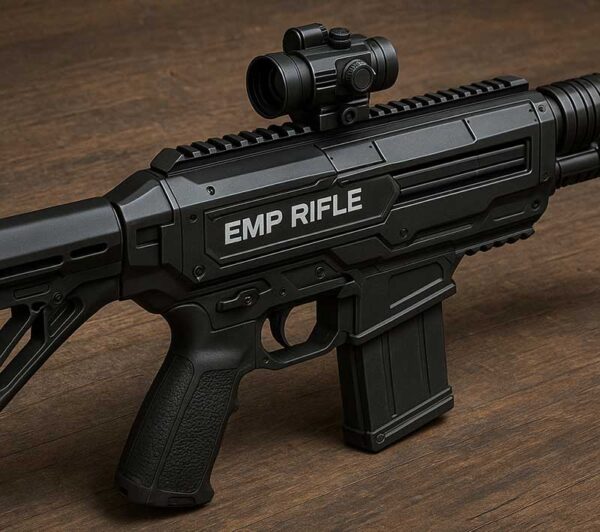
This isn’t just nerdy law talk. Look at where the tech is going:
- Tesla is planning tens of thousands of Optimus robots for internal use and then mass deployment. (The Times of India)
- Other companies are racing to build humanoid workers, autonomous vehicles, and cheap drones. (Reddit)
- The same pattern we saw with the internet and smartphones will repeat: first toys and convenience, then deep dependency, then weaponization.
By the time some bureaucrat says, “You can’t have that anti-robot rifle, it’s too dangerous for civilians,” the threat landscape will already have changed.
If the Second Amendment truly exists to preserve the people’s last line of defense against threats—whether foreign, domestic, or now digital/mechanical—then it must cover the tools that actually work against those threats.
The Founders didn’t write a right to “keep and bear the technology of 1791.” They wrote a right to keep and bear arms so free people could remain free as technology marched on.
So… Where is Your EMP Rifle?
Honestly? It’s still on the drawing board. Portable, directional, safe-enough-for-civilians EM weapons aren’t a thing yet—and that’s fine. The article isn’t about buying one tomorrow.
It’s about locking down the principle now:
- The Second Amendment covers all bearable arms, including those “not in existence at the time of the founding.” (Justia Law)
- That includes future defensive tech—anti-drone, anti-robot, and yes, hypothetical EMP rifles.
- The government doesn’t get a veto just because the weapon is new, electronic, or hurts their “monopoly on force” feelings.
When the robot revolution finally creeps out of the lab and into your neighborhood, the usual suspects will be lining up to tell you:
“Don’t worry, the government and the corporations will keep you safe. You don’t need your own tools to defend yourself from our machines.”
The right answer, grounded in the actual text and Supreme Court case law, is simple:
If I can carry it and use it to defend my life, my family, and my community, it’s a bearable arm—and it’s mine. Whether it’s made of wood, steel, polymer… or electromagnetics.
That’s the fight. That’s the headline. And that’s the future the Second Amendment was built for.
About Tred Law
Tred Law is your everyday patriot with a deep love for this country and a no-compromise approach to the Second Amendment. He does not write articles for Ammoland every week, but when he does write, it is usually about liberals Fing with his right to keep and bear arms.
We are in dangerous times! We are SO CLOSE to our final funding goals! With your help we can make it!
from https://ift.tt/8GM0UFN
via IFTTT
No comments:
Post a Comment