
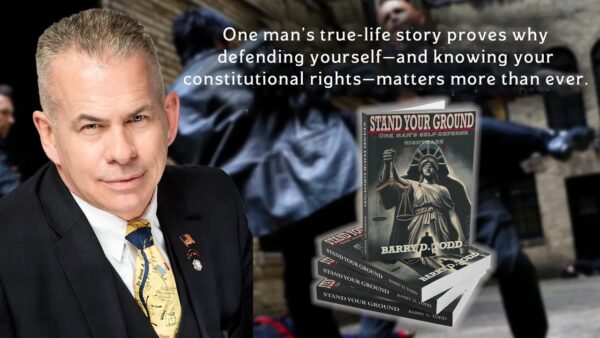
“In 2014, Barry’s life was turned upside down when he found himself facing charges of attempted murder, aggravated assault with a deadly weapon, and aggravated assault with intent to cause serious injury and bodily harm,” the synopsis for Stand Your Ground: One Man’s Self-Defense Nightmare explains. “It began when he was assaulted by a man outside a restaurant in Arizona, and he acted in self-defense by displaying his firearm. However, during the struggle, the weapon discharged when the attacker jumped on top of him, leading to a series of devastating accusations.”
The man is Barry D. Todd, of Yuma, AZ, a family man who has not just been a good, law-abiding citizen all his life, but an exemplary one. He’s a retired Army Captain with over two decades served “in B Company (Rangers), the 3rd Ranger Company, multiple Ranger Airborne assignments in the 82nd Airborne Division, the 101st Airborne Division, the 10th Mountain Division, the 2nd Infantry Division (Korea), the 24th Mechanized Division, and V Corps (Europe).” Following the military, Todd became a financial advisor, ultimately founding his own firm that became Invicta Financial Group, “serv[ing] a select group of clients (families/businesses) who desire to achieve a higher quality of life by making smart choices about their money.”
That background information is necessary to understand what kind of man Todd is, and to emphasize that if being prosecuted for self-defense can happen to an upstanding citizen like him, it can happen to any of us. Stand Your Ground leads the reader through the series of events and seemingly overwhelming and disheartening obstacles Todd had to overcome. Todd’s ordeal shows us what can happen when the state, with unlimited resources, decides to put you in its sights, and demonstrates how when that happens, one needs not only the wherewithal to fight for his rights, but also an indomitable will not give up in despair.
Determined to accept nothing short of vindication, Todd refused to surrender and would not break.
So, what happened?
He went out with his wife and a “close knit circle of friends” to a local bar and grill to celebrate the growth of his business and to have a good time. There, he was accosted and threatened by another patron, who at first appeared amiable, and then, for reasons that are still not clear, became hostile. Todd tried to defuse the situation and left to retrieve a can of snuff from his car, but when he tried to reenter was assaulted and told by his attacker he would not let him back in. Determined to retrieve his wife, his wallet, and his phone, Todd warned him that he had a gun in his car and went to get it. Displaying, but not aiming the gun, his attacker — and a bystander, who did not realize who the real aggressor was — jumped Todd, and the gun was discharged in the struggle for it, resulting in the attacker being shot and wounded.
What followed was an arrest and then years of legal proceedings and multiple grand jury hearings pursued by a seemingly vindictive prosecutor determined to brand Todd a criminal and punish him. Todd presents it all in a way that proceeds from narrative to actual courtroom transcripts, giving the book a sort of “Perry Mason” feel, especially as witnesses the prosecution was relying on to seal its case suddenly change their testimony on the stand when confronted with video evidence of what actually happened.
And spoiler alert: He’s a free man today with his rights intact.
As gun owners, Barry Todd’s story especially resonates with us. We know that something similar to what was forced on him, where we suddenly find ourselves having to defend ourselves against a previously unknown threat, could happen when we least expect it. And we know that police and prosecutors will often be personally and politically incentivized to treat us like criminals, and to interpret events to support their interests rather than ours. And speaking for myself, I’ve always found stories of the underdog who prevails victorious because he wouldn’t give up against all odds to be inspiring, that is, conduct and fortitude to aspire to should the trap ever close around me.
So instead of “just” a book review, I figured AmmoLand readers would benefit not from my second-hand interpretation, but from the man himself, who agreed to answer some questions:
DC: I’m still not clear on what your assailant’s beef with you was. Have you gotten a clearer feeling since on why he was mad enough at you to attack you, have you heard from him since, and do you foresee him still harboring resentment toward you and potentially posing a danger?
BT: No, I do not. I can share that in his statement he did not remember anything after playing darts, which according to the video was about 30 to 45 minutes prior to attacking. We believe he drank so much he had blacked out.
DC: If confronted with a similar situation today, would you do anything differently in terms of how you presented your gun?
BT: In Arizona – No, I followed the law to the letter.
DC: You initially made the decision not to talk to the police without the benefit of counsel. You then changed your mind and explained your side of things to the detective. What would you advise someone in a similar situation to do, and why?
BT: Don’t share anything with the police. In fact, I would recommend adhering to 3 lessons learned:
- Have appropriate self-defense insurance.
- Don’t’ talk to the police until you have your lawyer present.
- Remember, you are the CEO of your legal team you are writing the checks. Read everything and hold them accountable.
DC: You generally had high praise for your attorney throughout. That said, his not realizing that Arizona had changed the law from “affirmative defense” to “justification defense” struck me as something I’d have had a real problem with. Can you explain the difference between the two, and how you handled it when you had to point it out?
BT: Part 1:
- Affirmative defense means if you as a defendant claim self-defense you have to prove it was self-defense. In other words, affirmative defense has a presumption of guilt.
- Justification defense means if you as a defendant claim self-defense the onus passes the prosecution to prove it wasn’t self-defense. In other words, it provides a presumption of innocence. Most people today do not realize that this is one of the cornerstones that makes us a Constitutional Republic. For many decades, the Lawfare has taken over our police forces and court systems to the pretense of protection & security for our citizens and all the while eroding our rights under the Constitution.
Part 2: When my attorney called me after researching what I had shared on the changes in AZ law, he was extremely humble taking ownership for not researching the updated AZ laws and admitted I was correct. For that misstep he waived my next quarterly fee of $25k. We all need grace, and I learned from my years in the Rangers to be patient with those who commit errors of commission…. vs. errors of omission.
DC: How much time and money did this take from the time of your arrest until its conclusion, including making sure your business interests complied with all the state and federal requirements?
BT: Around $650,000 and nearly 8 years.
DC: You had the will and the wherewithal to fight this to the end. Most gun owners won’t have your financial resources to defend themselves with, and the temptation to take a plea and throw themselves at the mercy of the prosecution will be strong. You emerged from your ordeal determined to help others by setting up the Defense Resources Foundation. Tell us about that, how it’s going, and what you look for in deciding who you’re in the best position to help?
BT: The Defense Resources Foundation was created to provide financial support to individuals who are being unfairly targeted or who are facing criminal charges after legitimately defending themselves. We’re still in the very early stages of building the foundation, and while initial book sales have been good, they haven’t yet reached the level we need to fully launch our mission. Every additional purchase goes directly toward helping us get off the ground so we can begin assisting people who desperately need support.
We focus our efforts on cases where there is strong evidence of lawful self-defense, clear signs of prosecutorial overreach, or situations where someone is being targeted because of their political beliefs. Those are the individuals we are in the best position to help—people who did the right thing but lack the financial means to protect themselves in court. Our goal is to ensure they aren’t left to face the system alone.
You can order a copy of for Stand Your Ground: One Man’s Self-Defense Nightmare from Amazon, Barnes & Noble, and Dorrance, all linked on the standyourgroundbook.com website. And you can find out more about Defense Resources Foundation’s services and how to get involved at defenseresourcesfoundation.org.
About David Codrea:
David Codrea is the winner of multiple journalist awards for investigating/defending the RKBA and a long-time gun owner rights advocate who defiantly challenges the folly of citizen disarmament. He blogs at “The War on Guns: Notes from the Resistance,” is a regularly featured contributor to Firearms News, and posts on Twitter: @dcodrea and Facebook.

from https://ift.tt/3U0rfGH
via IFTTT
No comments:
Post a Comment